Company Share Ownership and Your Investor Rights

Company share ownership gives you more than a ticker symbol in a brokerage account. It gives you a financial claim on a business, a set of rights defined by law and corporate documents, and a practical way to participate in how public companies are governed. Those rights are not unlimited, but they can affect your returns more than many investors realize.
For retail investors, the key is knowing which rights are automatic, which require action and which depend on the kind of shares you own. This guide focuses on U.S. public equities, but the same framework can help you evaluate foreign stocks, funds, crypto-linked equities and private shares with more discipline.
What company share ownership actually gives you
A share is a unit of equity issued by a corporation. When you buy common stock, you usually become a shareholder with an economic interest in the company and certain governance rights attached to that class of stock. You do not personally own the company’s factories, patents, cash or office equipment. Those assets belong to the corporation.
That distinction matters. If the company performs well, your shares may rise in value or receive dividends if the board declares them. If the company fails, your loss is generally limited to the value of your investment, assuming you bought ordinary public shares and did not sign other obligations.
If you want a simpler foundation before going deeper into rights, Upside’s guide to what a share in company ownership really means explains the difference between owning stock and owning company assets.
Ownership is a bundle of rights, not total control
Most investors own tiny fractions of very large companies. A 100 share position in a mega-cap business may feel meaningful in your portfolio, but it represents a microscopic ownership percentage. That does not make it irrelevant. It means your rights are mostly exercised through systems built for many shareholders, such as proxy voting, annual meetings, disclosure rules and market liquidity.
In practice, company share ownership is powerful because it combines economic exposure with enforceable investor protections. You can benefit from growth, review required company disclosures, vote on selected matters and sell your shares in the public market if your thesis changes.
Core investor rights most public shareholders should understand
Shareholder rights vary by company, share class, jurisdiction and brokerage setup. Still, common shareholders in U.S. public companies generally encounter the same major categories.
Voting rights
Voting is the most visible governance right. Shareholders may vote on the election of directors, auditor ratification, executive compensation advisory votes, mergers, major corporate actions and shareholder proposals. Some votes are binding, while others are advisory.
Your voting power depends on how many voting shares you hold and what class they belong to. One company might issue common shares with one vote per share, while another might use a dual-class structure where insiders hold super-voting shares. That can leave public shareholders with economic exposure but limited influence.
Dividend rights
Shareholders may receive dividends if the board declares them. Dividends are not guaranteed for common stock, even when a company is profitable. Boards can raise, reduce, suspend or eliminate payouts depending on cash flow, capital needs, debt covenants and strategic priorities.
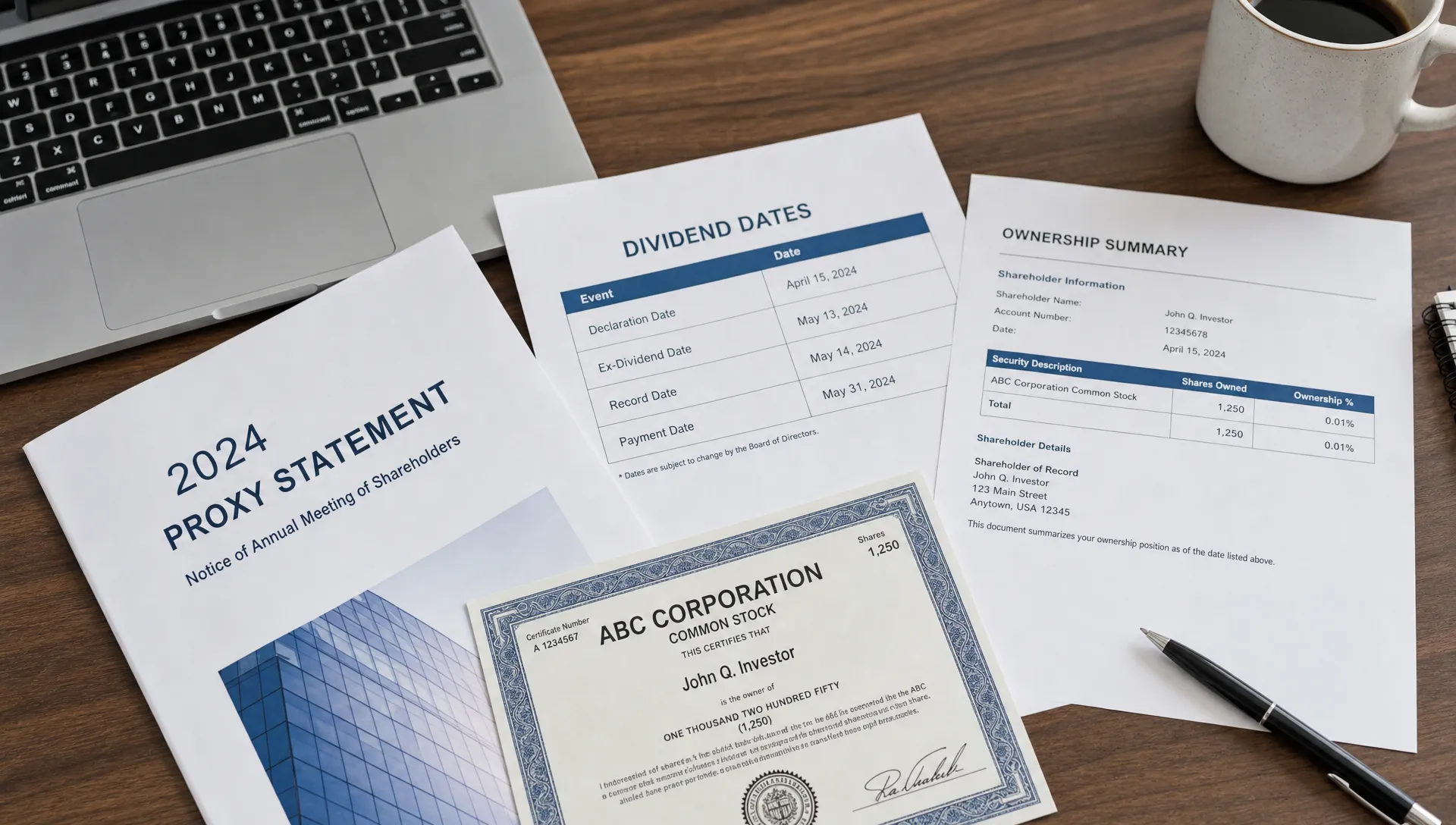
A second layer of company share ownership is understanding the dividend calendar. The record date determines which shareholders are entitled to a declared dividend, while the ex-dividend date is the first trading day when new buyers no longer receive that upcoming payment.
Information rights
Public shareholders have access to required disclosures, including annual reports, quarterly reports, proxy statements, material event filings and insider transaction reports. These filings do not remove investment risk, but they give you a structured way to monitor business performance, governance and ownership changes.
For U.S. public companies, the SEC’s EDGAR database is the central source for these filings. Many brokerages and investor platforms also summarize them, but primary filings remain the cleanest source when details matter.
Liquidity and transfer rights
Public market investors usually have the right to sell shares during normal market hours, subject to market liquidity, trading halts, settlement rules and brokerage restrictions. This right is often overlooked because selling is easy in large-cap stocks, but liquidity can disappear quickly in small-cap names, distressed companies or thinly traded securities.
| Investor right | What it usually means | Why it matters |
|---|---|---|
| Voting | You can vote on selected governance matters | Board quality and shareholder alignment can affect long-term value |
| Dividends | You may receive cash or stock distributions if declared | Income expectations should be tested against cash flow and payout policy |
| Information | You can review public filings and proxy materials | Disclosures help you monitor risk, dilution and governance changes |
| Transferability | You can usually sell public shares in the market | Liquidity gives you flexibility when facts change |
| Residual claim | You may receive value after creditors in a liquidation | Common shareholders are last in line, which affects downside risk |
Rights depend on share class, account type and legal structure
Not every share carries the same rights. Before you assume your vote or payout rights match another investor’s, read the company’s charter, bylaws, proxy statement and security description.
Common shares, preferred shares and special classes
Common shares usually carry voting rights and upside participation, but they sit below debt and preferred stock in a liquidation. Preferred shares often have priority dividend or liquidation terms, but they may have limited voting rights unless specific events occur.
Dual-class and multi-class structures deserve extra attention. A company may sell Class A shares to public investors while founders hold Class B shares with 10 votes per share. In that case, company share ownership may give you economic participation without meaningful control over director elections or strategic direction.
Beneficial owner vs registered shareholder
Most retail investors hold shares in “street name,” meaning the brokerage is the registered holder through the market’s clearing system and you are the beneficial owner. You still receive economic benefits and can usually vote through your broker’s proxy process, but the mechanics are indirect.
Registered shareholders hold shares directly on the company’s books or through a transfer agent. Direct registration can make some ownership records simpler, but it may also affect how quickly you can trade. For most investors, the main task is not choosing one setup over the other. It is understanding how your setup affects notices, votes, dividends and corporate action deadlines.
Margin accounts and stock lending
If you hold shares in a margin account, your broker may be allowed to lend those shares under your account agreement. When shares are loaned out over a record date, voting rights can be affected because votes generally follow the share’s current holder. Investors who care deeply about a specific vote should review their brokerage terms and ask how share lending may affect voting eligibility.
How to use your shareholder rights in real life
Knowing your rights is useful only if you build a routine around them. Most investors do not need to act like activists, but ignoring every proxy email and filing update can leave you blind to governance risks.
Because company share ownership includes both economic and voting rights, a simple annual process can help you stay engaged without turning investing into a full-time job. Review the annual report, scan the proxy statement, look at director independence, check executive pay alignment and note any shareholder proposals that relate to risk, governance or capital allocation.
Read proxy statements before voting
Proxy statements are dense, but you do not need to read every line with the same intensity. Focus on the board slate, director tenure, insider ownership, related-party transactions, executive compensation metrics, shareholder proposals and any material changes to governance rules.
Pay attention to companies where insiders control votes, compensation targets appear disconnected from shareholder returns or the board repeatedly approves dilutive equity plans. None of these issues automatically makes a stock uninvestable, but they can change the risk and reward profile.
Track ownership changes and dilution
Investor rights can be weakened if the share count expands faster than the business grows. New share issuance, stock-based compensation, convertible debt and secondary offerings can dilute existing shareholders. Buybacks can have the opposite effect when done at sensible valuations, but buybacks funded by excessive debt may introduce new risks.
Upside’s guide on how to find stock ownership changes in SEC filings walks through filings like Form 4, Schedule 13D, Schedule 13G and 13F reports. Those documents can help you see whether insiders, activists or large institutions are changing their exposure.
Protect your access and records
Investor rights are also operational. If you miss a tender offer deadline, lose tax records or fail to receive proxy materials because your account information is outdated, your legal rights may not translate into practical control. Keep brokerage contact details current, use strong authentication, save confirmations and monitor corporate action notices.
For investors who also run a business, investment club or small advisory office, secure systems matter because financial records, email access and backups are part of the investor workflow. Businesses in Southern California that need help with Microsoft 365, cybersecurity, cloud backups and network support can look at managed IT services for Southern California businesses to reduce operational risk around sensitive financial information.
The investor rights that matter most for returns
Some shareholder rights are defensive. They help protect you from poor governance, excessive dilution or unfair treatment. Others are economic. They influence whether you can benefit from dividends, buybacks, voting power and an eventual sale or liquidation.
From a return perspective, company share ownership matters most when rights, incentives and capital allocation point in the same direction. A founder-led company with meaningful insider ownership may be attractive if governance is fair and minority shareholders are respected. The same structure may be risky if insiders can approve self-serving transactions with little accountability.
Institutional ownership can also matter. Large asset managers may influence votes, engage with boards or push for governance changes. Activist investors may seek board seats, strategic reviews or capital return plans. Retail holders rarely drive these events alone, but they can benefit from understanding who else owns the stock and what incentives those holders have.
If you want a research checklist for these signals, Upside’s article on stock ownership data every investor should track covers insiders, institutions, float, dilution and short interest.
Rights do not eliminate investment risk
Owning shares gives you rights, not certainty. You can vote against directors and still lose the vote. You can review financial statements and still be surprised by fraud, recession, regulatory changes or competitive pressure. You can own dividend-paying shares and still see a payout cut.
That is why rights should be part of a broader investment process. Analyze business quality, valuation, balance sheet strength, ownership incentives and portfolio concentration together. Rights are most useful when they help you identify whether management’s incentives match yours.
A practical checklist before you buy or vote
Before you increase company share ownership in any single position, take a few minutes to confirm what you are actually buying. The goal is not to become a securities lawyer. The goal is to avoid surprises that were visible in public documents.
Use this checklist when evaluating a stock or preparing to vote:
- Confirm the share class and voting power per share
- Review whether insiders or founders control the vote
- Check recent share count trends and potential dilution
- Read the latest proxy statement for pay, board structure and related-party transactions
- Look at dividend policy, payout ratio and cash flow coverage if income matters to you
- Understand whether your shares are held in a cash account, margin account or direct registration
- Save key deadlines for votes, tender offers, dividends and corporate actions
This process is especially important when a company has multiple share classes, frequent acquisitions, heavy stock-based compensation or a history of controversial governance decisions.
When retail investors should pay extra attention
Some moments make investor rights more important than usual. Mergers, spin-offs, tender offers, bankruptcy proceedings, proxy contests, reverse splits and major equity issuances can change what your shares are worth and what choices you have.
You should also pay attention when a company changes its corporate domicile, amends bylaws, adopts a poison pill or asks shareholders to approve more shares. These items can sound procedural, but they may affect voting influence, takeover defenses or dilution risk.
For long-term investors, the best time to understand rights is before a controversy appears. Once a deadline is close, your options may be limited by record dates, broker processing times or the terms of a corporate action.
Frequently Asked Questions
Does company share ownership mean I can make decisions for the business? No. Shareholders usually vote on specific matters, such as directors and major corporate actions, but day-to-day decisions belong to management under board oversight.
Do all shares have voting rights? No. Voting rights depend on the share class and the company’s governing documents. Some preferred shares, non-voting common shares or foreign listings may have limited or different rights.
Can my shareholder rights change over time? Yes. Rights may change through charter amendments, mergers, recapitalizations, new share issuance or legal changes. Some changes require shareholder approval, while others may be allowed under existing corporate documents.
What should I read before voting my shares? Start with the proxy statement. Focus on board elections, compensation, auditor matters, shareholder proposals, ownership structure and any special items requiring approval.
Are shareholder rights the same in ETFs and mutual funds? No. When you own a fund, the fund owns the underlying shares. You own shares of the fund, and the fund sponsor generally votes the underlying company shares according to its policies.
Turn ownership data into better investing decisions
Investor rights are easier to use when you can see how your holdings compare with real portfolios, ownership trends and performance metrics. Upside Invest helps retail investors benchmark privately, explore verified investor holdings, track momentum and review return and Sharpe metrics without exposing their identity.
If you want to understand not just what you own but how your ownership fits into the broader market, use Upside Invest to compare allocations, spot emerging themes and make more informed portfolio decisions.