How to Find Stocks With High Insider Ownership

Insider ownership is one of the most useful ownership signals a retail investor can study because it answers a simple question: do the people closest to the business have meaningful personal exposure to its long-term outcome?
That does not mean every stock with high insider ownership is a good investment. Some insiders own a lot because they founded the company, some because they control a voting structure, and others because stock-based compensation has accumulated over time. The key is learning how to find the data, verify it in filings, and interpret what it actually says about alignment, conviction, liquidity, and governance.
This guide walks through a practical research process for finding stocks with high insider ownership and using that signal without overreading it.
What insider ownership means
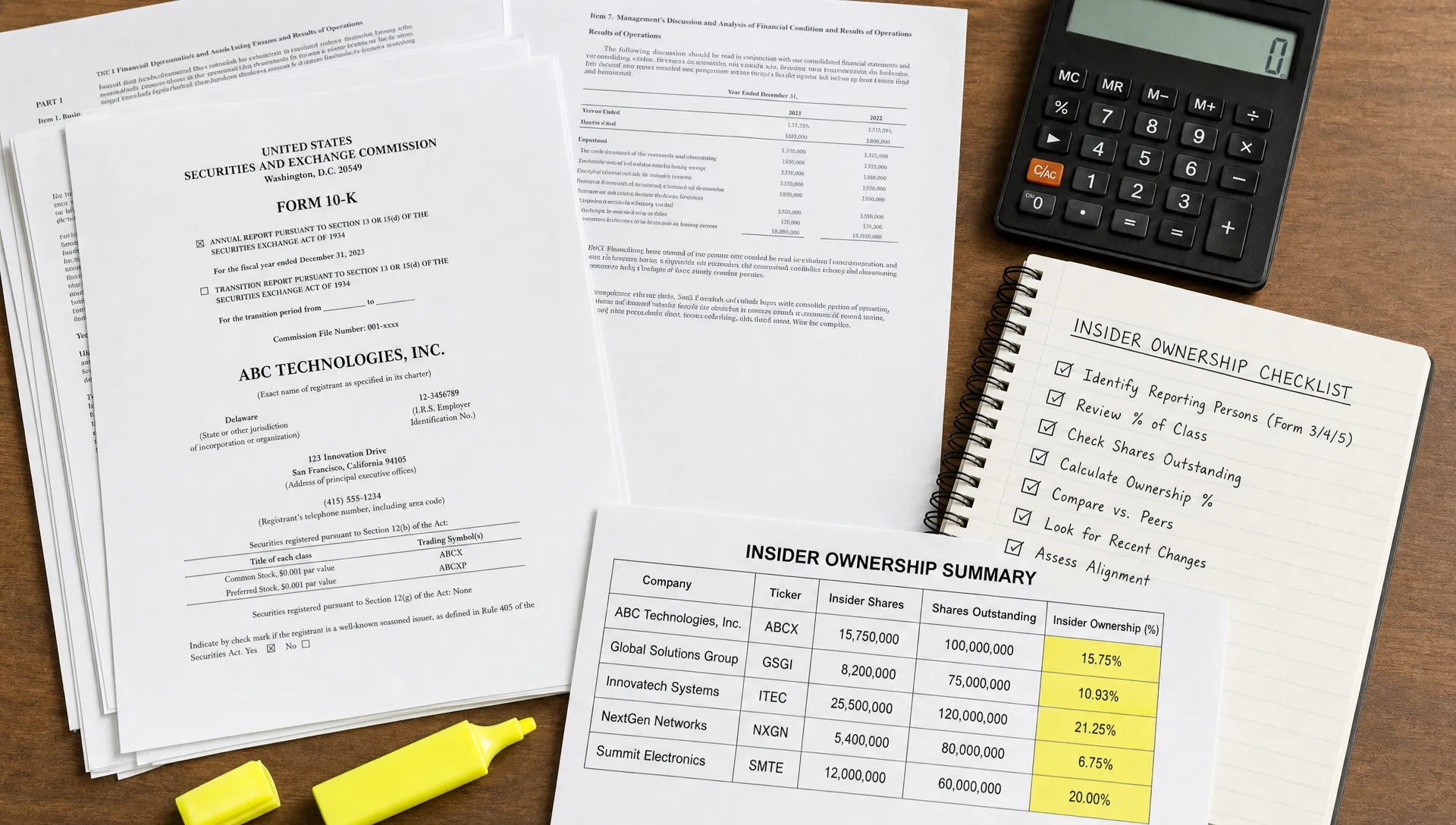
Insider ownership usually refers to the percentage of a company’s shares owned by executives, directors, founders, and sometimes large beneficial owners. In U.S. public company filings, “insider” often overlaps with Section 16 reporting persons, which generally include officers, directors, and beneficial owners of more than 10% of a registered class of equity securities.
In practice, different screeners define insider ownership differently. One platform may count only executives and directors. Another may include founders, trusts, family entities, or 10% holders. That is why you should treat a screener as a starting point, not the final answer.
| Term | What it usually means | Why it matters |
|---|---|---|
| Direct ownership | Shares held personally by an insider | Usually the cleanest alignment signal |
| Indirect ownership | Shares held through trusts, family entities, partnerships, or holding companies | Can still matter, but requires more careful reading |
| Beneficial ownership | Shares the person has voting or investment power over, often including certain exercisable options | The broadest and most filing-specific measure |
| Insider buying or selling | Recent transactions reported by insiders | Shows changes in exposure, not just the ownership level |
A founder owning 18% of a company, a CEO owning 1% of a mega-cap, and a director buying $250,000 of stock after a selloff are all different signals. The percentage matters, but the context matters more.
What counts as high insider ownership?
There is no universal threshold. A 3% stake can be enormous at a trillion-dollar company. A 20% insider stake may be normal at a founder-led small cap. A 60% insider stake may mean powerful alignment, but it can also mean minority shareholders have little influence.
As a rough starting framework, many investors treat insider ownership above 10% as meaningful and above 20% as high, especially outside mega-cap companies. But you should adjust that threshold based on company size, share class structure, float, and the insider’s role.
| Company context | What may be meaningful | Main question to ask |
|---|---|---|
| Mega-cap company | Even low single-digit insider ownership can represent major wealth exposure | Is management financially aligned despite the large market cap? |
| Founder-led mid cap | 10% to 30% can signal strong alignment | Is the founder still operating the business effectively? |
| Small cap or microcap | 20% or more may be common | Is there enough float and governance protection for outside shareholders? |
| Dual-class company | Economic ownership may differ from voting control | Do insiders control votes far beyond their economic stake? |
High insider ownership is most useful when it suggests managers will think like owners. It becomes less useful when it simply confirms that insiders can control the company regardless of outside shareholder concerns.
Where to find stocks with high insider ownership
The fastest workflow is to start with a stock screener, then verify the result in primary filings. You do not need to read every page of every filing at first, but you do need to know which documents contain the ownership information that matters.
1. Use a screener to build an initial list
Most financial data platforms include an insider ownership field. You can screen for companies above a chosen threshold, such as 10%, 15%, or 20%, then filter by market cap, exchange, liquidity, sector, or profitability.
This first pass is about discovery, not conviction. Screener data can lag, use different definitions, or include ownership that is technically beneficial but not economically straightforward. Your goal is to generate a research list of stocks with high insider ownership, then narrow it.
A simple first screen might include:
- Insider ownership above 10% or 20%, depending on market cap
- Average daily trading volume high enough for your position size
- Positive revenue growth or positive free cash flow, if that fits your strategy
- Reasonable debt levels for the industry
- No recent auditor warnings, going-concern language, or severe dilution pattern
You can also combine insider ownership with broader ownership signals. For example, Upside Invest’s guide to stock ownership data every investor should track explains how insider ownership fits alongside institutional holdings, float, dilution, and short interest.
2. Verify ownership in the proxy statement
For U.S. companies, the proxy statement is often the best document for confirming insider ownership. Look for the annual proxy, commonly filed as DEF 14A, and find the section usually titled “Security Ownership of Certain Beneficial Owners and Management” or similar wording.
That table usually shows beneficial ownership for directors, named executive officers, all directors and executive officers as a group, and certain large shareholders. It may also include footnotes explaining options, restricted stock units, trusts, family holdings, or share classes.
Use the SEC’s EDGAR search tool to find recent proxy statements, annual reports, and insider transaction filings. EDGAR is the primary source for U.S. public company filings, which makes it a better verification step than relying only on a third-party data field.
3. Check Forms 3, 4, and 5 for insider transactions
Ownership level tells you how much insiders own. Transaction filings tell you whether their exposure is increasing or decreasing.
| Filing | What it shows | How investors use it |
|---|---|---|
| Form 3 | Initial statement of beneficial ownership | Identifies an insider’s starting position |
| Form 4 | Changes in beneficial ownership | Tracks purchases, sales, option exercises, and grants |
| Form 5 | Annual statement for certain transactions not reported earlier | Helps catch some deferred or exempt reporting items |
Form 4 is especially important because many insider transactions must be reported within two business days. When you see multiple executives buying shares in the open market around the same period, that can be more interesting than one routine grant of stock-based compensation.
Be careful with insider selling. Sales can happen for taxes, diversification, estate planning, or prearranged trading plans. A sale is not automatically bearish. But repeated discretionary selling by multiple insiders, especially after aggressive promotional activity or weak fundamentals, deserves attention.
4. Review the 10-K and annual report
The 10-K often points investors to ownership details in the proxy, but it also gives you the business context you need to interpret insider ownership. A high insider stake in a company with shrinking revenue, heavy debt, weak controls, or constant dilution is not the same as a high insider stake in a profitable owner-operated business.
This is where many investors make mistakes. They find a company with 25% insider ownership and stop there. Instead, treat ownership as one column in your research file. The business still needs to make sense.
A step-by-step workflow for finding better candidates
A repeatable process helps you avoid chasing a metric just because it looks impressive. Think of insider ownership research as a funnel: broad screen, filing verification, qualitative review, then portfolio fit.
Step 1: Define the kind of insider ownership you want
Before screening, decide what you are trying to find. Are you looking for founder-led compounders? Small caps where management has “skin in the game”? Turnarounds with recent insider buying? Companies where executives own more stock than they receive in annual compensation?
Each goal leads to a different screen. Founder-led companies may have high ownership but limited recent buying. Turnarounds may have lower ownership but meaningful open-market purchases. Compensation-heavy companies may show insider ownership that came mostly from grants, which is less powerful than cash purchases.
Step 2: Screen by insider ownership percentage
Start with a broad threshold, then tighten it. For example, you might begin with companies above 10% insider ownership, exclude illiquid securities, then create a shorter list above 20% for deeper work.
Do not use the percentage alone. Also check market cap, float, volume, debt, profitability, and share issuance. A company with high insider ownership but frequent dilution may still be transferring value away from existing shareholders.
Step 3: Confirm the number in primary filings
Open the most recent proxy statement and compare the ownership table against your screener. Pay attention to footnotes. They often explain whether ownership includes exercisable options, shares held by entities, pledged shares, or different classes of stock.
If the company has multiple share classes, compare economic ownership with voting power. A founder might own 12% of the economic interest but control 55% of the vote through super-voting shares. That is not automatically bad, but it changes the governance equation.
Step 4: Separate ownership from buying behavior
High insider ownership answers “how much do they own?” Insider buying answers “are they adding at current prices?” Both are useful, but they are not the same.
An insider who already owns 30% may not buy more simply because their exposure is already concentrated. A newer CEO with only 0.3% ownership may send a strong signal by buying meaningful shares in the open market. Always compare the transaction size with the insider’s compensation, net worth context if available, and existing holdings.
Step 5: Compare insider ownership with institutional ownership
Insider-heavy companies can be overlooked by institutions because of float constraints, size, or governance concerns. They can also be heavily owned by institutions if the business quality is obvious. Neither pattern is automatically superior.
When insiders and long-term institutions both own meaningful stakes, it can suggest aligned conviction. When insiders control the vote but institutions avoid the stock, you should ask why. If you want to study this side of the ownership picture, see Upside Invest’s guide on how to read institutional ownership of a stock.
Step 6: Build a watchlist and monitor changes
The best insider ownership opportunities are not always buy-now ideas. Sometimes the data simply tells you which companies deserve a place on your watchlist.
Track changes over time. Has insider ownership increased through purchases or decreased through sales and dilution? Are new executives buying after joining? Did directors buy after a bad quarter? Are insiders selling while the company issues optimistic guidance?
This kind of pattern recognition is more valuable than a static percentage.
How to interpret high insider ownership
High insider ownership is a signal, not a verdict. It can point to alignment, but it can also reveal control risk. The best investors look for both sides.
Potential positives
When insiders own a meaningful stake, they may be more likely to focus on long-term per-share value rather than short-term optics. Founder-operators often think in years, not quarters. Directors with significant ownership may ask harder capital allocation questions. Executives with large personal stakes may be more cautious about debt, dilution, and acquisitions.
High insider ownership can also create psychological alignment. If management’s wealth rises and falls with shareholders, their incentives are easier to understand.
Potential negatives
High ownership can also reduce float, which may increase volatility and make large positions harder to enter or exit. It can entrench management, especially when insiders control voting power. It can limit shareholder influence on compensation, board composition, acquisitions, or related-party transactions.
The risk is highest when insiders have control without accountability. Watch for dual-class structures, staggered boards, related-party deals, excessive compensation, repeated dilution, or poor disclosure.
| Signal | Why it may be bullish | Why it may be risky |
|---|---|---|
| Founder owns a large stake | Long-term alignment and product vision | Founder control may override minority shareholders |
| Executives buying in open market | Cash commitment at current prices | Could be symbolic if purchase size is small |
| Directors own meaningful shares | Board may think like owners | Board may lack independence if tied to founder |
| Insider ownership above 30% | Strong economic exposure | Lower float, weaker outside influence, possible entrenchment |
Red flags when screening for stocks with high insider ownership
A high insider ownership percentage can hide problems. Before treating it as a positive, check for warning signs that weaken the signal.
One major red flag is ownership created mostly through low-cost grants while the company continues to dilute shareholders. Another is a pattern of insiders selling after promotional announcements. Also watch for insiders pledging shares as collateral, because forced sales can create unexpected pressure if the stock falls.
Related-party transactions deserve special attention. If the company leases property from an entity controlled by an executive, buys services from a founder-affiliated firm, or makes loans to insiders, read the details carefully. These arrangements are not always abusive, but they complicate the alignment story.
Finally, avoid assuming that a concentrated insider stake guarantees good capital allocation. Owner-operators can still overpay for acquisitions, resist necessary change, or pursue personal control over shareholder returns.
A practical checklist before investing
Use this checklist after you find a stock with high insider ownership. It will help you decide whether the signal supports the investment case or simply looks attractive on a screener.
| Question | What to look for |
|---|---|
| Who owns the shares? | Founder, CEO, CFO, directors, family trust, holding company, or 10% holder |
| How were the shares acquired? | Open-market purchases, founder stake, grants, options, acquisitions, or conversions |
| Is ownership increasing or decreasing? | Recent Form 4 activity, dilution, option exercises, planned sales |
| What is the voting structure? | One-share-one-vote, dual class, super-voting shares, shareholder agreements |
| Is the float sufficient? | Trading volume, bid-ask spreads, index eligibility, institutional access |
| Are insiders aligned on capital allocation? | Buybacks, dividends, acquisitions, debt, reinvestment, dilution discipline |
| Are there governance concerns? | Related-party transactions, board independence, compensation, pledging |
This checklist also helps reduce emotional decision-making. Investing benefits from the same principle as other long-term disciplines: a structured process beats improvisation. Just as personalized support like personal training and nutrition coaching can help turn health goals into consistent habits, an ownership checklist can help turn scattered stock ideas into a repeatable research routine.
Example: how the workflow might look
Imagine you screen for U.S. companies with insider ownership above 20%, market caps above $500 million, and average daily trading volume that fits your needs. The screen returns 40 companies.
You then remove companies with severe dilution, distressed balance sheets, or unclear filings. That leaves 18 names. Next, you open each company’s latest proxy and confirm whether the insider ownership is held by active executives, founders, directors, or passive entities.
Now the list drops to 10. You check Form 4 filings and find that three companies had recent open-market purchases by multiple insiders, four had mostly routine stock grants, and three had significant selling. You do not automatically buy the first group or reject the others, but you now know where to focus.
Finally, you compare valuation, fundamentals, ownership trends, and portfolio fit. The result is not “buy high insider ownership stocks.” The result is a better watchlist built around verified alignment.
How Upside Invest can help with ownership research
Insider ownership is more powerful when you view it alongside real investor behavior. A company may look attractive because insiders own a lot, but you still want to know whether verified investors are accumulating it, avoiding it, or rotating into similar themes.
Upside Invest helps retail investors compare portfolios, study verified investor holdings, spot trends, and benchmark decisions while preserving privacy through anonymous profiles. Instead of relying only on headlines or isolated data points, you can put insider ownership into a broader investing context that includes allocation behavior, performance metrics, and market momentum.
That does not replace your own research. It gives you another layer of evidence.
Frequently Asked Questions
What is a good insider ownership percentage? There is no single good percentage. Above 10% is often meaningful outside mega-cap stocks, and above 20% may be considered high, but the right threshold depends on market cap, float, voting structure, and who owns the shares.
Are stocks with high insider ownership better investments? Not automatically. High insider ownership can signal alignment, but it can also create governance, liquidity, and control risks. It should be combined with business quality, valuation, balance sheet strength, and capital allocation analysis.
Where can I find insider ownership data for free? You can use company proxy statements, annual reports, and insider transaction filings through SEC EDGAR. Screeners can help you find candidates faster, but primary filings are the best place to verify the numbers.
Is insider buying more important than insider ownership? They answer different questions. Insider ownership shows existing alignment. Insider buying shows recent action at current prices. A large owner may not need to buy more, while a smaller owner making a meaningful open-market purchase can still send a useful signal.
Should I copy insider trades? No. Insider trades can be informative, but they do not tell you the insider’s full financial situation, tax needs, diversification goals, or time horizon. Use insider activity as one input in a broader research process.
Turn insider ownership into a better research habit
Finding stocks with high insider ownership is not hard. Finding the ones where ownership actually improves the investment case takes more work.
Start with a screen, verify the data in filings, study who owns the shares, compare ownership with recent transactions, and look for governance risks before making any decision. When you combine insider ownership with verified investor behavior, institutional context, fundamentals, and valuation, the signal becomes far more useful.
The goal is not to blindly follow insiders. The goal is to understand when their incentives truly match yours.