How to Measure Crypto Exposure Across Your Investment Accounts
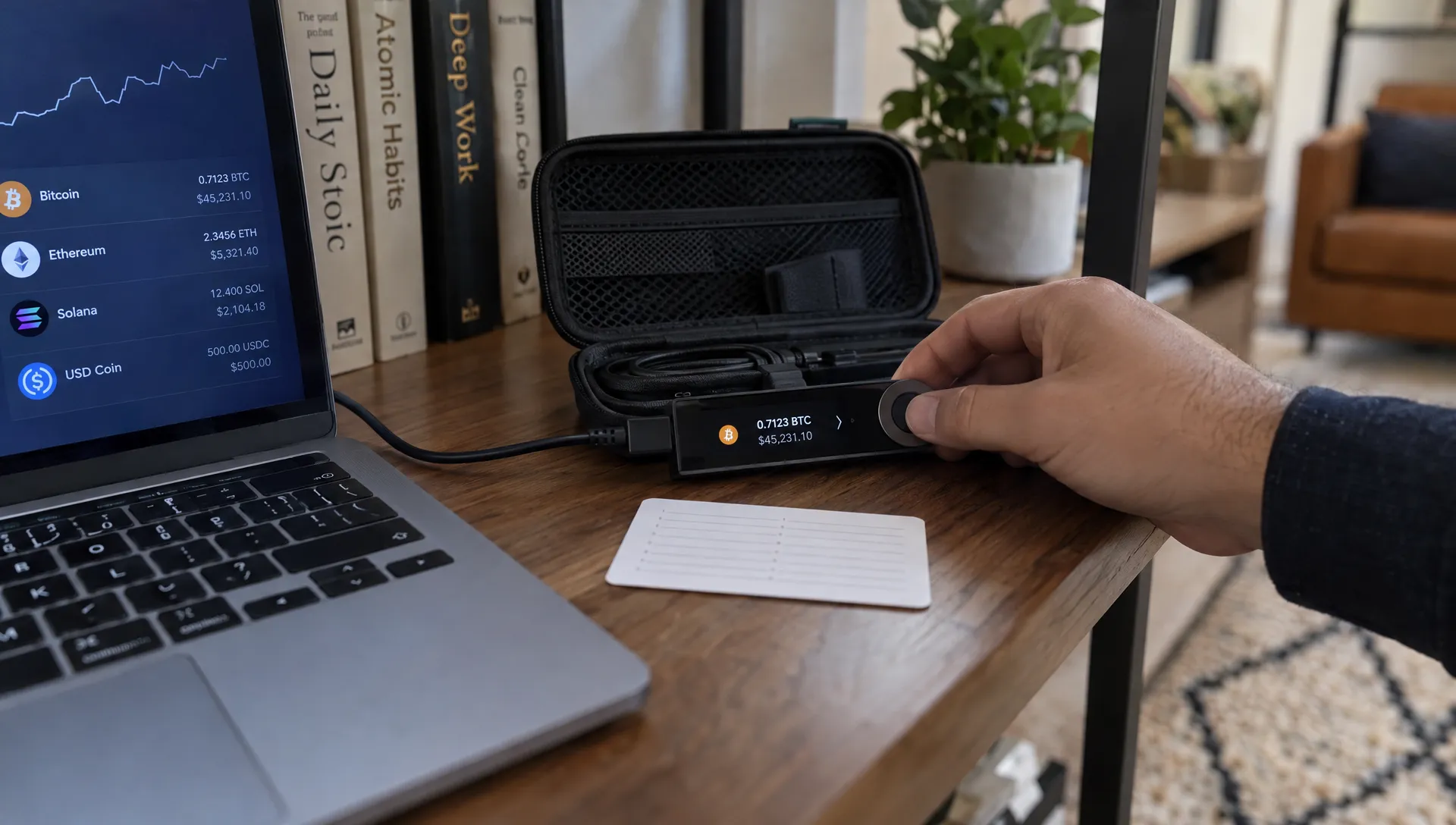
Your crypto exposure is not just the balance in your exchange account. Bitcoin held through a retirement-account fund, ether in a hardware wallet and a leveraged trading position can all affect the same portfolio. Unless you consolidate them, a modest-looking allocation in each account can become a sizable combined bet.
The useful starting point is a single, consistently valued portfolio total. From there, separate direct price exposure from stablecoins, crypto-related businesses and leverage. This guide walks through the calculation, including a worked example and the double-counting mistakes that can distort your results.
Define what your crypto exposure percentage measures
For an unleveraged portfolio, the basic calculation is:
Crypto allocation (%) = crypto-attributable investment value ÷ total investment portfolio value × 100
Before entering numbers, define the denominator. A practical approach is to include your taxable brokerage accounts, retirement investments, exchange balances and self-custody assets. Include cash held inside those accounts too.
Exclude personal property, such as your home or car, unless you deliberately want a broader net-worth calculation. Otherwise, rising home equity could make your investment allocation appear smaller without changing anything you own in your accounts.
If you borrow to invest, distinguish total assets from net investment equity, which subtracts investment-related debt. Exposure measured against net equity can exceed 100%. Derivative notional belongs in the exposure calculation, not as an extra asset in the denominator.
Label the result clearly, such as “percentage of investment portfolio net value.” A percentage without a defined base is difficult to interpret or compare.
Build one inventory across every account
Create a spreadsheet with one row per position. Record the account, asset, quantity, valuation timestamp, dollar value and exposure category. Add separate fields for any borrowing or derivatives.
Your inventory should cover:
- Brokerage accounts: Individual securities, spot crypto exchange-traded products, futures-based funds and cash.
- Retirement accounts: Relevant holdings inside IRAs, workplace plans or self-directed accounts, where available.
- Exchanges and custodians: Coins, stablecoins, staking balances, collateral and outstanding loans.
- Self-custody and DeFi: Wallet balances, staking receipt tokens, lending positions and liquidity-pool interests.
Use one reporting currency. Convert foreign-currency account values using a consistent exchange-rate snapshot.
Timing matters because crypto trades around the clock while brokerage products have market closing prices. For a comparable snapshot, value tokens near the relevant securities-market close or disclose the timestamp mismatch. Do not present Friday fund prices alongside Sunday token prices as though they were simultaneous.
This inventory can remain private. Calculating allocation does not require sharing seed phrases, private keys or account credentials.
Classify holdings before adding them together
Direct tokens and crypto-backed investment products
Bitcoin, ether and other tokens create direct price exposure. Spot products holding those assets generally belong in the same underlying-asset category, adjusted for any cash or other holdings.
For a fund, use:
Underlying crypto-attributable value = your fund position value × the fund’s relevant underlying allocation
For example, a hypothetical $10,000 fund position with 98% allocated to bitcoin contributes approximately $9,800 to bitcoin exposure. The remaining $200 stays elsewhere in your allocation breakdown.
Check the issuer’s holdings and disclosures, such as those available on the iShares Bitcoin Trust ETF fund page, rather than assuming the ticker tells you everything.
Futures-based, leveraged and inverse products need additional work. Their market value does not necessarily equal their underlying economic exposure. A fund-of-funds structure may also require looking through more than one ownership layer.
Stablecoins and crypto-related equities
Keep stablecoins in a separate category. A dollar-pegged token is not intended to behave like bitcoin, but it can introduce issuer, reserve, redemption and depegging risks. Its custody arrangements may create additional dependencies.
Crypto-related equities deserve another bucket. A miner, exchange operator or company holding substantial tokens can respond to crypto markets, but its shares also reflect operating costs, financing decisions and business performance.
Do not automatically classify every financial-technology stock as a crypto proxy. For example, the Visa stock profile on Upside describes an operating-company investment, not ownership of bitcoin.
For useful crypto exposure reporting, show three figures separately: underlying coin-price exposure, stablecoin allocation and crypto-related equity allocation. You may also show their combined portfolio weight, but do not imply that they carry identical risks.
Work through a consolidated portfolio example
Consider an investor with $200,000 across four locations, no investment debt and no derivatives. For simplicity, the spot products below are treated as fully invested in their underlying crypto assets, ignoring small cash balances.
| Account | Total account value | Direct tokens and spot products | Stablecoins | Crypto-related equities |
|---|---|---|---|---|
| Taxable brokerage | $110,000 | $10,000 | $0 | $0 |
| IRA | $60,000 | $4,000 | $0 | $2,000 |
| Crypto exchange | $20,000 | $12,000 | $3,000 | $0 |
| Self-custody wallet | $10,000 | $10,000 | $0 | $0 |
| Total | $200,000 | $36,000 | $3,000 | $2,000 |
The resulting allocations are:
- Underlying coin-price exposure: $36,000 ÷ $200,000 = 18%.
- Stablecoin allocation: $3,000 ÷ $200,000 = 1.5%.
- Crypto-related equities: $2,000 ÷ $200,000 = 1%.
Together, those categories represent 20.5% of the portfolio, but only 18% is classified as direct or spot-product coin-price exposure in this example.
Looking only at the exchange would miss the retirement holdings, brokerage product and self-custody wallet. Conversely, treating the entire exchange account as crypto would incorrectly include its $5,000 cash balance.
Remove double counting and look through wrappers
The same economic asset can appear in multiple records. Count the asset or its ownership claim once, not every representation of it.
For a spot fund, include your shares in total portfolio value once. Use its underlying holdings to classify that value, but do not add the fund’s attributed bitcoin as another asset on top.
Apply the same principle to staking receipt tokens and wrapped assets. If a receipt represents a claim on deposited tokens, counting both the receipt and the deposited tokens as independently owned assets overstates your wealth.
For liquidity pools, estimate your share of the underlying assets at the snapshot time. A position containing ether and a stablecoin should be split between those categories rather than assigned entirely to ether. The mix can change as prices move, and the position also carries protocol-specific risks.
Reconcile pending transfers carefully. A withdrawal shown in exchange history and a matching wallet deposit are one movement, not two holdings. Similarly, collateral remains an asset you own subject to restrictions; the associated borrowing is a separate liability.
Measure leveraged crypto exposure separately
For derivatives, distinguish the capital committed from the exposure controlled.
A futures position backed by $2,000 of margin might control a much larger underlying amount. For standard contracts, calculate notional exposure using the number of contracts, contract size and underlying price. Check the actual specification, such as the CME Bitcoin futures contract details, because contract sizes differ.
For options, a common first approximation is:
Delta-adjusted exposure = contracts × contract multiplier × underlying price × option delta
Use position signs consistently. Delta changes with price, time and volatility, so this is a snapshot rather than a fixed exposure measure. Check whether the contract’s quoted delta is already multiplier-adjusted before applying the formula.
Report both net and gross exposure. A $30,000 bitcoin holding paired with a $20,000 short bitcoin futures position has approximately $10,000 of net bitcoin exposure and $50,000 of gross position-level exposure. The hedge reduces directional sensitivity but does not eliminate margin, liquidity or execution risks.
Calculate these figures by underlying asset before combining them. A short bitcoin position is not a precise hedge for a long position in another token. For complex DeFi borrowing or options strategies, supplement the spreadsheet with scenario analysis.
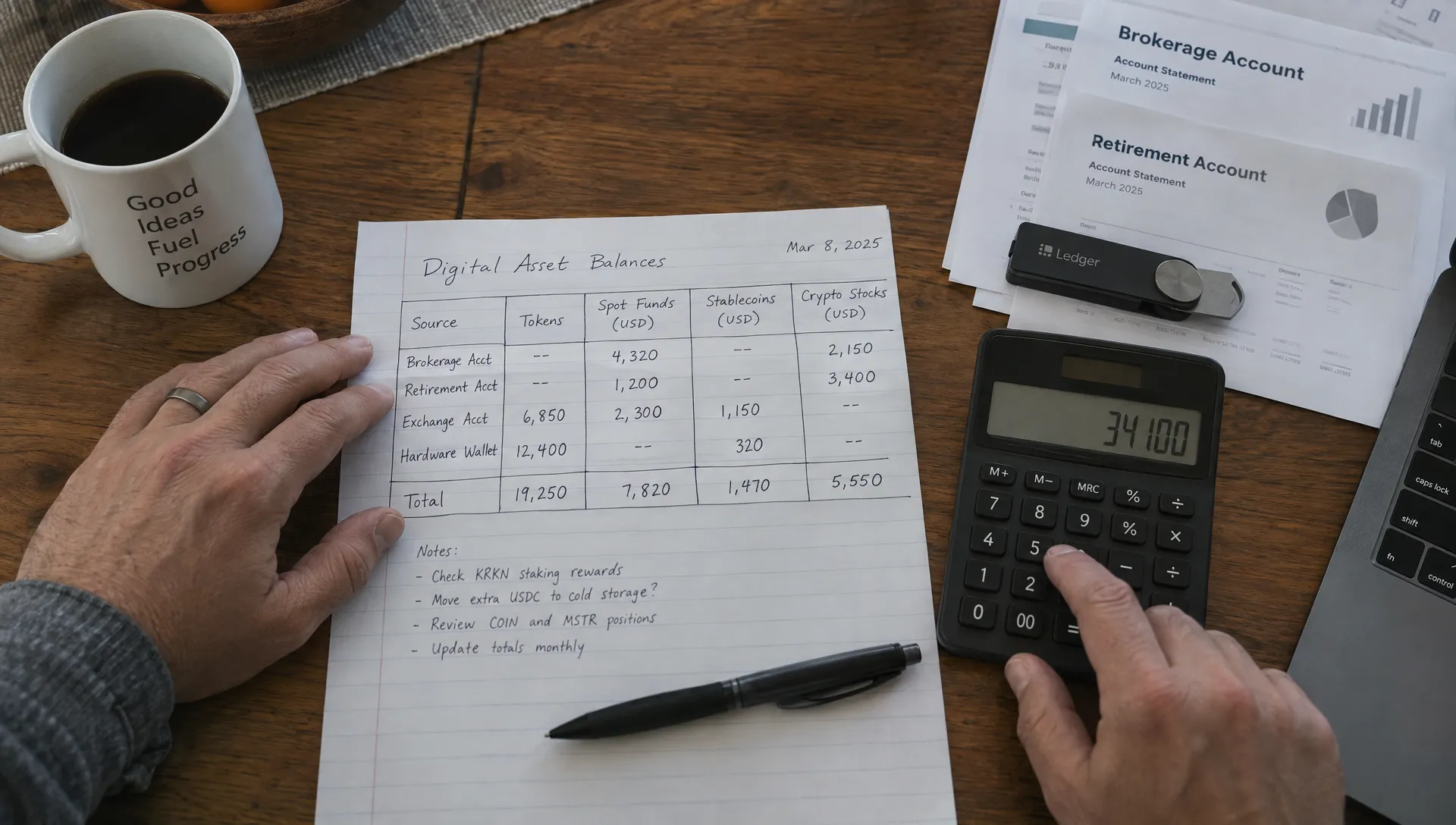
Translate allocation into potential portfolio losses
An 18% allocation does not mean crypto contributes exactly 18% of portfolio risk. Risk also depends on volatility, correlations, leverage and how positions behave during market stress.
Start with a transparent scenario. In the worked example, a 50% decline in the $36,000 direct and spot-product bucket would produce an $18,000 loss, equal to 9% of the starting portfolio value, assuming everything else stayed unchanged.
That is a sensitivity calculation, not a forecast. It excludes any simultaneous losses in crypto-related equities, stablecoin impairment, trading costs or changes elsewhere in the portfolio.
Then test additional scenarios separately. Consider a stablecoin losing its peg, an exchange temporarily blocking withdrawals or a leveraged position requiring more collateral. Custody problems can affect access to assets even when their quoted market prices have not changed.
Also examine concentration within the crypto bucket. Several tokens, funds and platforms may still depend on the same underlying coin, custodian, blockchain or source of liquidity. More account names do not necessarily mean more diversification.
Keep near-term spending separate from risk capital
Your denominator should be consistent, but your allocation decision also needs a household cash plan. Money required soon should not quietly become available for a speculative rebalance.
For example, a family budgeting for children’s furniture from Ocodile should earmark that planned purchase before deciding how much capital can tolerate a crypto drawdown. The same principle applies to tuition, taxes or a home repair.
You can include such reserves in a broad financial-assets report while excluding them from a separately labeled long-term investment allocation. Neither convention is useful if you switch between them without explanation.
Establish a repeatable review process
Refresh the inventory on a schedule you can maintain, such as monthly, and after material deposits, withdrawals, borrowing or major trades. Use the same categories and valuation convention each time.
Track changes in both dollars and percentages. Your allocation can rise without any purchase if crypto appreciates faster than the rest of the portfolio. It can also rise after you withdraw money from a non-crypto account.
Set a review threshold in advance rather than borrowing someone else’s allocation. For example, you might decide to reassess whenever the crypto bucket moves outside your chosen policy range. The appropriate range depends on your liquidity needs, loss tolerance and investment plan.
Finally, distinguish a measurement problem from a trading decision. Discovering your true exposure does not automatically mean you should sell. Taxes, transaction costs, account restrictions and your broader objectives still matter.
Frequently asked questions
Should crypto in an IRA count toward my total allocation? Yes. Account tax treatment does not remove the underlying investment risk. Include the IRA’s relevant holdings alongside positions in taxable accounts and wallets, using the same valuation approach.
Do stablecoins count as crypto exposure? Include them in your inventory and report them separately. They create exposure to the crypto ecosystem and their own structural risks, but a stablecoin intended to track the dollar is not equivalent to a bitcoin position.
Should I use purchase cost or current market value? Use current market value to measure today’s allocation. Cost basis helps calculate taxable gains and investment performance, but it does not show how much portfolio capital is currently exposed.
Can I offset one coin against another? Not as a precise hedge. Report exposures by underlying asset first. Even highly correlated tokens can diverge sharply, so a smaller net dollar figure can conceal substantial gross risk.
Is a crypto stock the same as holding tokens? No. Its sensitivity can change with its business model, debt, expenses and token holdings. Report the stock’s portfolio weight separately unless you have a defensible model for estimating its underlying sensitivity.
Put portfolio comparisons in context
Once you have a consolidated view, Upside can help you compare allocations with verified investor holdings and explore sector and theme concentrations. Use those comparisons as research context, not as an allocation target.
The essential first step remains your own inventory: one portfolio total, clearly separated risk categories and no duplicated assets.