How to Use an Insider Ownership Stock Screener Step by Step

An insider ownership stock screener helps you find companies where executives, directors or other qualifying insiders hold shares. Some tools also track their purchases and sales. Those are related signals, but they answer different questions: ownership measures an existing stake; transactions show changes to that stake.
A founder can own a large percentage of a company without having bought shares recently. An executive can report acquiring shares through compensation without committing fresh cash. Neither observation automatically makes the stock attractive.
The useful workflow is to screen for candidates, identify what actually happened and verify the original disclosure before researching the business. This guide focuses on U.S. public-company filings, with checks for tools that cover other markets. The sample filters and transactions below are illustrative, not investment recommendations.
Step 1: Choose an insider ownership stock screener you can audit
Start with data transparency rather than the number of available filters. A useful tool should explain where its ownership figures come from and link individual transactions to their original filings.
Check four things before relying on the results:
- Coverage: Does it cover U.S. domestic issuers, foreign companies, OTC securities or only selected exchanges?
- Freshness: Does it disclose when filings are processed and when ownership percentages were last refreshed?
- Definitions: Does “insider ownership” include directors, executive officers, large shareholders or some combination?
- Traceability: Can you inspect transaction codes, footnotes, amendments and direct versus indirect holdings?
U.S. transaction screeners commonly use SEC Form 4 data. Most covered transactions by directors, certain officers and beneficial owners of more than 10% of a registered equity class must be reported within two business days. Exceptions apply.
International coverage needs a separate check. Local disclosure rules, ownership thresholds and reporting deadlines differ. Foreign private issuers generally are not subject to the same Section 16 reporting regime as U.S. domestic issuers.
Treat a tool’s “global coverage” label as a starting point, not proof that every market has comparable data.
Step 2: Separate ownership filters from buying filters
Decide whether you want management alignment, recent buying activity or both. Otherwise, you can accidentally exclude useful candidates or include companies for the wrong reason.
Here is an illustrative starting preset for a retail investor researching reasonably liquid U.S. stocks:
| Filter | Example setting | Purpose |
|---|---|---|
| Market capitalization | At least $500 million | Limit the initial universe, without assuming size guarantees safety |
| Average daily dollar volume | At least $2 million | Reduce exposure to very thin trading |
| Reported insider ownership | At least 5% | Find companies with a meaningful reported insider stake |
| Purchase window | Previous 90 days | Focus on relatively recent activity |
| Purchase transaction value | At least $100,000 per transaction | Exclude smaller transactions from the first pass |
| Distinct purchasers | Two or more, when available | Identify potential clusters for review |
These thresholds are arbitrary research settings, not proven predictors of returns. They may exclude worthwhile large-cap companies with low percentage ownership or smaller firms where a modest purchase is significant.
An insider ownership stock screener becomes more useful when you save separate searches for ownership and buying, then compare their overlap.
Also check the percentage denominator. A figure based on shares outstanding is not interchangeable with one based on public float. Dual-class voting rights can differ substantially from economic ownership.
Step 3: Filter transaction types before sorting by value
Do not assume every reported acquisition is an insider purchase. Compensation, option exercises and gifts can all change reported holdings.
The SEC’s Form 4 instructions and transaction-code definitions explain the distinctions. These common codes deserve particular attention:
| Code | General meaning | Screening implication |
|---|---|---|
| P | Open-market or private purchase | A candidate for fresh-capital buying, subject to verification |
| S | Open-market or private sale | A sale, but not necessarily a negative business forecast |
| A | Grant, award or other acquisition under specified rules | Often compensation-related rather than discretionary buying |
| M | Exercise or conversion of a derivative security | Not equivalent to buying shares in the market |
| F | Shares delivered or withheld for exercise costs or tax liabilities | Can reflect compensation mechanics rather than a discretionary sale |
| G | Gift | A transfer, not an ordinary purchase or sale |
Importantly, code P does not mean “open-market purchase only.” It also covers private purchases. Read the footnotes and any accompanying company disclosure when the distinction matters.
Configure your insider ownership stock screener to isolate purchase transactions first, then inspect the underlying records rather than trusting an “acquired shares” label.
Keep insider sales in a separate view. Diversification, taxes and personal spending can explain sales, while repeated large disposals may still deserve investigation. Context determines which interpretation is reasonable.
Step 4: Check transaction dates, filing dates and amendments
A purchase made on Monday and disclosed on Wednesday has two relevant dates. A screener that filters by filing date may show it as Wednesday activity; another may place it under Monday.
That difference affects short screening windows, event studies and alerts. It also explains why two services can display different “recent buying” totals without either necessarily being wrong.
For each candidate, record the transaction date, filing date and the time your tool incorporated the filing. Use transaction dates to understand when the insider acted. Use filing dates to understand when the information became publicly available.
Check amendments as well. A Form 4/A can correct an earlier report, so confirm that the tool has not counted the original and amended records as separate purchases.
Your insider ownership stock screener should help reconstruct the sequence, not merely surface the newest headline.
A historical test needs special care: using a transaction before its public filing date introduces look-ahead bias. Likewise, comparing today’s stock price with the insider’s purchase price does not establish whether the stock remains attractive after subsequent news.
Step 5: Verify the signal against the original filing
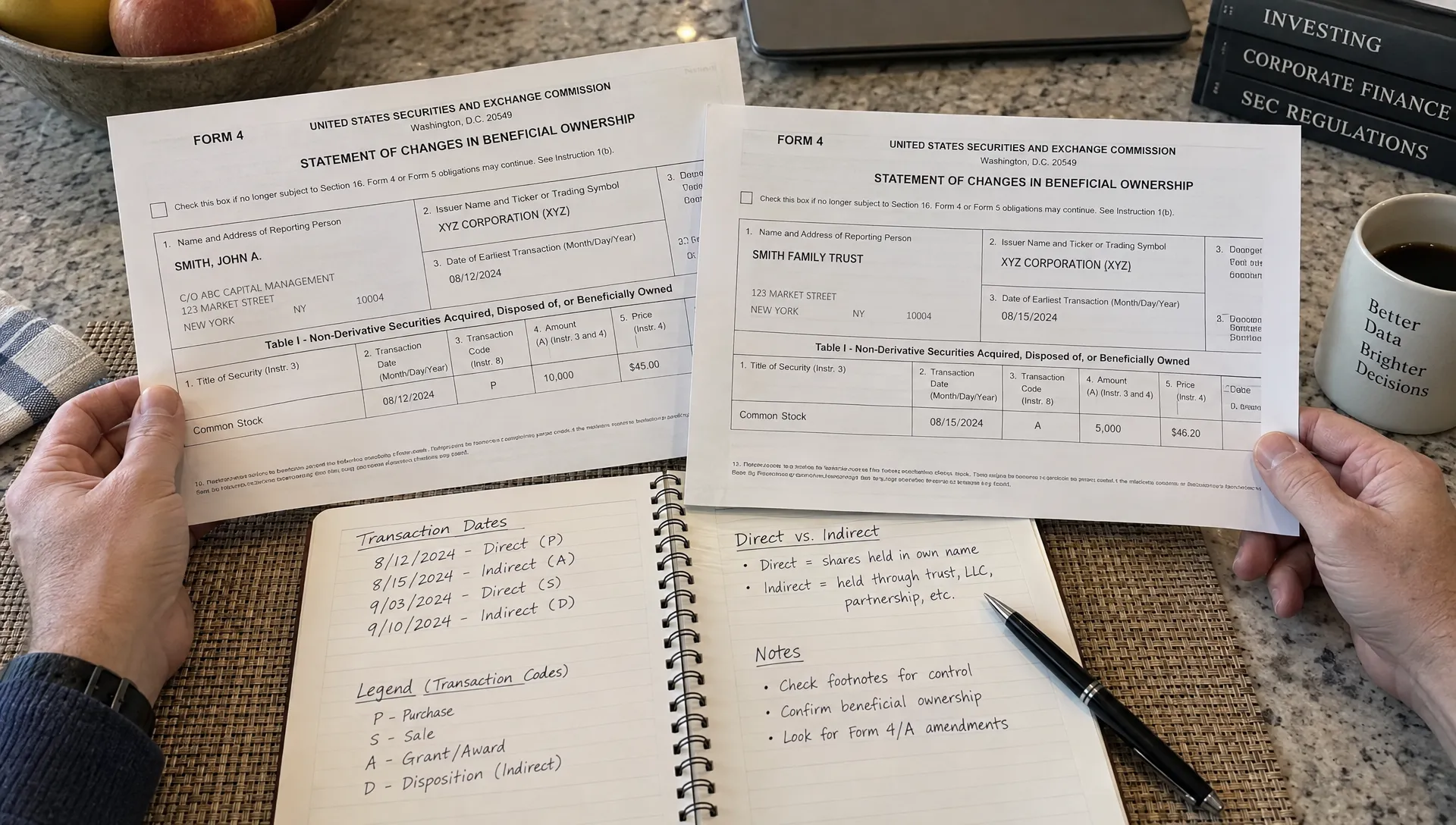
Open the source document through SEC EDGAR’s filing search. Match the issuer, reporting person and filing date before interpreting the trade.
Check the security class, transaction code, share quantity, price and acquisition-or-disposition indicator. Then inspect shares owned following the transaction, the direct-or-indirect ownership designation and all relevant footnotes.
Indirect ownership may involve a trust, partnership, family relationship or another entity. It does not automatically mean the insider personally paid for the purchase or controls every reported share without qualification. Shared beneficial ownership can also cause double counting if you simply add different insiders’ reported positions.
For an ownership percentage, locate the latest relevant beneficial-ownership table, often in a proxy statement or annual report. Review its measurement date and methodology. Certain exercisable options may be included, and percentages for different holders can involve holder-specific adjustments.
Use your insider ownership stock screener as an index to the evidence, not a replacement for reading it.
For sales, check the Rule 10b5-1 indicator and any plan-adoption details. A prearranged trading plan changes the context because the sale may follow instructions established earlier. It does not establish that the transaction is irrelevant or that the stock is fairly valued.
Step 6: Evaluate clusters and purchase size in context
Cluster buying means multiple insiders purchase shares within a defined period. It can be more informative than one isolated transaction, but only after you confirm that the buyers are distinct decision-makers and the transactions are genuinely comparable.
Consider this hypothetical example:
| Buyer | Purchase | Cost | Comparable holdings before purchase |
|---|---|---|---|
| Chief financial officer | 20,000 shares at $30 | $600,000 | 100,000 shares |
| Independent director | 5,000 shares at $31 | $155,000 | 45,000 shares |
Suppose these purchases occurred ten days apart and both filings confirm ordinary cash purchases. The CFO increased the comparable share position by 20%. The director increased it by about 11.1%.
That gives you more context than the combined $755,000 headline. It still does not reveal either person’s total wealth, unreported financial commitments or expected investment return.
An insider ownership stock screener can flag the cluster, but your review must establish whether it represents separate commitments or related transactions.
Look for routine purchase patterns, connected entities and financing arrangements. Two reports connected to the same trust should not automatically count as two independent votes of confidence. A purchase that materially increases someone’s stake deserves a different reading from a large-dollar purchase that barely changes an already enormous position.
Step 7: Test the business case and today’s valuation
After verifying the activity, write a short investment thesis without mentioning insiders. If the business case disappears, the transaction is doing too much work in your reasoning.
Review revenue trends, operating margins, cash generation, debt maturities and potential dilution. Choose industry-appropriate measures: a bank, software company and manufacturer do not have interchangeable financial models.
Next, compare the valuation at the purchase date with today’s valuation. An insider may have bought before a large rally, a financing announcement or disappointing results. The filing describes a past decision, not an offer to buy at the same terms now.
An insider ownership stock screener narrows the research universe; it cannot determine whether the current price compensates you for the risks.
Industry research should be concrete. For a home-furnishings stock, for example, examining Manor Editions’ furniture, lighting and décor assortment can help you map product categories and potential substitutes. Then test your assumptions against the issuer’s disclosed sales, inventory and margins. A retailer’s assortment is qualitative context, not evidence of market-wide demand.
Also investigate the downside of concentrated ownership. A controlling shareholder may have strong financial alignment while leaving minority shareholders with limited influence. Review voting rights, related-party transactions and governance protections rather than treating a high ownership percentage as an automatic advantage.
Step 8: Save a watchlist with a reason to revisit each stock
A watchlist should capture your reasoning, not just a ticker. Record the verified purchase, ownership measurement date, business thesis, main risk and next event that could change your view.
Useful alerts include new purchase filings, amendments, earnings releases and financing announcements. If a tool offers transaction alerts, check whether they trigger on filing receipt or after additional processing.
Re-run your insider ownership stock screener on a consistent schedule and investigate changes before acting. Avoid interpreting small ownership-percentage movements without checking share issuance, buybacks and denominator changes.
You can add a separate community perspective through Upside. For example, Visa’s Upside stock profile presents community ownership information. That is different from corporate insider ownership: verified investor portfolios do not establish that their owners are company officers or directors.
Keep those evidence types separate. Insider filings show reportable activity by covered people; community portfolio data shows how participating investors allocate capital. Neither should substitute for valuation work or portfolio risk limits.
Frequently asked questions
What is the difference between insider ownership and insider buying? Ownership describes a reported stake at a particular measurement date. Buying describes a transaction during a period. A large stake may come from founding the company, compensation or earlier purchases rather than recent buying.
Can an insider ownership stock screener identify open-market purchases automatically? Some tools provide that filter, but verify how it works. Form 4 code P covers both open-market and private purchases, so the code alone does not establish that a trade occurred on an exchange.
Does cluster buying predict a stock-price increase? It can identify a candidate worth researching, but it does not guarantee gains. Confirm independent buyers, transaction details and purchase size, then evaluate the business and valuation separately.
Where can I verify the current ownership percentage? Start with the company’s latest relevant beneficial-ownership disclosure, often in its proxy statement or annual report. Check the disclosure date, share class, footnotes and subsequent filings. A screener’s displayed percentage may lag changes.
Add portfolio context after verifying the filings
Once a stock passes your filing checks and fundamental review, compare its role with your existing holdings. A promising signal does not justify excessive exposure to one company, sector or theme.
Explore Upside’s verified portfolio comparisons to examine allocations and community holdings while keeping personal profiles private. Use that perspective alongside your research, with insider disclosures, valuation and portfolio fit answering separate questions.