Share Ownership in a Company: Rights, Risk, and Dilution

Buying stock feels simple: choose a ticker, place an order and watch the price move. But share ownership in a company is more than a line item in a brokerage account. It is a bundle of economic rights, governance rights and risks that can change as the business issues new shares, buys back stock, raises debt or shifts its strategy.
For retail investors, the practical question is not just whether you own shares. It is what those shares entitle you to, how exposed you are if the business disappoints and whether your percentage ownership can shrink over time. Understanding those mechanics helps you read a stock as a business claim, not only as a price chart.
What share ownership in a company actually gives you
A share is a legal and economic claim on a corporation, but it does not usually give you direct control over the company’s assets. The company owns its cash, buildings, patents and inventory. You own a security that may entitle you to a portion of profits, votes on certain matters and residual value if the company is ever liquidated after higher-priority claims are paid.
For most public stocks, share ownership in a company means a proportional claim on future value rather than a seat at management’s table. If you want a deeper foundation, Upside’s guide to what owning a share really means explains the distinction between owning stock and owning the company’s assets.
Economic rights: dividends, appreciation and residual claims
The economic side is what most investors focus on first. If the company becomes more valuable, your shares may rise in price. If the board approves dividends, shareholders may receive cash distributions. If the company buys back stock and the total share count falls, each remaining share may represent a larger percentage of the business.
These outcomes are never automatic. A profitable company can reinvest cash instead of paying dividends. A buyback can help shareholders when shares are reasonably valued, but it can destroy value if the company overpays. In a liquidation, common shareholders are last in line behind lenders, bondholders, suppliers, employees and sometimes preferred shareholders.
Governance rights: voting and oversight
Governance rights vary by company and share class. Many common shares carry one vote per share, often used to elect directors, approve major transactions or vote on shareholder proposals. Some companies have dual-class structures where founders or insiders hold shares with superior voting power.
That means voting rights should be read alongside the capital structure. A small retail investor may not sway an election alone, but governance still matters because the board sets management incentives, capital allocation priorities and the rules that shape long-term shareholder outcomes.
Rights that matter more than most investors realize
The value of share ownership in a company depends heavily on which rights attach to the specific security you buy. Two companies can both trade publicly and still give outside shareholders very different influence, cash-flow exposure and protection.
| Shareholder right | What it can mean | Common limitation |
|---|---|---|
| Voting rights | Ability to vote on directors, mergers and certain governance matters | Dual-class structures can limit outside influence |
| Dividend rights | Eligibility to receive distributions if the board declares them | Dividends can be reduced, suspended or never initiated |
| Information access | Public filings, earnings reports and proxy materials | Retail investors still rely on management disclosures |
| Liquidity | Ability to sell shares in the public market | Small caps and stressed companies can have thin trading |
| Residual claim | Claim on remaining value after higher-priority claims | Common shareholders are last in liquidation |
Rights are not valuable in isolation. A company with strong shareholder voting rights but weak economics may still be a poor investment. A company with limited voting power but excellent capital allocation may still compound value. The goal is to understand the whole package before you decide how much capital to commit.
Risk: your ownership is not the same as control
Share ownership in a company becomes riskier when price, voting power and information access do not line up with investor expectations. You may legally own shares, but management decides daily operations, the board approves strategy and the market sets the price at which you can sell.
The upside of common stock is large because there is no fixed ceiling on business value. The downside is also real. A stock can decline sharply, dividends can stop and in bankruptcy common equity can be wiped out. Limited liability usually means you cannot lose more than you invest, but that still includes the possibility of a 100 percent loss on the position.
Business, market and valuation risk
Business risk comes from the company itself: slowing revenue, weak margins, failed products, poor execution or competitive pressure. Market risk comes from broader conditions such as interest rates, recession fears or sector rotations that affect even strong companies. Valuation risk appears when a good business is purchased at a price that assumes too much future growth.
These risks interact. A richly valued company has less room for disappointment. A highly leveraged company may have less flexibility when revenue falls. A cyclical company can look cheap near peak earnings and expensive near trough earnings if you only compare price to recent profits.
Capital structure risk
Common shareholders sit below debt and preferred equity. If a company has heavy obligations, more cash flow may go to interest payments before common shareholders benefit. If lenders impose restrictive covenants, management may have fewer options during downturns.
Preferred stock can also change the risk profile. Preferred shareholders may have dividend preferences, liquidation preferences or conversion rights that affect common shareholders. Before buying common stock, review whether other claims sit ahead of you and how those claims behave in stress.
Dilution: the hidden math behind a smaller slice
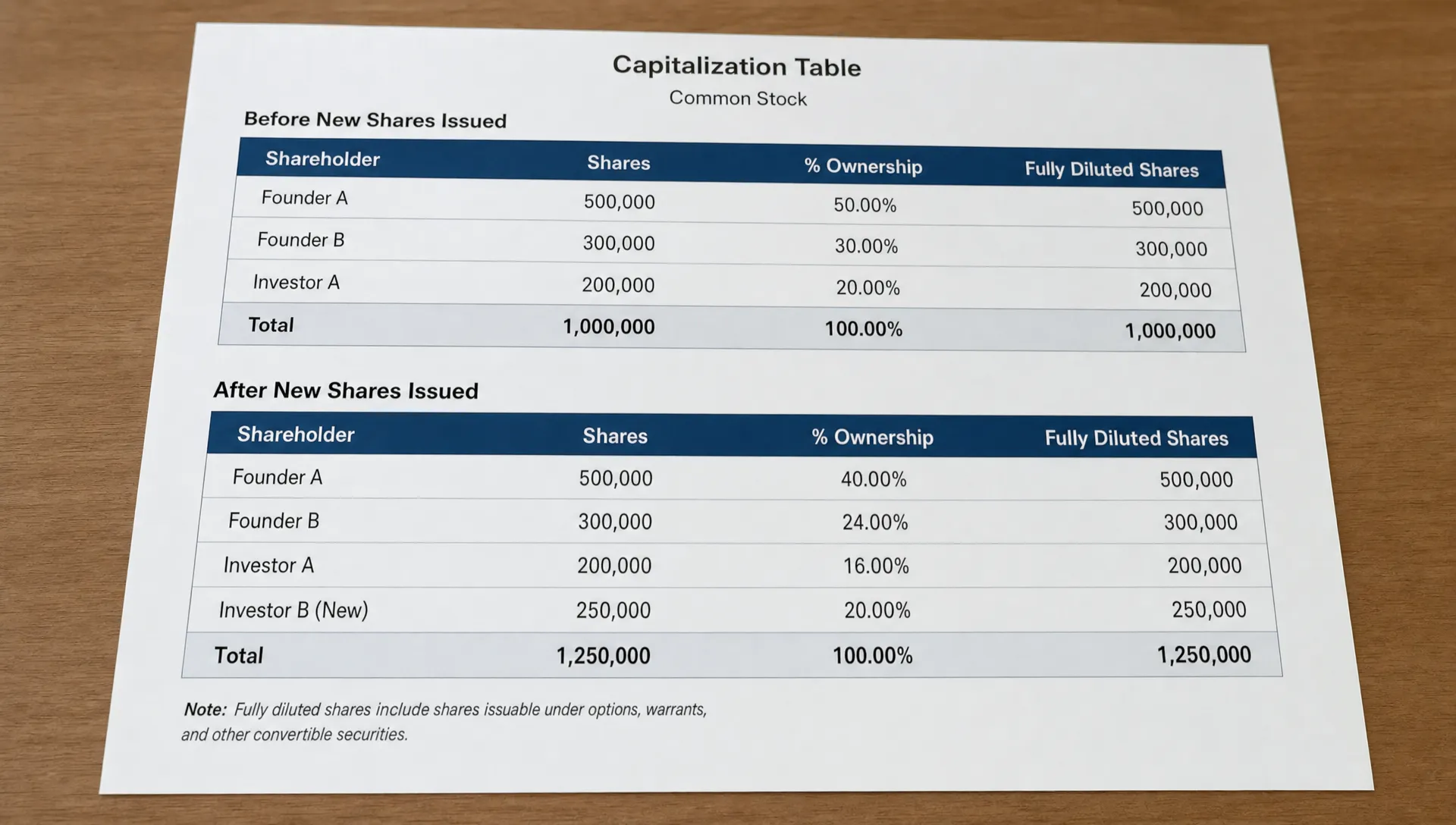
For long-term investors, share ownership in a company can be diluted even when their number of shares never changes. Dilution happens when the total share count rises, usually because the company issues new shares, grants stock-based compensation, converts debt or preferred stock into common equity or uses stock to fund an acquisition.
The core formula is simple:
Ownership percentage = your shares / total shares outstanding
If your share count is fixed and total shares outstanding increase, your percentage ownership falls. That smaller slice may still be worth more if the new capital creates enough value, but investors should not ignore the math.
A simple dilution example
Assume you own 1,000 shares in a company with 1,000,000 shares outstanding. Your ownership is 0.10 percent. If the company issues 250,000 new shares and you do not buy more, you still own 1,000 shares, but the total share count becomes 1,250,000.
| Item | Before issuance | After issuance |
|---|---|---|
| Your shares | 1,000 | 1,000 |
| Total shares outstanding | 1,000,000 | 1,250,000 |
| Your ownership percentage | 0.10% | 0.08% |
Your share count did not fall, but your claim on the business did. This is why investors track both basic shares and fully diluted shares, especially at companies that rely heavily on stock compensation or convertible securities.
When dilution can be good and when it is a warning sign
Dilution is not always bad. A growing company may issue shares to fund a high-return project, acquire a strategic asset or attract employees with incentives that align them with shareholders. If the capital raised produces returns above the cost of dilution, remaining shareholders can still come out ahead.
Good dilution often has a clear business purpose, reasonable pricing and transparent communication from management. Bad dilution tends to fund recurring losses, plug cash shortfalls or mask weak unit economics. Repeated issuance at depressed prices is especially damaging because more shares must be sold to raise the same amount of capital.
The key question is whether share ownership in a company is being diluted to create value or merely to keep the lights on. This is why ownership trends belong in the same review process as revenue growth, margins, debt and cash flow. Upside’s guide to stock ownership data every investor should track covers related signals such as insider ownership, float and institutional holdings.
Private vs public company ownership
In a private market setting, share ownership in a company often comes with more documents, more restrictions and less liquidity than public stock. Private shareholders may need to review shareholder agreements, option plans, transfer restrictions, valuation reports and board updates.
That extra documentation creates a privacy and control issue as well as an investment issue. When sensitive cap tables, tax records or investor updates move between founders, shareholders, lawyers and advisers, disciplined access rules matter. This primer on secure file sharing rules for teams and external partners is useful for thinking about least-privilege access, recipient verification and controlled links in document-heavy ownership processes.
Public company shares are easier to trade, not risk-free
Public shares usually offer better liquidity and standardized disclosure. Investors can review annual reports, quarterly results, proxy statements and exchange filings. Public markets also make it easier to compare valuation, ownership trends and performance against peers.
Liquidity does not remove risk. Public stock prices can move faster than business fundamentals, especially around earnings, regulation, interest rates or sector sentiment. For retail investors, the advantage is that public data makes it easier to build a repeatable research process.
Private shares require more attention to terms
Private shares can carry rights that differ materially from public common stock. Transfer restrictions may limit when you can sell. A right of first refusal may let the company or existing investors buy your shares before an outside buyer can. Preferred investors may hold liquidation preferences that determine who gets paid first in a sale.
If you are evaluating private company equity, read the documents rather than relying on the headline valuation. A high valuation does not help much if your share class has weak protection, limited information rights or no realistic liquidity path.
How retail investors can evaluate ownership before buying
Before buying or adding to a position, treat share ownership in a company as a claim you can analyze across ownership, governance and downside risk. The point is not to predict every future event. The point is to avoid being surprised by mechanics that were visible before you bought.
Start with the latest annual report, quarterly report and proxy statement. Look for the share count, share classes, insider holdings, stock compensation, buyback activity, debt levels and any convertible securities. Then compare those signals to business quality and valuation.
What to check before you buy
Use a simple review framework rather than chasing every possible metric:
- Shares outstanding and fully diluted shares: Check whether the share count is rising, falling or stable.
- Share class and voting structure: Confirm whether your shares carry normal voting rights or limited rights.
- Insider ownership: Look for meaningful alignment, but watch for excessive control.
- Institutional concentration: Large holders can influence governance and liquidity.
- Issuance and buyback history: Compare management’s words with capital allocation behavior.
- Debt and preferred claims: Understand who gets paid before common shareholders.
- Float and liquidity: Thinly traded shares can be harder to exit at a fair price.
- Valuation relative to quality: A strong business can still be a weak investment if the price assumes perfection.
Portfolio context matters too. A position that looks attractive on its own may increase your exposure to one sector, factor or theme more than you realize. With Upside, investors can compare allocations against anonymous verified portfolios, explore what other investors are holding and use portfolio data as another input in their decision process.
Frequently Asked Questions
Does share ownership in a company mean I own the company’s assets? No. You own shares issued by the corporation. The corporation owns its assets, and shareholders have rights attached to their shares, such as voting, dividends if declared and residual claims after higher-priority obligations.
Can my ownership percentage fall if I never sell? Yes. If the company issues additional shares and you do not buy more, your percentage ownership can fall. This is dilution, and it is why investors track total shares outstanding and fully diluted share count.
Are voting rights important for small retail investors? They can be. A small investor may not control outcomes alone, but voting rights still affect accountability, board elections and major corporate decisions. They also signal how much power insiders may hold.
Is dilution always bad? No. Dilution can be acceptable if new shares fund investments that create more value than they give up. It becomes a warning sign when issuance repeatedly covers weak cash flow or happens at very low prices.
What should I watch after I buy shares? Track share count, margins, cash flow, debt, insider activity, capital allocation and valuation. Also watch whether management’s actions match the shareholder-friendly language used in reports and presentations.
Turn ownership into a better investing process
Owning shares is not only about being bullish on a brand, product or chart. It is about understanding your claim, the rights attached to that claim and the ways your economics can improve or weaken over time.
Upside helps make that context easier to see by showing verified investor holdings, portfolio comparisons, trend data, performance metrics and anonymous community benchmarks. Use those signals as inputs, not shortcuts, and combine them with your own analysis of rights, risk and dilution before deciding what deserves a place in your portfolio.