Beneficial Ownership of Shares Explained for Investors

Beneficial ownership of shares means you can hold an ownership interest in stock even when someone else’s name appears on the company’s shareholder register. This is common when you invest through a brokerage account: you receive the economic benefits of your investment, while a broker or nominee handles the registered holding.
That distinction matters for dividends, voting, account transfers and public ownership disclosures. It also explains why a brokerage statement and a company’s shareholder register can show different names without contradicting each other.
The details depend on the securities, account arrangement and applicable law. This guide focuses on U.S. investors holding publicly traded stocks.
Beneficial owner versus registered owner
A registered owner is the person or entity recorded on the issuer’s shareholder register. A beneficial owner holds the underlying interest or relevant ownership powers, even if the registered holder is an intermediary.
For ordinary brokerage holdings, the investor typically receives the financial benefits and can give voting instructions through the broker. The registered holder may be a nominee within the securities custody system rather than the investor or even the investor’s broker.
| Term | What it describes | Typical example |
|---|---|---|
| Registered owner | The holder named on the issuer’s shareholder register | A nominee holding shares within the custody system |
| Beneficial owner | The investor holding the underlying interest or relevant ownership powers | A retail investor holding stock through a broker |
| Broker or custodian | An intermediary maintaining accounts and administering holdings | The brokerage showing shares on your statement |
| Directly registered investor | An investor recorded in their own name on the issuer’s register | An individual holding through direct registration |
These roles can overlap. Someone who holds directly registered shares may be both the registered and beneficial owner.
For retail investors, beneficial ownership of shares usually describes the relationship between their investment and the intermediary holding it. For SEC reporting, however, the definition focuses on voting or investment power, not just who receives the financial benefit.
What happens when you buy through a brokerage account?
Most U.S. brokerage stock holdings use street name registration. Your broker’s records identify your position, while the issuer’s register may show an intermediary or nominee. Depository Trust Company’s nominee, Cede & Co., commonly appears within this holding structure.
Suppose you buy 100 shares of a listed company. Your account shows those shares, and changes in their market value affect your account. If the company pays a dividend to eligible shareholders, the payment passes through the custody chain to your account, subject to the relevant dates and account terms.
You generally do not receive a paper certificate bearing your name. That does not, by itself, mean you lack an ownership interest.
The SEC’s Investor.gov guide to ways of holding your securities explains the differences between street name holdings, physical certificates and direct registration.
A practical consequence of beneficial ownership of shares is that communications and instructions often travel through intermediaries. Your voting notice, corporate-action election or transfer request may therefore follow your broker’s process rather than going directly to the issuer.
Check the account agreement instead of assuming that every platform handles these processes identically.
What rights do beneficial shareholders have?
Economic benefits and investment risk
Ordinary shareholders participate in changes in the stock’s value and may receive dividends when declared. They also bear the risk that the investment loses value. Beneficial ownership does not guarantee dividends, preserve your original investment or protect you against an issuer’s failure.
The share class matters. Common stock and preferred stock can carry different dividend, voting and liquidation rights. Holding through an intermediary does not erase those differences.
For broader background, understanding company share ownership and investor rights helps separate the rights attached to a security from the mechanics of holding it.
Voting through an intermediary
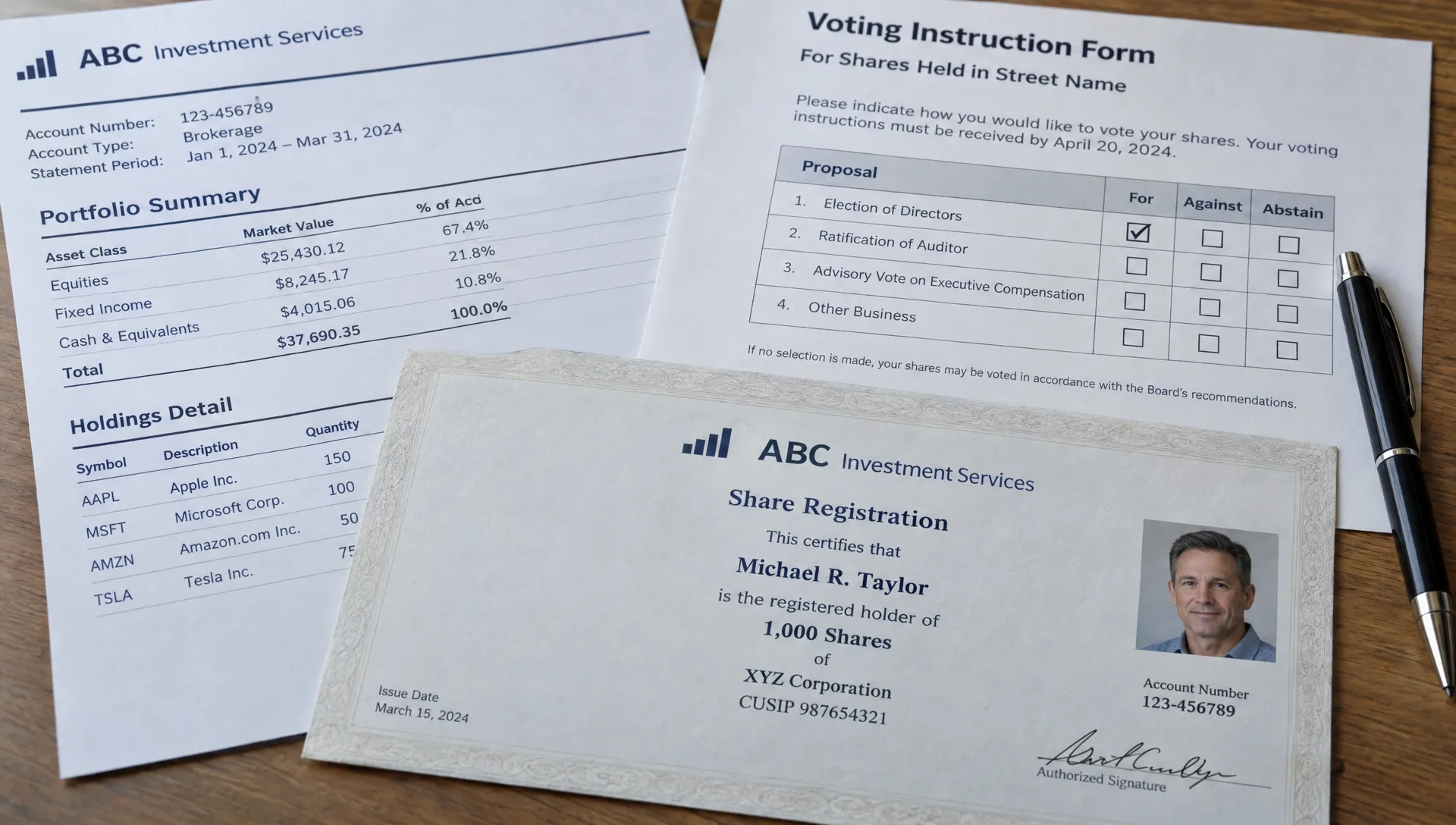
Beneficial shareholders commonly receive a voting instruction form from their broker or its service provider. That form lets them tell the intermediary how to vote eligible shares.
A voting instruction form is not the same as being the registered shareholder. Procedures can differ if you want to vote directly at a meeting, submit a shareholder proposal or exercise another formal shareholder right. You may need additional documentation or a legal proxy.
Beneficial ownership of shares also does not guarantee voting rights for every position shown in an account. Fractional holdings, shares on loan, nonvoting share classes and certain product structures require closer attention.
Ownership is not ownership of specific company assets
Shareholders own a security issued by the company, not a particular item of its property. Apple stock, for example, does not give its holder ownership of a specific iPhone.
Likewise, buying a phone or using an independent iPhone repair service in Marktredwitz creates a customer relationship, not a shareholding in Apple. Keeping the issuer, its products and independent service providers separate helps avoid confusing commercial relationships with equity ownership.
How beneficial ownership of shares works under SEC rules
The everyday brokerage explanation is useful, but securities disclosure rules apply a more specific test.
Under SEC Rule 13d-3, a person can be a beneficial owner if they directly or indirectly have or share:
- Voting power: The power to vote the security or direct its voting.
- Investment power: The power to dispose of the security or direct its disposition.
That authority can arise through a contract, arrangement, understanding, relationship or other means. Certain rights to acquire shares within 60 days can also count, and some control-related acquisition rights can count immediately.
This means an ownership filing is not simply a list of people who bought stock with their own money. An investment manager, trust arrangement or controlling entity may have reportable power over securities whose economic benefits belong partly or entirely to others.
Several parties can consequently report interests involving the same shares. Shared authority does not necessarily mean separate blocks of stock exist.
When interpreting beneficial ownership of shares in a filing, look at the stated voting and disposition powers, ownership chain and explanatory footnotes. The headline share count alone may not show the full relationship.
When do Schedule 13D and Schedule 13G apply?
An investor who acquires beneficial ownership of more than 5% of a covered class of equity securities registered under Section 12 of the Securities Exchange Act generally enters the Schedule 13D or Schedule 13G reporting framework, subject to the applicable rules and exemptions.
The threshold concerns a particular covered class, not necessarily a percentage of every security the company has issued.
| Filing | General role | What investors should examine |
|---|---|---|
| Schedule 13D | Detailed reporting for owners who do not qualify to report on Schedule 13G | Purpose of the investment, ownership powers, funding and relevant agreements |
| Schedule 13G | Shorter reporting available to qualifying institutional, passive or exempt investors | Eligibility category, ownership percentage and voting or disposition powers |
Schedule 13D’s initial filing deadline is generally five business days after the triggering acquisition. Amendments following a material change are generally due within two business days. Schedule 13G deadlines depend on the filer category and triggering event.
The SEC’s beneficial ownership reporting amendments shortened reporting deadlines. Investors approaching a threshold should obtain current legal advice rather than rely on an old summary.
For most small retail positions, beneficial ownership of shares does not create a Schedule 13D or 13G filing obligation. But indirect holdings, shared powers, acquisition rights and coordinated arrangements can complicate the calculation.
How to read ownership filings without double counting
Identify the reporting person and their authority
Start with who is reporting. An individual, adviser, parent company and affiliated fund may describe different relationships to the same position.
Next, distinguish sole from shared voting and disposition power. These categories explain who can make decisions, but they are not independent buckets to add together automatically.
For example, an adviser and a fund may both report interests involving the fund’s holdings. Adding their reported positions without reviewing the relationship could overstate ownership.
Check the date, denominator and footnotes
Ownership percentages depend on the relevant share-count denominator. Certain acquisition rights may affect how a reporting person calculates their percentage, so figures from different sources are not always directly comparable.
A filing also describes ownership as of a stated date, not necessarily the position at the moment you read it. Amendments, subsequent transactions and changes in shares outstanding may affect the current picture.
Footnotes can explain trusts, affiliated entities, acquisition rights or disclaimers that materially change how you interpret the table.
When researching beneficial ownership of shares, treat the filing as evidence about a specific relationship at a specific time. Do not treat the percentage as a permanently current measure of conviction.
Keep other ownership datasets separate
Form 13F reports describe qualifying managers’ holdings in specified securities under their investment discretion. They are not a complete register of beneficial owners and should not be treated as interchangeable with Schedules 13D and 13G.
A broader review of stock ownership data investors should track can help place these filings alongside insider activity, share counts and other evidence without confusing their purposes.
Check what your own account actually holds
Before relying on an ownership label, confirm the legal and operational details of your position.
| Account question | Why it matters |
|---|---|
| Am I holding actual shares, fund shares or a derivative? | Price exposure alone does not establish ownership of the underlying stock |
| How are my securities registered? | This determines whether you appear directly on the issuer’s register |
| What voting process applies? | Intermediary deadlines and documentation can affect participation |
| Are any shares lent out? | Lending can affect voting and payment treatment while shares are on loan |
| How are fractional positions handled? | Voting and transfer arrangements may differ from whole-share holdings |
| Can I transfer or directly register the position? | Eligibility and procedures depend on the security and provider |
A contract for difference or another derivative may track a stock’s price without making you a shareholder. Likewise, owning an ETF generally makes you an owner of ETF shares, not a direct shareholder of each company in its portfolio.
Beneficial ownership of shares should therefore be established from the instrument and account terms, not inferred solely from a stock ticker displayed in an app.
If you participate in securities lending, ask how voting eligibility and substitute payments are handled. If you hold fractional shares, check whether voting is supported and whether the fraction can transfer to another broker.
What anonymous portfolio data can tell you
Verified portfolio data can help you compare allocations, identify concentrations and understand how other investors position their holdings. It serves a different purpose from a legal ownership filing.
A portfolio snapshot does not necessarily establish who has voting authority, whether shares are lent out or whether an investor has additional holdings outside the displayed account. Verification of holdings also does not make the visible community representative of the entire market.
Anonymous sharing can protect a public-facing identity without eliminating identification requirements at a broker or any applicable disclosure obligations. Privacy in a portfolio community and anonymity under securities law are separate questions.
Use community comparisons to generate research questions. Use account documents and regulatory filings to resolve questions about ownership rights and reporting powers. Neither dataset should substitute for assessing valuation, business risk and your own investment objectives.
Frequently asked questions
Am I a shareholder if my broker holds stock in street name? For ordinary stock held through a brokerage account, you are typically the beneficial shareholder, while an intermediary or nominee is the registered holder. Confirm that your position consists of actual shares rather than a derivative or another form of exposure.
Can I be both the registered and beneficial owner? Yes. Direct registration can place your name on the issuer’s shareholder register while you retain the underlying ownership interest. Transfer agents administer direct registration for participating issuers, and procedures vary by security and provider.
Does beneficial ownership of shares always include voting rights? No. Rights depend on the share class, holding arrangement and applicable rules. Nonvoting securities, fractional positions and shares on loan can require different treatment. For SEC reporting, investment power can establish beneficial ownership even without voting power.
Does every beneficial owner appear in a public SEC filing? No. Ordinary retail shareholders generally do not file Schedules 13D or 13G for small positions. Public reporting depends on the covered security, threshold, ownership powers and applicable reporting category.
Does a large beneficial holding make a stock a good investment? No. A large position may warrant further research, but it does not establish attractive valuation, manageable risk or future returns. The holder’s objectives, investment horizon and exposure elsewhere may differ from yours.
Compare portfolios with the ownership context in mind
Once you understand your holdings and their rights, portfolio comparisons become more useful. You can distinguish an allocation decision from a legal ownership relationship and avoid reading too much into a single disclosed position.
Upside Invest offers anonymous portfolio sharing, verified investor holdings and portfolio comparison tools. Use those insights alongside company filings and your account documents, not as a substitute for them.