Futures Trend Following and the Risks of Leverage

Futures trend following uses rules to buy markets showing upward momentum and sell markets showing downward momentum. The signal may be straightforward, but the financing is not: a relatively small margin deposit can support a much larger market exposure. That gap allows ordinary price moves to produce substantial account losses, even before a trend-following rule calls for an exit.
The key question is not simply whether a strategy can identify trends. It is whether the account can withstand adverse moves, changing margin requirements and periods when several positions lose together. Understanding those mechanics matters more than choosing another indicator.
A futures position is larger than its margin deposit
A futures contract creates exposure based on its price and contract multiplier. Margin is collateral supporting that obligation, not a down payment that limits your eventual loss.
Three figures deserve separate attention:
- Notional exposure: The market value represented by the contracts, calculated using the contract’s specifications.
- Account equity: The account’s net value after gains and losses, against which exposure should be assessed.
- Required margin: The collateral required to open or maintain positions, subject to exchange and broker rules.
For conventional linear futures, dividing absolute notional exposure by account equity gives a useful first measure of gross leverage. It is not a complete risk model: equal notionals in equity, bond and energy futures can behave very differently.
The central distinction in futures trend following is between market exposure and cash posted as collateral. Lower margin does not make an otherwise identical position less risky. It simply allows more exposure to be supported by the same account balance.
CME Group’s explanation of futures margin provides background on initial and maintenance requirements. Always check the actual contract specifications and your broker’s requirements before trading.
Calculate the loss before looking at available buying power
Consider a hypothetical account holding four long index futures contracts. Each contract has a multiplier of $5 per index point and the index trades at 5,000.
The margin figures below are illustrative, not current exchange or broker requirements.
| Measure | Calculation | Result |
|---|---|---|
| Starting account equity | Assumed account value | $25,000 |
| Notional exposure per contract | 5,000 × $5 | $25,000 |
| Total notional exposure | $25,000 × 4 | $100,000 |
| Gross notional leverage | $100,000 ÷ $25,000 | 4 times |
| Assumed initial margin | $1,500 × 4 | $6,000 |
| Loss after a 2% index decline | 100 points × $5 × 4 | $2,000 |
| Loss as a share of starting equity | $2,000 ÷ $25,000 | 8% |
A 2% market move has produced an 8% account loss, before fees and execution costs. The $6,000 margin requirement did not determine that loss. The contract exposure did.
Afterward, equity would be $23,000. At the lower index level, the remaining position would represent $98,000 of exposure, increasing leverage to roughly 4.26 times equity without adding a contract.
For futures trend following, calculate leverage using the entire account supporting the strategy, not just the margin posted. Exclude money that cannot actually be transferred or used when needed.
A stop order does not change this arithmetic. It establishes an intended exit mechanism, not a guaranteed execution price. A gap, thin order book or trading restriction can produce a larger loss than planned.
A valid trend signal can still end in forced liquidation
A systematic strategy can remain within its trading rules while its account runs short of usable collateral. Signal validity and funding capacity are separate questions.
Futures gains and losses are settled through variation margin. Depending on the market and broker, additional collateral can be required on short notice, including intraday. Brokers may also impose requirements above exchange minimums.
Suppose the illustrative initial margin requirement rises from $1,500 to $2,500 per contract. Four contracts would then require $10,000 rather than $6,000. That increase is not an additional trading loss, but it commits more collateral and reduces the account’s remaining flexibility.
The uncomfortable combination is a falling account balance and rising collateral requirements. An account that looked comfortably funded at entry may then require a transfer or position reduction.
A futures trend following signal does not override the broker’s liquidation rights. Do not assume that a broker will provide a predictable grace period or wait for your preferred exit.
Separate your strategy exit from your liquidity response. The first determines when the trend thesis ends. The second determines what happens if available funds become inadequate before that exit occurs. Both need written rules, including which positions would be reduced first.
Hidden leverage can sit across several markets
Four different contracts do not necessarily provide four independent sources of risk. Equity index positions across countries may share the same exposure to global risk appetite. Energy contracts can react together to supply news. Currency positions can contain overlapping bets on the US dollar.
In futures trend following, diversification should be assessed by underlying risk drivers as well as contract names. Correlations observed during quiet periods can change during a shock, so a historical correlation matrix is only a starting point.
Gross notional leverage is useful, but it cannot fully compare contracts with different sensitivities. Interest-rate futures, for example, require attention to rate sensitivity rather than notional value alone. Commodity contracts have their own physical units, delivery terms and price behavior.
Contract rolls introduce another practical issue. A continuous historical price series is a research tool, not a contract you can trade. Results should account for actual contract selection, roll execution, spreads and fees. Back-adjusted data also needs careful handling when translating signals into live price levels.
Upside’s guide to commodity volatility and risk controls explores market-level sizing decisions. At the portfolio level, the additional task is identifying exposures that could demand cash simultaneously.
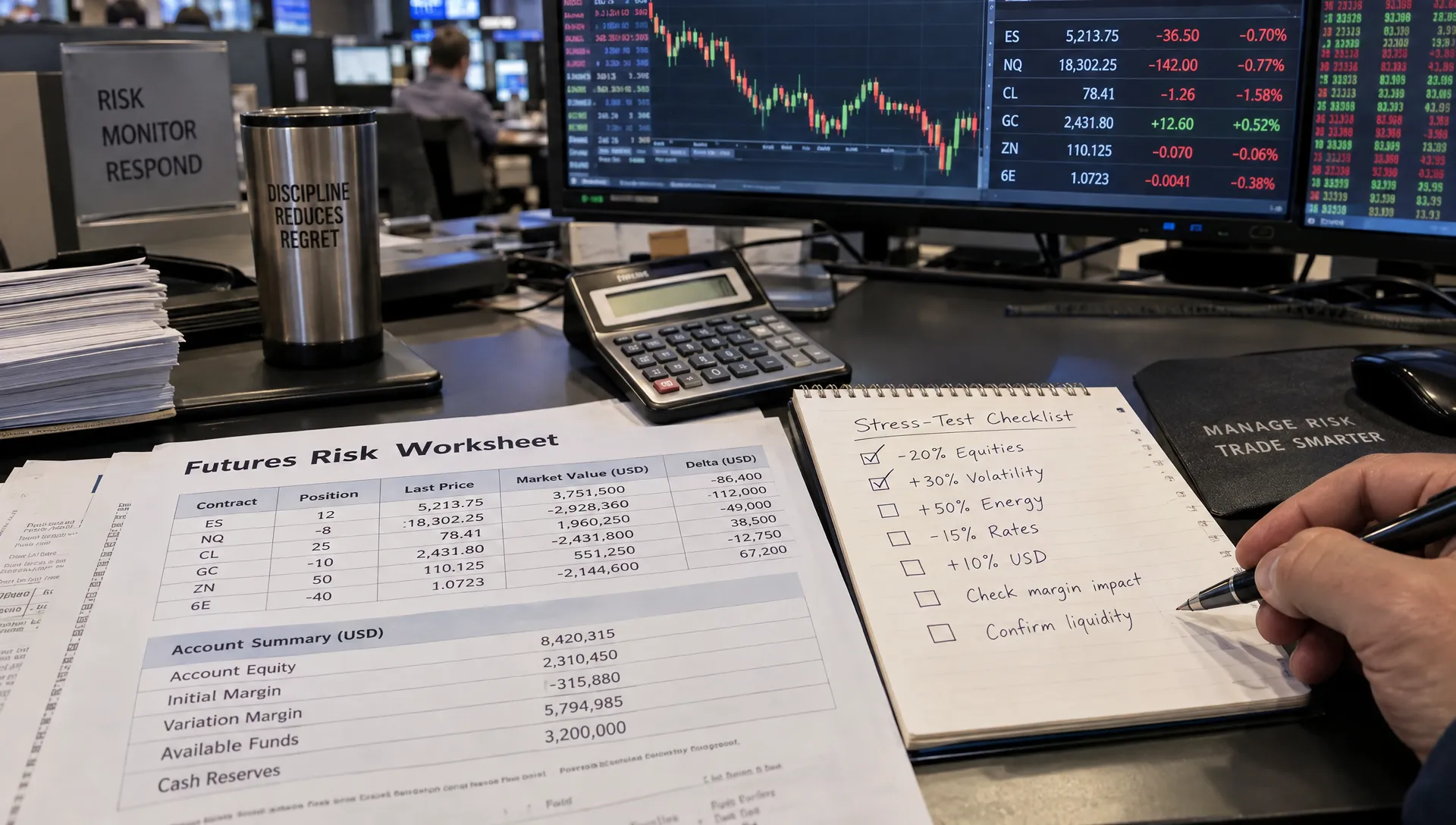
Build a futures trend following stress test
A useful stress test converts hypothetical market events into account losses and collateral demands. It should answer whether the account remains operable, not merely whether the strategy eventually recovers in a backtest.
Test losses and collateral separately
Start with a market shock, then apply a separate margin assumption. For the $25,000 account above, a 5% adverse index move would lose $5,000, leaving $20,000 before costs.
If the assumed initial requirement simultaneously doubled from $1,500 to $3,000 per contract, maintaining four contracts would require $12,000. The account would still have equity above that illustrative requirement, but substantially less room for further losses or additional requirements.
Those numbers are scenario inputs, not forecasts. Replace them with assumptions suited to the contract, its historical behavior and the possibility that future conditions are worse.
Model execution failure and shared losses
Include an exit that fills beyond its intended level and a scenario where several supposedly diversified positions move against you together. If a contract is locked at a price limit or liquidity deteriorates, an immediate exit may not be available at an acceptable price.
Also test the timing of external cash. Money in another account may not arrive before a broker’s deadline. A reserve is only useful if it is eligible, accessible and available when required.
The output should be a decision: smaller initial exposure, more immediately usable reserves, fewer overlapping positions or no trade. If the smallest available contract still exceeds the risk budget, skipping it is a valid outcome.
Judge a track record beyond its headline return
Leverage can make an ordinary strategy look impressive during a favorable period. A return ranking alone cannot tell you whether the outcome came from a durable process, unusually high exposure or a fortunate market environment.
When reviewing futures trend following results, ask how returns were calculated and which account value served as the denominator. A return measured against posted margin can look dramatically different from the return on all capital supporting the strategy.
A useful review examines maximum drawdown, recovery time, worst daily and weekly losses, realized volatility and the history of exposure changes. It should also distinguish live results from simulated results and account for fees, slippage and contract rolls.
The Sharpe ratio adds information about returns relative to observed volatility, but it does not directly measure margin-call risk or guarantee protection from rare losses. A short record can miss precisely the conditions that matter most.
There is another selection problem when comparing visible winners: failed or abandoned accounts may be absent. Surviving portfolios do not necessarily represent everyone who attempted the strategy.
Upside’s verified holdings, portfolio comparisons and return and Sharpe metrics can provide context for evaluating investment outcomes. They should not be treated as a complete futures risk audit. Visible holdings alone do not establish an investor’s full leverage, off-platform hedges or ability to meet an urgent collateral demand.
Keep trading stress out of position sizing
Operational discipline becomes harder when an account is large enough to affect sleep, concentration or everyday finances. Repeatedly checking overnight prices or transferring money impulsively can indicate that the chosen exposure exceeds your practical tolerance, even if it fits a spreadsheet.
For futures trend following, position sizing must be sustainable through a losing sequence, not merely acceptable on entry day. A rule that you cannot follow during a drawdown is not a reliable live process.
Keep essential living expenses separate from trading capital. Write down when exposure must be reduced and avoid increasing position size simply to recover a recent loss. A pause should be possible without jeopardizing household commitments.
If persistent stress is affecting daily life, free, confidential health screening quizzes can offer an initial prompt to seek appropriate support. They are not diagnoses or substitutes for professional assessment. Reducing financial exposure and addressing a health concern are separate steps, and either may be necessary.
Frequently asked questions
Can futures losses exceed the money deposited? Yes. Adverse price moves can create losses greater than the initial margin and, in severe circumstances, greater than the account balance. Your obligations depend on the contract, account agreement and applicable rules. Do not assume protections offered for other financial products also apply to futures.
Does a smaller futures contract remove leverage risk? No. Smaller contracts can make position sizing more precise, but total exposure still depends on how many contracts you hold. Ten small contracts can recreate the exposure of a larger contract. Calculate the combined exposure and potential loss.
How much leverage is safe for futures trend following? There is no universally safe multiple. Appropriate exposure depends on the instruments, their sensitivities, available liquidity and the losses you can absorb. Gross leverage alone is insufficient. Test adverse moves, simultaneous losses and higher collateral requirements before setting a limit.
Will a stop-loss prevent a margin call? Not necessarily. Prices can gap through the intended exit, execution can be delayed and collateral requirements can change before the position closes. A stop is one risk control, not a substitute for accessible reserves and manageable exposure.
Compare portfolios without copying their leverage
Before copying a successful position, establish its notional exposure, plausible stressed loss and funding requirements. If those figures are unknown, the visible return is not enough to justify the trade.
Use Upside’s anonymous portfolio comparisons to examine verified holdings and put your broader allocation in context. Keep the decision to use futures separate from any leaderboard or investor move: your account must be able to fund its own losses, regardless of what another investor appears to be holding.