Highest Institutional Ownership Stocks Aren’t Always Safer
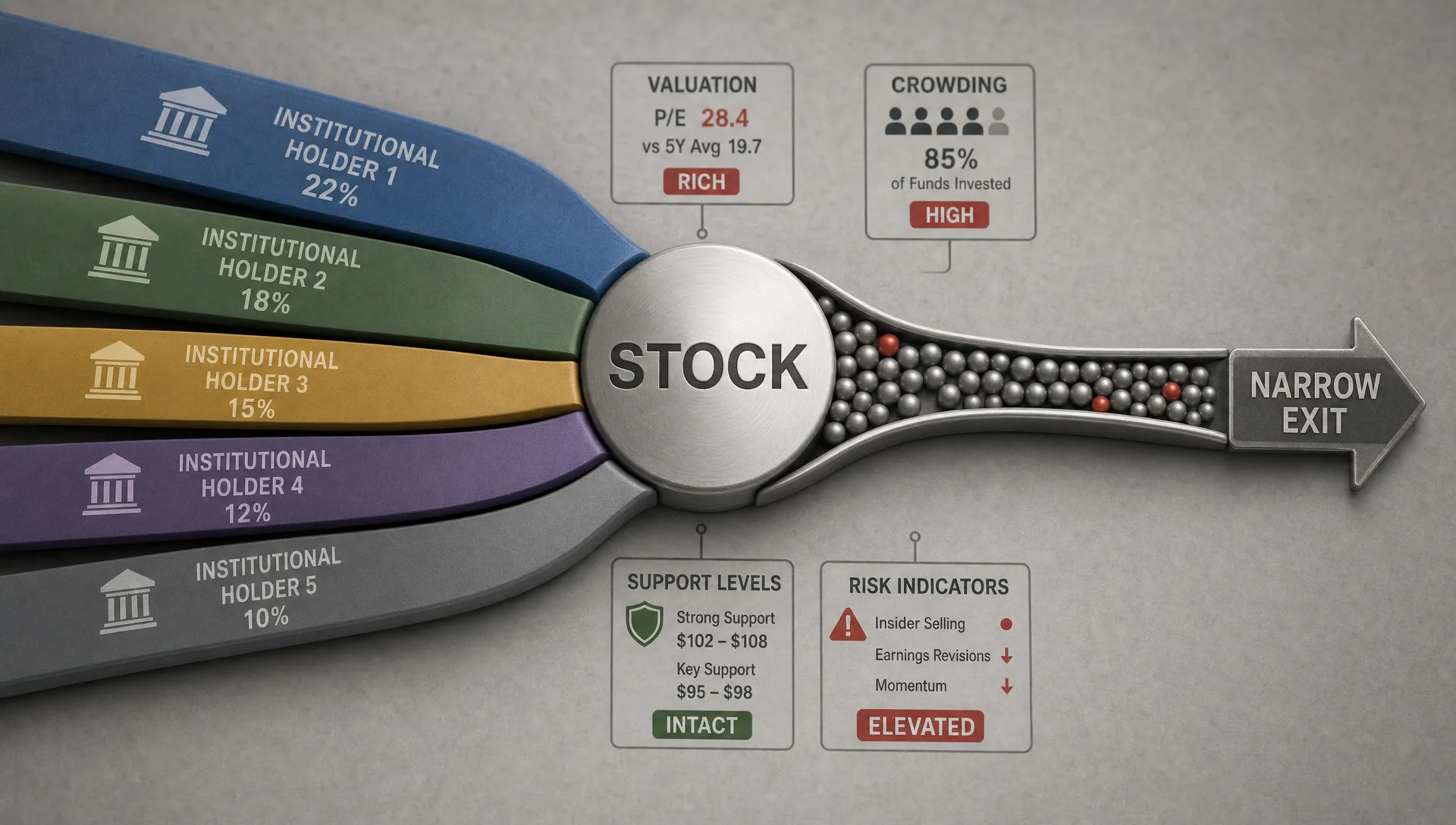
A high institutional ownership percentage can feel like a quality seal. If mutual funds, pension funds, hedge funds and asset managers own most of a company, the logic seems simple: professionals have done the work, so the stock must be safer.
That logic is incomplete. The highest institutional ownership stocks can be excellent businesses with durable demand and strong governance. They can also be crowded trades, index fund staples, overvalued consensus ideas or stocks where professional investors all rush for the same exit at once.
Institutional ownership is a useful signal, not a safety rating. To use it well, you need to know who owns the stock, why they likely own it, whether ownership is rising for the right reasons and what would happen if that support fades.
What high institutional ownership really tells you
Institutional ownership measures the percentage of a company’s shares held by professional investment organizations such as asset managers, mutual funds, ETFs, pension funds, insurance companies, hedge funds and endowments.
In the U.S., much of the public data comes from Form 13F filings. The SEC’s Form 13F guidance explains that institutional investment managers with at least $100 million in qualifying securities generally report holdings each quarter. That makes the data valuable, but it also comes with limits: filings are delayed, they do not show the full investment thesis and they usually do not reveal short positions or hedges.
A stock with 85 percent institutional ownership may be widely accepted by professional capital. It may also simply sit in major indexes, forcing passive funds to hold it regardless of valuation. If you want the mechanics before going deeper, Upside’s guide on how to read institutional ownership of a stock explains the core data points and reporting caveats.
The key is to separate ownership from conviction. They are related, but they are not the same.
Why the highest institutional ownership stocks can feel safer
There are good reasons investors pay attention to institutional ownership. Large institutions have research teams, access to management, risk controls and long experience reading financial statements. When many of them own a company, it can suggest the business has passed a basic quality screen.
High institutional ownership may also support liquidity. Large cap stocks with broad fund ownership often trade more easily than thinly held small caps. That can reduce bid ask spreads and make it easier for investors to enter or exit positions.
Governance is another reason. Institutions can pressure management teams on capital allocation, executive pay, board structure and shareholder returns. A company owned mostly by engaged long-term institutions may face more scrutiny than one dominated by scattered, passive retail shareholders.
Those advantages are real. The problem starts when investors turn them into a blanket assumption that high ownership equals low risk.
The hidden risks behind high institutional ownership
Passive ownership is not the same as active conviction
A large portion of institutional ownership can come from index funds and ETFs. These funds often own a stock because it is in a benchmark, not because analysts believe the company is undervalued.
That does not make passive ownership bad. It just means it should not be mistaken for a strong buy signal. A megacap company can have enormous institutional ownership because it is a large component of market cap weighted indexes. If valuation becomes stretched, passive funds may still hold it until index rules or investor flows change.
Crowded trades can reverse quickly
When too many funds own the same stock for the same reason, the stock becomes vulnerable to crowding risk. If earnings disappoint, guidance weakens or a macro factor changes, many holders may reduce exposure at the same time.
This is especially important for growth stocks, AI related names, biotech winners, highly owned software companies and stocks tied to a popular theme. The ownership base can become a source of volatility rather than stability.
Institutions can be late too
Professional investors are not immune to performance chasing. Some institutions buy after a stock has already moved sharply because they need exposure to a winning sector or benchmark leader. That can push ownership higher near moments when future returns are less attractive.
A rising institutional ownership chart looks bullish only if you connect it to price, valuation and fundamentals. If ownership rises after a 200 percent rally and margin expectations are already aggressive, the stock may be more fragile than it appears.
Reported data may be stale
13F data is not real-time. By the time an investor sees a filing, the fund may have changed its position. That matters most in fast-moving situations such as turnarounds, regulatory events, earnings misses or speculative bubbles.
Institutional ownership should be treated like a dated snapshot. It tells you what was reported for a prior period, not exactly what institutions are doing this minute.
High ownership can reduce the marginal buyer base
If institutions already own most of the float, ask a simple question: who is left to buy more?
A highly owned stock can keep rising if earnings compound, the company buys back shares or funds increase position sizes. But if ownership is already saturated, upside may depend more heavily on fundamental execution. There may be fewer new institutional buyers available to re-rate the stock.
Common safety traps to watch
| Signal | Why it looks safe | Risk investors may miss |
|---|---|---|
| Very high institutional ownership | Professional investors appear to validate the company | Ownership may be passive, benchmark driven or crowded |
| Rising institutional ownership | Funds are accumulating shares | Buying may be late cycle after a major price move |
| Large ETF ownership | Broad market access can support liquidity | ETF outflows can pressure many holdings at once |
| Many hedge fund holders | Sophisticated investors are involved | Positions may be short-term, hedged or catalyst based |
| High ownership plus low float | Scarce shares can amplify upside | Exits can become disorderly if sentiment flips |
| High ownership plus expensive valuation | Institutions seem willing to pay up | Any earnings miss can trigger rapid multiple compression |
The table does not mean high institutional ownership is negative. It means the ownership percentage needs context before you use it in a buy decision.
When high institutional ownership can be a strong signal
High institutional ownership becomes more meaningful when it lines up with other evidence of quality and conviction.
The strongest setup is not simply a high percentage. It is a pattern: ownership is broadening, long-term active managers are increasing exposure, insiders remain aligned, fundamentals are improving and valuation still leaves room for returns.
Look for institutions that hold through multiple reporting periods rather than funds that appear for one quarter and disappear the next. Also pay attention to whether ownership is concentrated in a few top holders or spread across many types of investors. Broad ownership can signal durable interest, but concentrated ownership can either show deep conviction or create exit risk.
This is where the nuance matters. As Upside has covered in its article on how institutional holdings can signal market conviction, the best signals come from persistence, accumulation and ownership quality rather than the headline number alone.
A better way to analyze the highest institutional ownership stocks
Instead of asking whether a stock has high institutional ownership, ask what kind of institutional ownership it has. The difference can change your entire risk assessment.
Identify who owns the stock
Break institutional holders into categories. Index funds, active mutual funds, hedge funds, pension funds and strategic institutions behave differently.
| Holder type | Typical reason for owning | What to check |
|---|---|---|
| Index funds and ETFs | Benchmark exposure | Index weight, fund flows and rebalancing risk |
| Active mutual funds | Fundamental thesis | Holding period, position size and recent changes |
| Hedge funds | Catalyst, valuation gap or trade setup | Turnover, concentration and event dependence |
| Pension or long-only institutions | Long-term allocation | Stability across quarters and governance stance |
| Quant funds | Factor exposure | Sensitivity to momentum, value, quality or volatility factors |
A stock owned mostly by index funds should be interpreted differently from one where respected active managers are building large positions over several quarters.
Compare ownership with valuation
High institutional ownership does not protect you from overpaying. Institutions can own expensive stocks for years if fundamentals justify the premium, but the margin for error narrows as expectations rise.
Check valuation against revenue growth, free cash flow, margins, return on invested capital and balance sheet strength. If a stock trades at a premium, the business needs to earn that premium through execution. Ownership alone cannot do that work.
Study the ownership trend, not just the current level
A stock with 70 percent institutional ownership that has been rising steadily may tell a different story from a stock with 95 percent ownership that has started to decline.
The trend can answer practical questions:
- Are institutions accumulating or distributing shares?
- Is the buyer base broadening or narrowing?
- Are top holders adding, trimming or staying flat?
- Is ownership changing before or after major price moves?
- Is the shift tied to fundamentals, index inclusion or a short-term catalyst?
A single data point invites overconfidence. A trend gives you a better read on behavior.

Examine float, liquidity and short interest
High institutional ownership can interact with float in ways that increase volatility. If insiders, founders or strategic owners hold a large portion of shares, the tradable float may be smaller than the basic share count suggests.
A limited float can help a stock rise quickly when demand increases. It can also make selloffs sharper. Add short interest to the picture and the risk profile changes again. High institutional ownership plus high short interest may signal a polarized market where sophisticated investors strongly disagree.
Check whether the business is actually resilient
The safest looking ownership structure cannot fix a weak business model. You still need to understand the company’s revenue drivers, margins, leverage, customer concentration, competitive position and industry cycle.
This matters even in sectors where institutional ownership feels comforting. For example, if you are evaluating a consumer or apparel related company, ownership tables will not tell you how product development, sourcing and small batch production affect margins and execution risk. Looking at the role of full-service apparel development and production partners can help investors understand the operating details behind a brand’s financial statements.
The same principle applies across sectors. A semiconductor stock requires a view on capacity and customer demand. A bank requires credit quality analysis. A biotech company requires pipeline and regulatory diligence. Institutional ownership is only one layer.
Compare institutional ownership with insider behavior
Insider ownership and insider transactions can add important context. If institutions are buying and insiders own meaningful shares, alignment may be stronger. If institutions are crowded into a stock and insiders are aggressively selling, the signal deserves more caution.
Insider selling is not always bearish. Executives sell for taxes, diversification and personal planning. Still, the combination of ownership signals often matters more than any single metric.
A practical checklist before buying a highly owned stock
Use this framework before treating high institutional ownership as a reason to buy:
| Question | Why it matters | Green flag | Red flag |
|---|---|---|---|
| Who owns the stock? | Different institutions behave differently | Long-term active holders and stable index ownership | Short-term funds dominating the holder list |
| Is ownership rising? | Trend shows behavior | Gradual accumulation over several quarters | Spike after a huge rally with weak fundamentals |
| Is ownership passive or active? | Passive ownership may not reflect conviction | Active funds increasing meaningful positions | Mostly index driven ownership at stretched valuation |
| What is the valuation? | Price determines future returns | Growth and cash flow support the multiple | Expectations require near perfect execution |
| How liquid is the stock? | Liquidity affects exit risk | Deep trading volume and broad float | Low float with crowded ownership |
| What are insiders doing? | Insider alignment adds context | Meaningful ownership and measured transactions | Heavy selling with little insider ownership |
| What could force selling? | Risk often appears during stress | Diverse holder base and stable thesis | Benchmark removal, fund outflows or broken catalyst |
This checklist keeps the ownership signal useful without letting it dominate the entire investment case.
What high institutional ownership does not tell you
There are several things the headline percentage cannot answer.
It does not tell you whether the stock is undervalued. It does not tell you whether a fund’s position is hedged. It does not reveal the investor’s time horizon. It does not show whether the institution bought shares at today’s price or years ago at a much lower cost basis.
It also does not tell you whether the institution is outperforming. A stock may be held by many funds that are trailing their benchmark. A smaller group of skilled investors with strong risk-adjusted results may be more informative than a large crowd of average holders.
That is why portfolio comparison and performance context matter. Seeing who owns a stock is useful. Seeing whether those investors have strong return and Sharpe metrics is more useful.
How retail investors can use the signal without copying blindly
The mistake is not looking at institutional ownership. The mistake is outsourcing your decision to it.
A better approach is to use high institutional ownership as a prompt for deeper research. If many institutions own a stock, ask what they might see. Then test the thesis yourself using valuation, fundamentals, ownership trend, insider behavior and risk controls.
You can also compare the stock against alternatives. Sometimes the best insight is not that institutions own a company, but that they are rotating within a sector. If professional investors are reducing one software stock and adding another, that shift may reveal changing expectations before it shows up in headlines.
For investors who want to go beyond static filing data, Upside Invest helps users compare their portfolios against verified investor holdings, spot trends, view top performer rankings and track sector or theme discovery through anonymous portfolio data. That makes institutional and community ownership signals easier to interpret alongside performance metrics rather than in isolation.
Frequently Asked Questions
Are the highest institutional ownership stocks safer? Not automatically. High institutional ownership can signal liquidity, validation and governance oversight, but it can also indicate passive index exposure, crowded positioning or limited new buyer demand.
What percentage counts as high institutional ownership? It depends on market cap, float and sector. For many large public companies, institutional ownership above 70 percent is common. For smaller companies, the same level may mean a much more concentrated and potentially volatile ownership base.
Can institutional ownership be too high? Yes, in some cases. Very high ownership can mean the stock is already widely held, which may reduce the pool of new buyers. If the trade becomes crowded, negative news can trigger rapid selling by funds with similar risk models.
Is rising institutional ownership always bullish? Rising ownership is more useful when it happens over several quarters and lines up with improving fundamentals. If ownership rises only after a major rally, it may reflect performance chasing rather than early conviction.
Should retail investors copy institutional investors? Retail investors should not copy blindly. Institutional holdings can generate ideas, but every investor still needs to evaluate valuation, risk tolerance, time horizon and portfolio fit.
The smarter takeaway
Highest institutional ownership stocks are not automatically safer. They are simply stocks that professional capital owns heavily, and that can mean many different things.
Use the data as a starting point, then ask sharper questions: who owns the shares, why they might own them, whether ownership is changing, how crowded the trade is and whether the business can justify the valuation.
If you want to compare your portfolio with verified investors and see ownership trends in context, Upside Invest gives you a privacy-first way to learn from real holdings without treating any single metric as a shortcut.