How Institutional Holdings Can Signal Market Conviction
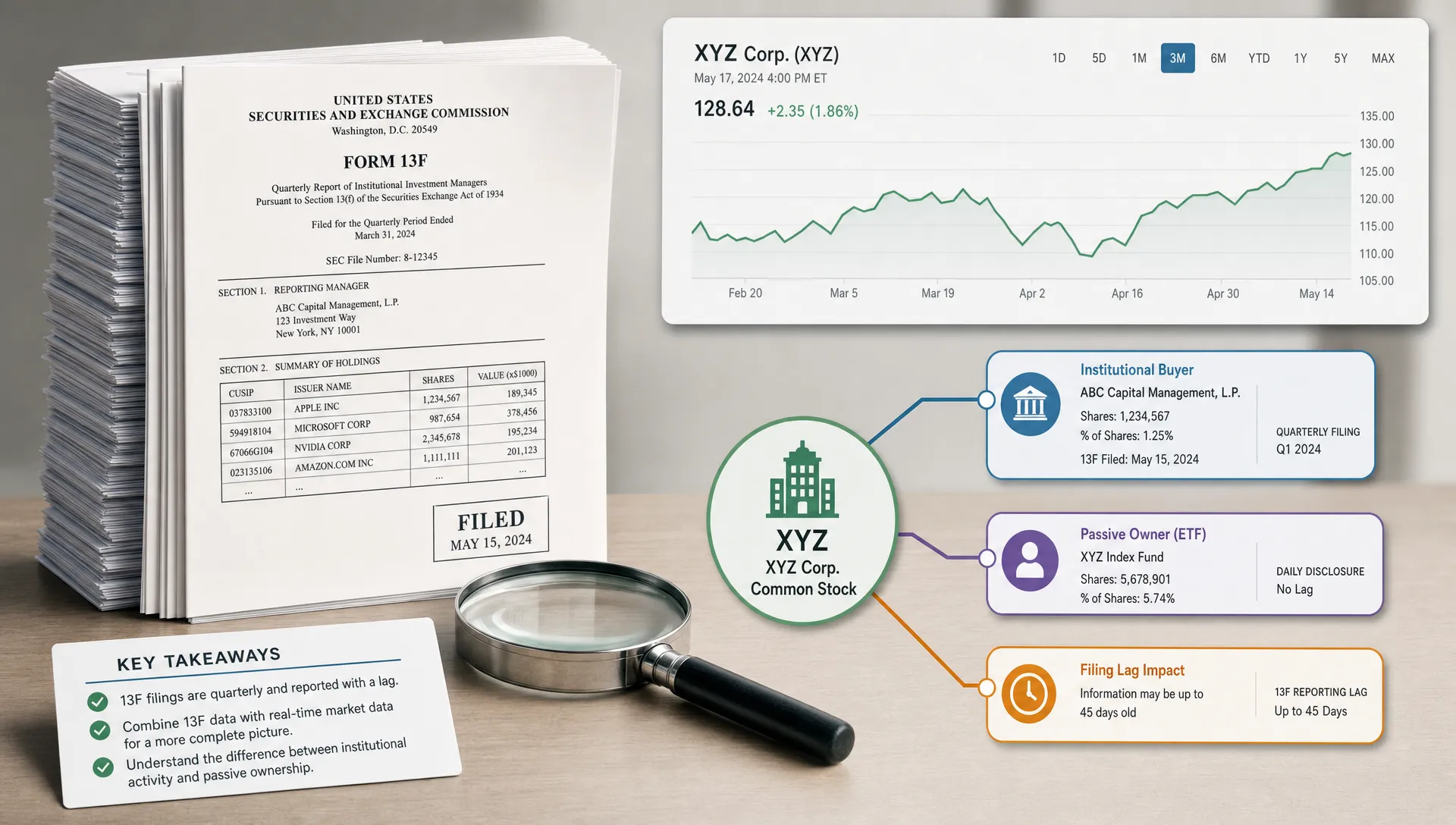
Institutional investors do not move in and out of positions casually. When large asset managers, hedge funds, pension funds, endowments, or mutual funds build stakes in a company, they often bring deep research, access to management, and a disciplined process. That is why many investors watch institutional holdings as a clue about market conviction.
But the signal is easy to misread.
A rising institutional ownership percentage can mean serious long-term interest, but it can also reflect passive index flows. A respected fund buying more shares may be meaningful, but the data may be weeks old by the time you see it. A heavily owned stock may look validated, yet it can also become vulnerable if too many large holders try to exit at once.
The goal is not to copy institutions blindly. The goal is to understand what their ownership patterns can tell you, then combine that signal with valuation, fundamentals, price action, and your own portfolio risk.
What institutional holdings actually represent
Institutional holdings are shares owned by professional investment organizations rather than individual retail investors. These holders can include:
- Mutual funds and ETFs
- Hedge funds
- Pension funds
- Insurance companies
- Banks and trust companies
- Endowments and foundations
- Registered investment advisers
In the United States, one of the most watched sources is Form 13F. The SEC generally requires institutional investment managers with at least $100 million in certain securities under management to file quarterly reports showing many of their long U.S.-listed equity holdings. The SEC explains the basics in its Form 13F information, including the timing and scope of these disclosures.
Investors may also look at Schedule 13D and 13G filings when an investor crosses certain beneficial ownership thresholds, commonly associated with stakes above 5%. These filings can be especially important when the holder is an activist investor or strategic buyer.
For everyday investors, institutional holdings are best viewed as ownership evidence. They show who has capital committed, how that capital may be changing, and whether a stock is attracting or losing sponsorship from professional buyers.
Why institutional holdings can signal conviction
A single institution buying a stock does not automatically mean the stock is attractive. But patterns across institutional holders can reveal how the market’s most resourced investors are positioning themselves.
The strongest signal usually comes from a combination of three things: accumulation, concentration, and persistence.
Accumulation means institutions are adding shares over time, not just appearing briefly in one filing. Concentration means the position is large enough to matter, either relative to the company’s float or the institution’s own portfolio. Persistence means holders remain invested through volatility rather than selling at the first sign of pressure.
When all three appear together, institutional ownership can suggest that sophisticated investors see a durable opportunity.
The difference between ownership and conviction
Not all institutional ownership reflects conviction. Some institutions hold a stock because an index requires it. Others may own it through broad sector funds, factor strategies, or quantitative models. In those cases, the position can be less about company-specific belief and more about portfolio construction.
Conviction is more likely when an active manager builds a meaningful position, increases it over several quarters, and holds through short-term volatility. It becomes even more interesting when multiple active managers independently move in the same direction.
That is why the type of holder matters as much as the percentage owned.
| Institutional signal | What it may suggest | What to verify before acting |
|---|---|---|
| Rising ownership over multiple quarters | Growing professional interest | Whether buying is active or index-driven |
| Large active-manager position | High conviction from a specific fund | Position size relative to the fund’s total portfolio |
| New activist ownership | Potential pressure for strategic change | Filing language, history of activism, and company response |
| High ETF ownership | Strong passive sponsorship | Index membership and fund flow trends |
| Declining ownership by several active funds | Weakening confidence | Whether sales reflect fundamentals, redemptions, or rebalancing |
This distinction helps investors avoid the common mistake of treating every institutional buyer as a bullish endorsement.
The most useful institutional holdings signals to watch
The value of institutional holdings is not in the headline number alone. A stock that is 85% institutionally owned is not automatically better than one that is 35% institutionally owned. The useful insights come from how ownership changes, who is making the changes, and whether those changes align with other evidence.
1. Multi-quarter accumulation
One quarter of buying can be noise. Three or four quarters of steady accumulation is more interesting.
When institutions build positions gradually, it may indicate they are willing to buy across different price levels. That can suggest a longer research horizon, especially if the buying continues during market pullbacks.
The key question is simple: are institutions repeatedly adding, or was the increase a one-time event?
2. Active manager sponsorship
A stock owned mostly by passive index funds may have broad market exposure, but not necessarily active conviction. By contrast, ownership by respected active managers can be more revealing because those managers have chosen to allocate capital to that company over alternatives.
That does not mean they are always right. Even elite managers make mistakes. But active sponsorship can help validate that a company has attracted serious analytical attention.
3. Position size within the institution’s portfolio
If a hedge fund owns $50 million of a company, that sounds meaningful. But if the fund manages tens of billions, the position may be tiny. If a smaller fund allocates 8% of its disclosed equity portfolio to the same company, that is a different signal.
Conviction is often clearer when the position is meaningful to the buyer, not just meaningful to the company.
4. Ownership relative to float
Float refers to shares available for public trading. When institutions own a large portion of the float, supply can become tighter. That may support price strength when demand rises, but it can also increase volatility if large holders sell.
High institutional ownership is not automatically good or bad. It increases the importance of understanding liquidity and crowding.
5. Changes among top holders
The top holders list can be more informative than the aggregate ownership number. If long-term, research-driven investors are replacing short-term holders, the shareholder base may be improving. If the reverse is happening, it may suggest reduced confidence.
This is why investors should look at ownership composition, not just ownership percentage. If you want a broader framework, Upside’s guide to stock ownership data every investor should track explains how institutional holdings fit alongside insider ownership, float, dilution, and short interest.
Where institutional holdings can mislead investors
Institutional data is useful, but it has real limitations. Ignoring those limitations can turn a helpful signal into a false sense of confidence.
The first issue is delay. Quarterly filings can arrive weeks after quarter-end, which means the institution may have already changed its position by the time you see the data. For fast-moving stocks, that lag can matter.
The second issue is incomplete context. Many institutional disclosures focus on long positions and may not fully reveal hedges, derivatives, short exposure, or the broader strategy behind a trade. A fund might appear bullish in one filing while hedging elsewhere.
The third issue is passive ownership. As more assets flow into index funds and ETFs, institutional ownership can rise simply because a company belongs to an index. That is different from a discretionary manager making a company-specific bet.
The fourth issue is crowding. A stock with heavy institutional sponsorship can be vulnerable if the narrative changes. When many large holders own the same stock, selling pressure can accelerate quickly, especially in less liquid names.

A practical framework for using institutional holdings
The best way to use institutional holdings is to turn them into a repeatable checklist. You want a process that prevents emotional interpretation, especially when you find a famous investor buying a stock you already like.
Start with the ownership trend. Has institutional ownership increased, decreased, or stayed flat over several quarters? Then identify the source of the change. Is it coming from active managers, passive funds, insiders, or a mix?
Next, compare the ownership data with the company’s fundamentals. If institutional buying is rising while revenue quality, margins, cash flow, and balance sheet strength are improving, the signal is stronger. If institutions are buying while fundamentals are deteriorating, you need to understand what future catalyst they may be underwriting.
Then check valuation. Institutional conviction does not eliminate valuation risk. A company can be excellent and still overpriced. If ownership is crowded and expectations are high, the margin for error may be thin.
Finally, consider your own portfolio. A stock may have strong institutional sponsorship but still create concentration risk for you if you already own similar names, sectors, or themes. Upside’s article on portfolio comparison tips that reveal hidden risk is useful here because ownership signals are only valuable if they improve your total portfolio decision.
A disciplined workflow matters. If you use AI tools to summarize filings, screen holders, or cluster ownership changes, define your rules before trusting the output. This principle is not limited to investing. In other data-heavy fields, teams use creative AI governance systems to standardize workflows, preserve context, and reduce inconsistent results. Investors can apply the same mindset by documenting how they interpret ownership signals before those signals influence capital allocation.
Institutional holdings vs. verified retail investor behavior
Institutional ownership gives one view of market conviction, but it is not the only one. Retail investors increasingly have access to community-based data that shows how other verified investors are positioned.
That can be a useful complement because institutional data is often delayed, formal, and incomplete. Verified retail portfolio data can show real-time or more current behavior from investors who may be closer to emerging trends, consumer behavior, or niche sectors.
The key is not to assume retail investors are better than institutions, or that institutions are automatically smarter than retail investors. The useful insight comes from comparing both groups.
For example, if institutional ownership is rising and verified retail investors are also accumulating the same stock, that may suggest broadening conviction. If institutions are selling while retail investors are buying aggressively, the divergence deserves more research. It may reflect an opportunity, or it may reflect retail enthusiasm arriving late.
Upside Invest is built around this type of comparison. By showing verified investor holdings through private, anonymous profiles, Upside helps investors see how real portfolios are allocated, which positions are gaining traction, and how their own portfolio compares with others. That adds a community benchmark to traditional ownership research.
If you want to go deeper on that benchmarking angle, Upside’s guide on how to benchmark your portfolio against verified investors explains why comparing against real portfolios can reveal more than a broad index alone.
How to interpret institutional buying in different market environments
Institutional holdings do not mean the same thing in every market cycle.
In a bull market, rising institutional ownership may confirm momentum, but it can also indicate crowded optimism. Investors should ask whether institutions are early in the thesis or simply chasing performance.
In a bear market, accumulation can be more meaningful if institutions are buying while sentiment is weak. That kind of buying may suggest a longer-term view, especially when the company has resilient fundamentals.
In a volatile, rate-sensitive market, ownership changes can reflect macro positioning rather than company-specific conviction. For example, funds may rotate into defensive sectors, profitable companies, short-duration assets, or balance-sheet strength because of interest rate expectations.
In small-cap stocks, a few institutional buyers can have an outsized impact because liquidity is thinner. That can create opportunity, but also risk. If the same funds exit, prices can move sharply.
Context is everything. Institutional holdings should answer one question, not all questions: who is committing capital, and how is that commitment changing?
Red flags to watch in institutional holdings data
Some ownership patterns should make investors more cautious, even if the headline ownership percentage looks impressive.
One red flag is broad selling by active managers while passive ownership remains high. This may make the aggregate number look stable even though discretionary investors are losing interest.
Another red flag is rapid turnover among top holders. If major institutions appear and disappear quickly, the shareholder base may be less stable than it looks.
A third red flag is extreme crowding in a stock with weak liquidity. If many funds own a company and trading volume is limited, a negative surprise can create a crowded exit.
A fourth red flag is institutional buying that conflicts with your thesis. If you cannot explain why institutions are buying, do not use their buying as a substitute for your own research.
A simple scorecard for market conviction
You can make institutional holdings more actionable by scoring the evidence before making a decision.
| Question | Stronger signal | Weaker signal |
|---|---|---|
| Are institutions adding over time? | Multi-quarter accumulation | One-quarter spike |
| Who is buying? | Active, research-driven holders | Mostly passive index ownership |
| Is the position meaningful? | Large weight for the buyer | Tiny portfolio allocation |
| Does it match fundamentals? | Improving business quality | Deteriorating fundamentals |
| Is ownership crowded? | Balanced holder base | Heavy crowding with weak liquidity |
| Does it fit your portfolio? | Improves diversification or risk-adjusted return | Adds hidden concentration |
This type of scorecard keeps the signal in perspective. Institutional holdings can support a thesis, challenge a thesis, or highlight a stock worth researching. They should rarely be the thesis by themselves.
Frequently Asked Questions
Are institutional holdings bullish? Institutional holdings can be bullish when active managers are accumulating shares over time and the buying aligns with improving fundamentals. But high institutional ownership can also reflect passive index flows or crowded positioning, so it should not be treated as an automatic buy signal.
How often are institutional holdings reported? Many U.S. institutional managers report certain holdings quarterly through Form 13F, usually within 45 days after the end of each calendar quarter. Some ownership events, such as crossing major beneficial ownership thresholds, may trigger other filings.
Do institutional investors always know more than retail investors? No. Institutions often have deeper resources, but they can be wrong, late, constrained by mandates, or forced to trade because of flows. Retail investors should use institutional data as one input, not as proof that a stock will outperform.
What is a good level of institutional ownership? There is no universal ideal level. A healthy level depends on company size, float, liquidity, sector, and investor base. Moderate to high ownership by long-term active investors may be constructive, while extreme crowding can increase downside risk.
How can I use institutional holdings in my own portfolio process? Track ownership trends, identify which holders are buying or selling, compare the signal with fundamentals and valuation, and then check whether the position improves or worsens your overall portfolio risk.
Turn ownership signals into better investment decisions
Institutional holdings can reveal where professional investors are showing conviction, but the real edge comes from interpretation. Look for persistent accumulation, meaningful active-manager positions, and ownership changes that align with the business story.
Then compare those signals with your own portfolio, not in isolation.
Upside Invest helps retail investors bring ownership data into a broader decision process by combining verified investor holdings, portfolio comparison, trend discovery, and anonymous benchmarking. Instead of guessing whether your positioning is crowded, underexposed, or aligned with strong investors, you can evaluate it against real portfolio behavior and make more informed decisions.