How Upside Invest Helps You Benchmark Your Portfolio
A useful benchmark does more than tell you whether your portfolio beat the S&P 500 last quarter. It helps you understand why your portfolio behaved the way it did, where your risk is concentrated, and whether your allocation still matches the kind of investor you want to be.
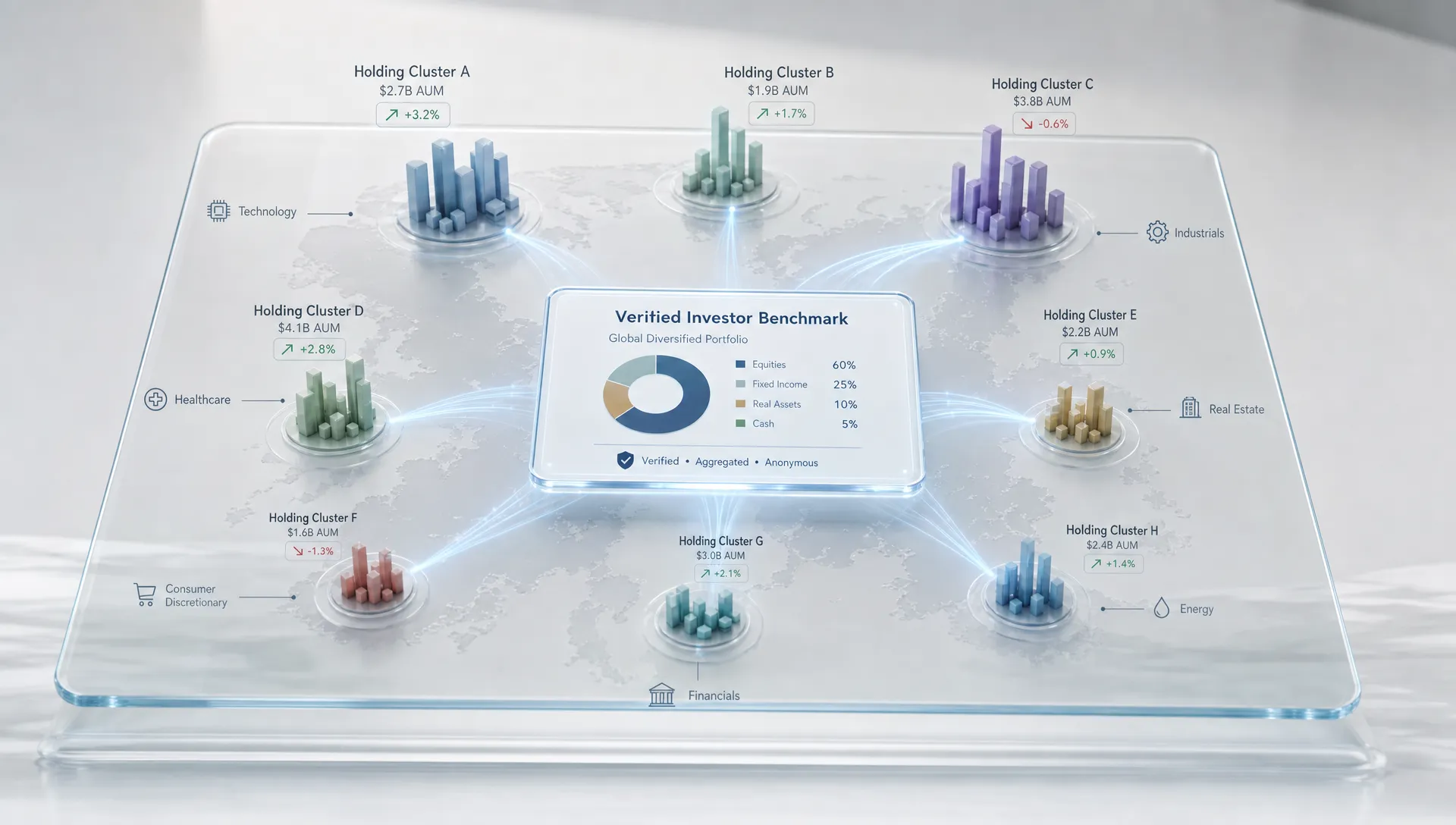
That is where Upside Invest is different from a static index comparison. Instead of only comparing your portfolio to a broad market benchmark, Upside Invest helps you see how your holdings stack up against verified investors using real, anonymized portfolio data. You can compare allocations, identify trends, study what top performers hold, and evaluate your portfolio with context that most retail investors rarely get.
This does not mean you should copy someone else’s trades. Benchmarking is not imitation. The goal is to turn comparison into better questions, better risk awareness, and more informed decisions.
Why traditional portfolio benchmarks often fall short
Most investors start with a simple question: “Did I beat the market?” It is a fair question, but it is also incomplete.
If you own mostly large-cap U.S. stocks, comparing your returns to the S&P 500 may be reasonable. But if your portfolio includes small-cap ETFs, international funds, individual growth stocks, dividend stocks, crypto, cash, and sector bets, one broad index cannot explain much. You might outperform because you took more risk, underperform because you held more cash, or look diversified while actually owning many funds with the same underlying exposure.
A benchmark should help you answer questions like:
- Is my portfolio more concentrated than investors with similar goals?
- Am I taking sector, theme, or single-stock risk without realizing it?
- Are my returns strong after accounting for volatility?
- Do my allocations match the kind of investor I think I am?
- Are other verified investors moving toward or away from the areas I own?
The U.S. SEC’s investor education materials emphasize that asset allocation and diversification are central to managing risk. Upside Invest builds on that idea by helping retail investors compare allocation choices against real investor behavior, not just textbook models.
What Upside Invest adds to portfolio benchmarking
Upside Invest is an investing intelligence platform built around verified investor holdings. The key difference is that the benchmark is not only an index, a model portfolio, or a social media screenshot. It is anonymized, verified portfolio data from real investors.
That matters because the investing internet is full of confident opinions, but not all claims are backed by real positions. Online content is also increasingly easy to manufacture or polish. Even outside finance, resources focused on AI detection and rewriting tools show how difficult it can be to judge authenticity from text alone. A verified-holdings approach shifts the focus from what people say to what investors actually hold.
With Upside Invest, benchmarking can include several layers of comparison:
| Benchmarking layer | What it helps you evaluate | Why it matters |
|---|---|---|
| Allocation comparison | How your portfolio is distributed across assets, sectors, themes, stocks, funds, and crypto views | Reveals whether your actual exposure matches your intended strategy |
| Verified holdings | What other investors are buying and holding | Adds real-world context beyond market headlines |
| Top performer rankings | How stronger performers are positioned | Helps you study patterns without blindly copying trades |
| Return and Sharpe metrics | Performance relative to volatility | Distinguishes high returns from efficient risk-taking |
| Trend and momentum tracking | Where investor interest appears to be shifting | Helps you spot emerging themes and crowded areas |
| Anonymous profiles | How investors compare while preserving privacy | Encourages honest benchmarking without public exposure |
The result is a more practical view of your portfolio. Instead of asking only, “Did I outperform?” you can ask, “What kind of risk did I take to get this outcome, and how does that compare with verified investors?”
Benchmarking your allocation, not just your returns
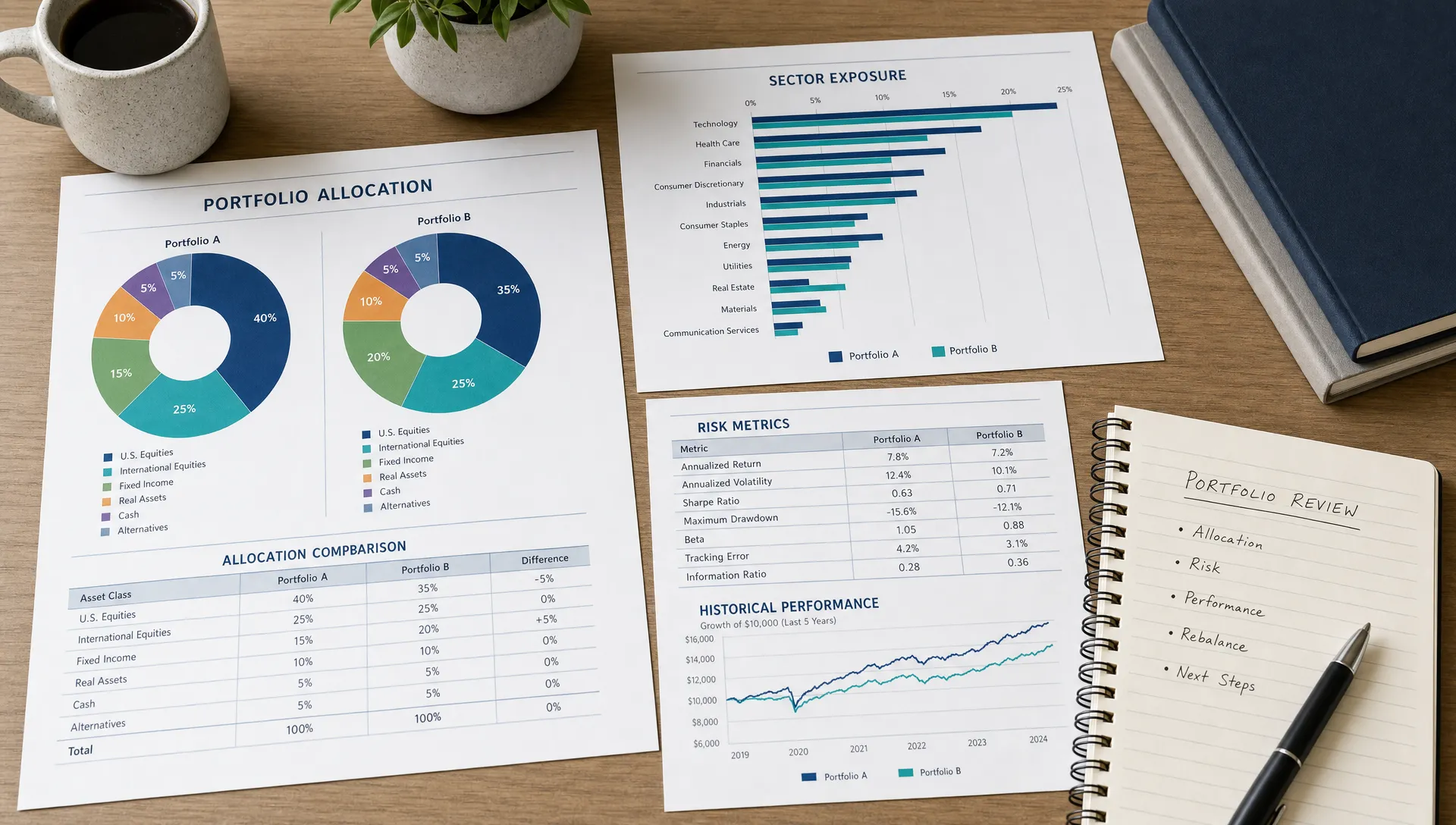
Returns get attention, but allocation usually explains the bulk of portfolio behavior. If your portfolio is heavily tilted toward technology, small caps, crypto, or a single macro theme, your results may be driven more by exposure than stock-picking skill.
Upside Invest helps you compare your allocation with the allocations of other verified investors. That can reveal gaps between your stated strategy and your real portfolio. For example, you may think you are broadly diversified because you own several ETFs, but those funds may overlap heavily in the same mega-cap names. Or you may believe you are a long-term investor, while your holdings show a portfolio crowded with short-term momentum trades.
This is where benchmarking becomes useful. A comparison does not tell you what your allocation should be, but it does show you whether your current mix is unusual, concentrated, or aligned with investors you consider relevant.
If you want to go deeper on risk that is easy to miss, Upside’s guide to portfolio comparison tips that reveal hidden risk is a helpful companion to this process.
Using risk-adjusted metrics to avoid misleading conclusions
A portfolio that gains 25% with extreme volatility is different from a portfolio that gains 15% with steadier performance. Both may be successful, but they are not the same kind of success.
That is why Upside Invest includes return and Sharpe metrics. The Sharpe ratio is commonly used to evaluate return relative to volatility. In plain English, it helps investors ask whether they were compensated for the risk they took.
This matters because raw returns can tempt investors into bad comparisons. If a top-performing portfolio is concentrated in a handful of volatile assets, it may not be a suitable reference point for someone with a lower risk tolerance, shorter time horizon, or more need for stability. By looking at risk-adjusted performance, you can separate “high return” from “high-quality return.”
Benchmarking through this lens can be especially useful during market extremes. In a bull market, risky portfolios can look brilliant. In a drawdown, conservative portfolios can look wise. Risk-adjusted metrics help you evaluate performance across a fuller range of conditions.
How to benchmark your portfolio with Upside Invest
A strong benchmarking process is repeatable. You do not need to rebuild your strategy every week, but you should periodically check whether your portfolio still reflects your goals and whether new data changes your assumptions.
Start with your own baseline
Before comparing yourself to anyone else, define what you are trying to achieve. A young investor saving for long-term growth should not benchmark the same way as someone nearing retirement, preserving capital, or investing for income.
Your baseline should include your time horizon, risk tolerance, liquidity needs, tax considerations, and preferred level of complexity. Once you know your own baseline, comparisons become more meaningful. You are no longer asking, “What is everyone else buying?” You are asking, “Which comparisons are relevant to my situation?”
Compare your actual allocation
Next, look at what you actually own. This is often more revealing than what you intended to own.
Upside Invest can help you compare your portfolio across categories such as stocks, funds, crypto views, sectors, and themes. This can surface concentration that might otherwise remain hidden. For instance, you may have multiple positions tied to the same interest-rate cycle, artificial intelligence theme, consumer trend, or commodity exposure.
The goal is not to eliminate every concentration. Concentrated bets can be intentional. The goal is to know when concentration exists and decide whether it is still worth taking.
Study verified investor behavior
Once your own allocation is clear, compare it against verified investors. This is where Upside Invest becomes more powerful than a traditional portfolio tracker.
You can observe what verified investors are buying, holding, and outperforming with. You can also monitor investor moves and see which sectors or themes are gaining attention. This helps you separate broad market noise from actual portfolio behavior.
Still, the key is interpretation. If many investors are moving into a theme, that may signal momentum, but it may also signal crowding. If top performers hold an asset you do not own, that does not automatically make it right for you. The value is in the question it raises: “Is there a reason this position belongs in my research process?”
Look at security-level context
Good benchmarking is not only about portfolio-level allocation. Sometimes you need to understand the role of a specific stock, fund, or asset inside the broader market.
Ownership patterns, holder behavior, and changing interest can all add useful context. If you are analyzing individual positions, Upside’s article on stock ownership data every investor should track explains the kinds of ownership signals that can help investors think more clearly.
This kind of data does not replace fundamental research. It complements it. A company’s financials, valuation, competitive position, and management quality still matter. But ownership context can help you understand whether your position is popular, contrarian, increasingly crowded, or losing investor attention.
Use AI recommendations as a prompt, not a command
Upside Invest includes AI portfolio recommendations, which can help surface ideas and comparison points. The most productive way to use AI in investing is not to outsource judgment. It is to expand the set of questions you consider.
For example, an AI recommendation might highlight an allocation gap, suggest an alternative exposure, or point to a theme you have overlooked. From there, your job is to evaluate whether the idea fits your goals, risk tolerance, and existing holdings.
The best investors use tools to improve decision quality. They do not let tools make decisions in a vacuum.
What anonymous benchmarking makes possible
Many retail investors want better comparison data, but they do not want to reveal their net worth, exact account balances, or personal identity. That is a reasonable concern.
Upside Invest’s emphasis on private anonymous profiles makes benchmarking more accessible. Investors can learn from verified holdings and community-level data without turning their personal finances into public content. This is especially important because money decisions are sensitive, and many people are uncomfortable sharing portfolio details openly.
Anonymous benchmarking can also reduce some of the performance theater that appears in public investing spaces. When the focus is on verified data rather than personal branding, the conversation can become more useful. Investors can study allocation, risk, and behavior without needing to know who is behind every portfolio.
Privacy does not make data perfect, but it can make participation more honest. More honest participation can lead to better comparison sets.
Common mistakes to avoid when benchmarking
Portfolio benchmarking is powerful, but it can be misused. The biggest mistake is treating another investor’s portfolio as a shortcut to conviction.
A top performer’s holdings reflect their time horizon, risk tolerance, entry prices, tax situation, and willingness to endure drawdowns. You may not share any of those factors. Copying the end result without understanding the context can lead to poor decisions.
Another mistake is comparing yourself to the wrong peer group. If you hold diversified ETFs and cash, comparing yourself to aggressive crypto-heavy portfolios will probably create unnecessary anxiety. If you are a concentrated growth investor, comparing yourself only to broad market index funds may hide the risks you are actually taking.
A better approach is to use benchmarking as a structured review:
- Compare against investors with similar goals or risk profiles when possible.
- Separate allocation decisions from security selection decisions.
- Look at risk-adjusted performance, not only raw returns.
- Treat trends as research signals, not automatic buy or sell instructions.
- Revisit your benchmark periodically instead of reacting to every short-term move.
The purpose of Upside Invest is not to make every portfolio look the same. It is to help investors see their portfolios more clearly.
A simple 15-minute portfolio benchmark routine
You can use Upside Invest as part of a recurring review process. A short monthly or quarterly review is often more useful than checking prices every day.
Start by looking at your overall allocation. Ask whether your exposure has drifted because of market movement, new contributions, or recent trades. Then compare your allocation with relevant investor groups and top performers. Look for large differences, not tiny deviations.
Next, review your risk-adjusted performance. If your returns improved, did volatility rise too? If your returns lagged, was that because of intentional defensiveness or because your positions performed poorly relative to similar investors?
Then examine trend and momentum signals. Are verified investors increasing exposure to areas you already own? Are they moving away from themes you still like? Are top performers concentrated in areas you have ignored?
Finally, write down one or two decisions. Those decisions might be to rebalance, research a position, reduce overlap, add diversification, set an alert, or do nothing. “Do nothing” is a valid decision when it is intentional.
How Upside Invest fits into an investor’s research stack
No single tool can answer every investing question. Upside Invest is most useful when paired with fundamental research, personal financial planning, and a clear investment policy.
Think of it as the benchmarking and investor intelligence layer. Financial statements can tell you how a company is performing. Market data can tell you how prices are moving. Your personal plan can tell you what risk you can afford. Upside Invest helps you understand how your portfolio compares with verified investors and where real investor behavior is shifting.
That combination can improve decision-making because it adds context. You are not investing in isolation, and you are not relying only on headlines. You are comparing your choices against actual portfolios while maintaining privacy.
For retail investors, that is a meaningful upgrade.
Frequently Asked Questions
What does it mean to benchmark a portfolio? Benchmarking a portfolio means comparing its allocation, performance, risk, and holdings against a relevant reference point. That reference point might be an index, a model portfolio, or, with Upside Invest, verified investor portfolios.
How is Upside Invest different from comparing my portfolio to the S&P 500? The S&P 500 is a broad U.S. large-cap stock index. Upside Invest adds context from verified investor holdings, allocation comparisons, trend tracking, top performer rankings, and risk-adjusted metrics.
Should I copy top-performing investors on Upside Invest? No. Top performer data should be used for research and benchmarking, not blind copying. Their goals, risk tolerance, entry prices, and tax situation may be very different from yours.
Can Upside Invest help me find hidden risk? Yes, Upside Invest can help you compare allocations and spot concentration across sectors, themes, securities, and asset types. This can reveal risks that may not be obvious from performance alone.
Is portfolio benchmarking only useful for active investors? No. Long-term passive investors can also benefit from benchmarking. It can help confirm whether their allocation remains diversified, whether fund overlap is creating hidden concentration, and whether their portfolio still matches their plan.
Benchmark your portfolio with better context
If you want to understand your portfolio beyond simple returns, Upside Invest gives you a more practical way to compare. You can study verified investor holdings, review allocation differences, track trends, evaluate risk-adjusted performance, and keep your identity private while learning from real portfolio data.
Use it as an intelligence layer, not a crystal ball. The goal is not to chase every move other investors make. The goal is to make your own portfolio decisions with clearer context and fewer blind spots.
Start exploring how your portfolio compares with verified investors at Upside Invest.