How an Owner of Stocks Should Think About Dilution

For an owner of stocks, dilution is one of the easiest risks to underestimate because it happens in the denominator. The business may be growing, revenue may be rising and headlines may sound upbeat, yet your slice of future profits can still shrink if the company issues more shares faster than value per share grows. Dilution is not automatically a reason to sell. It can fund an acquisition, strengthen a balance sheet or pay talent when cash is scarce. The question is whether the new shares create more value than they take from existing holders. Think of every share issuance as a trade: existing shareholders give up some percentage ownership, and the company should receive something valuable enough in return.
What an owner of stocks actually loses when dilution happens
Dilution occurs when a company increases its shares outstanding. If the company’s value does not rise proportionally, each existing share represents a smaller claim on future earnings, free cash flow, dividends and voting power.
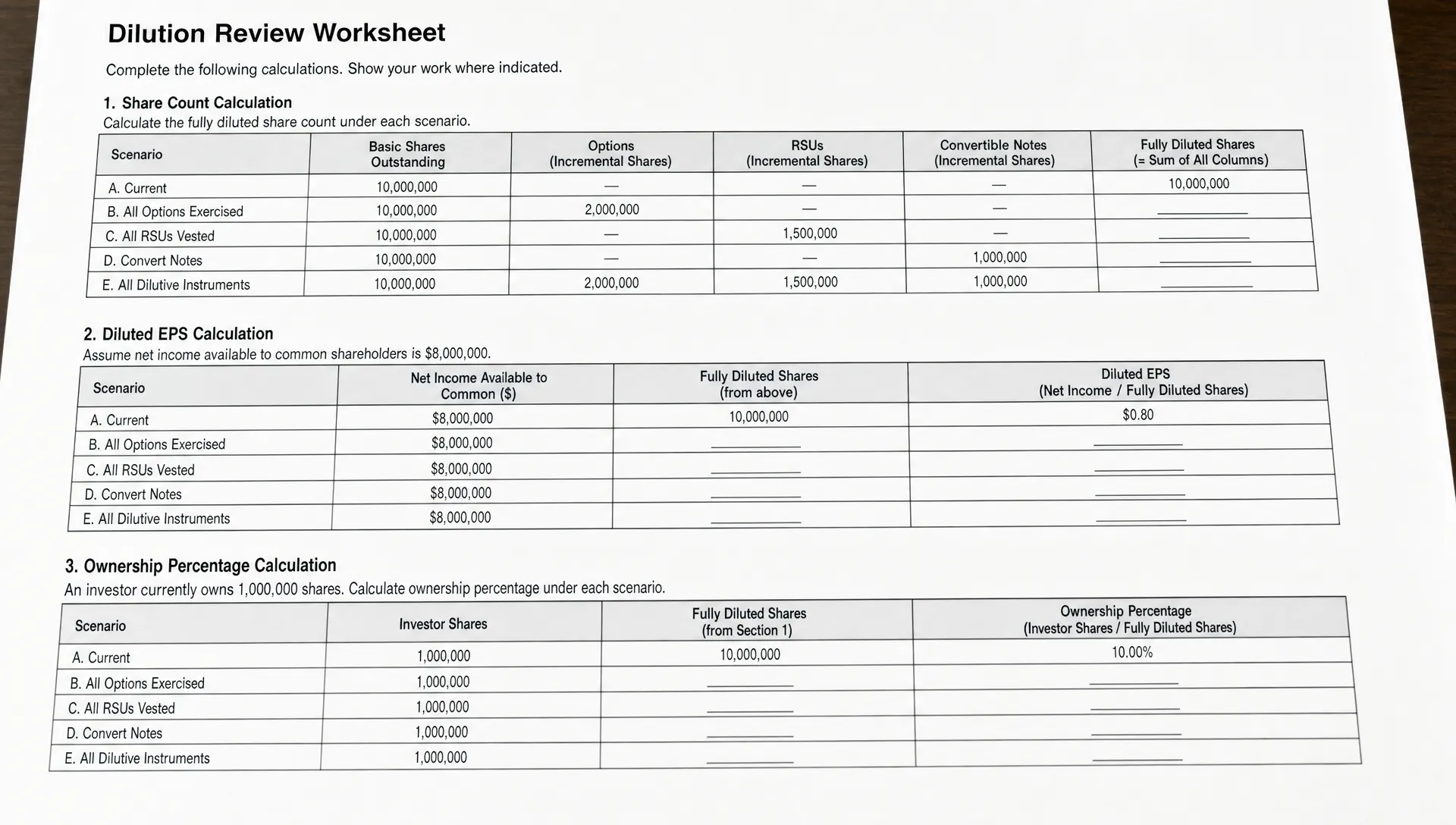
A simple example makes the math clear. Imagine a company has 100 million shares outstanding and earns $100 million. Earnings per share are $1. If it issues 25 million new shares and earnings stay the same, the share count rises to 125 million and earnings per share fall to $0.80. The company did not become less profitable in total, but each share now receives a smaller portion of the same profit pool.
| Metric | Before issuance | After issuance, same earnings |
|---|---|---|
| Shares outstanding | 100 million | 125 million |
| Company earnings | $100 million | $100 million |
| Earnings per share | $1.00 | $0.80 |
| Ownership per share | Higher | Lower |
A practical owner of stocks should watch per-share results, not only companywide results. Revenue, net income and cash flow can all rise while per-share value stagnates if the share count rises just as quickly.
For a broader foundation on shareholder rights and economic claims, Upside’s guide to share ownership in a company explains how ownership percentage, voting rights and dilution fit together.
Dilution is about value per share, not just share count
The mistake many retail investors make is treating all dilution as bad. That is too simple. Issuing new shares can be rational when the company receives assets, cash or talent that increase long-term value per share.
A biotechnology company may issue shares to fund clinical trials. A bank may raise equity to meet capital requirements. A fast-growing software business may use stock compensation to recruit engineers before it produces consistent free cash flow. None of these automatically destroy value.
The key test is whether the return on the capital raised exceeds the cost paid by existing shareholders. If a company sells 10 percent more shares but uses the money to create 25 percent more future earning power, dilution may be acceptable. If it sells shares simply to cover recurring losses with no credible path to better economics, existing shareholders are financing survival rather than growth.
How an owner of stocks can tell if dilution is acceptable
Start by asking what the company received in exchange for the new shares. Cash for expansion, repayment of expensive debt or a high-quality acquisition can be defensible. Shares issued to fund vague plans, persistent operating losses or insider-friendly compensation deserve more skepticism.
Then look at timing. A company that issues stock when its valuation is high may be acting wisely because each share sold raises more cash. A company that issues stock after a major price decline may still need the money, but the cost to existing holders is usually heavier.
The process is similar to narrowing possibilities in a word puzzle. Each new clue should reduce uncertainty. If you have ever used a Wordle solver to filter possible answers from incomplete information, apply the same discipline to dilution: every filing detail should make the capital raise more understandable, not more confusing.
For an owner of stocks, the strongest sign is alignment. Management should explain why the issuance is necessary, how proceeds will be used and how success will be measured in per-share terms. Vague language about “strategic flexibility” is not enough on its own.
Where dilution hides in company filings
Dilution is not limited to the headline share count on a finance app. It often appears in several places across company filings, and retail investors should know where to look.
The income statement usually shows basic shares and diluted shares. Basic shares count common shares outstanding. Diluted shares include potential shares from options, restricted stock units, warrants, convertible debt and similar instruments when they are considered dilutive.
The statement of shareholders’ equity shows how the share count changed during the period. The cash flow statement can also help because stock-based compensation is often added back as a non-cash expense, even though it can dilute shareholders over time.
For the owner of stocks who wants a cleaner picture, compare share count trends over multiple years rather than one quarter. A single issuance may be understandable. A pattern of rising diluted shares with weak per-share growth is a more serious warning.
You can also use ownership data to see whether dilution is happening alongside insider buying, insider selling or institutional accumulation. Upside’s article on stock ownership data every investor should track covers related signals such as insider ownership, float and short interest.
| Filing area | What to check | Why it matters |
|---|---|---|
| Income statement | Basic and diluted share count | Shows current and potential per-share impact |
| Cash flow statement | Stock-based compensation | Reveals non-cash pay that may become dilution |
| Balance sheet notes | Convertible debt and warrants | Identifies future share issuance risk |
| Proxy statement | Executive equity awards | Shows whether incentives align with shareholders |
| Share repurchase disclosures | Buybacks versus issuance | Shows whether buybacks actually reduce shares |
Stock-based compensation deserves special attention
Stock-based compensation is common in public companies, especially in technology and growth businesses. It can help companies conserve cash and attract employees, but it is still part of the economic cost of running the business.
Some investors ignore stock-based compensation because it is non-cash in the current period. That can be misleading. If a company pays employees with shares, existing shareholders give up part of their claim on the business. If the company later repurchases stock just to offset those awards, cash is being used to prevent dilution rather than to shrink the share count for long-term holders.
This does not mean every company with stock compensation is unattractive. The question is scale. If equity compensation is modest relative to revenue, free cash flow and market capitalization, it may be reasonable. If it consumes a large share of revenue or repeatedly prevents per-share progress, investors should adjust their expectations.
A careful owner of stocks should compare reported profitability with per-share value creation. A company that looks profitable after adding back stock compensation may still be expensive if shareholders are paying the bill through dilution.
Buybacks can offset dilution, but not always help you
Share repurchases are often presented as shareholder friendly. They can be, especially when a company buys back stock below intrinsic value and reduces the share count over time. But buybacks can also mask dilution from stock compensation or acquisitions.
The number to watch is net share count change. If a company announces a large buyback program but diluted shares outstanding barely decline, much of the repurchase activity may simply be offsetting new share issuance. That is not necessarily bad, but it is less powerful than a true reduction in shares.
Price matters too. Buybacks create value when the company buys shares for less than they are worth. They can destroy value when management repurchases aggressively at inflated prices and later issues stock at lower prices to raise cash.
Investors should also compare buybacks with other capital uses. Paying down debt, reinvesting in the business or making an acquisition may be better than repurchasing shares if the stock is expensive. The right choice depends on expected returns, balance sheet strength and management discipline.
A checklist for the owner of stocks before buying or holding
Dilution analysis does not need to be complicated, but it does need to be consistent. Before buying or holding a stock, run through a short checklist.
- Check whether diluted shares outstanding have risen, fallen or stayed flat over three to five years.
- Compare growth in revenue, earnings and free cash flow with growth in per-share metrics.
- Read the stated purpose of any equity issuance and judge whether it is specific or vague.
- Review stock-based compensation as a percentage of revenue and free cash flow.
- Look for convertible debt, warrants, options and restricted stock units that could become future shares.
- Compare buybacks with total share issuance to see the net effect.
- Watch management language for per-share accountability, not just companywide growth.
This checklist is especially useful for companies that look cheap on headline valuation multiples. A low price-to-sales or price-to-earnings ratio can be a trap if the share count keeps expanding and the business does not generate enough incremental value.
It also helps when comparing two similar companies. The one with slower revenue growth but strong per-share discipline may produce better returns than the faster-growing company that constantly issues equity.
How dilution should affect portfolio decisions
Dilution risk should influence position size, required return and the type of evidence you demand before adding capital. A business with frequent share issuance is not automatically uninvestable, but it should clear a higher bar.
For early-stage companies, investors may accept dilution if the potential upside is large and each raise extends the runway toward a valuable milestone. For mature companies, recurring dilution is harder to justify unless it funds acquisitions or compensation that clearly improve per-share economics.
An owner of stocks should also compare dilution risk across the whole portfolio. If many holdings depend on future equity raises, the portfolio may be more sensitive to weak capital markets than it appears. When stock prices fall and funding becomes expensive, dilution can accelerate at the worst possible time.
This is where portfolio comparison can help. Upside Invest is built around anonymous, verified portfolio intelligence, so investors can compare allocations, spot trends and see what other verified investors are holding without exposing their identity. That broader context can help you decide whether a dilution-heavy position deserves a smaller weight or closer monitoring.
Frequently Asked Questions
Is dilution always bad for shareholders? No. Dilution is harmful when new shares reduce per-share value, but it can be acceptable when the company receives cash, assets or talent that increase future value per share by more than the ownership given up.
What is the difference between basic shares and diluted shares? Basic shares count current common shares outstanding. Diluted shares estimate the share count after including potentially dilutive securities such as options, restricted stock units, warrants and convertible debt.
How often should I check dilution? A long-term owner of stocks should review share count trends at least quarterly for active holdings and more deeply during annual report season. Multi-year trends matter more than one isolated quarter.
Can buybacks eliminate dilution? Buybacks can offset dilution, but only the net share count tells the real story. If a company spends heavily on repurchases while diluted shares barely decline, buybacks may be neutralizing stock compensation rather than increasing your ownership.
What is the biggest dilution red flag? The biggest red flag is repeated equity issuance used to fund ongoing losses without clear progress in per-share economics. That pattern can transfer value from existing shareholders to new capital providers.
Turn dilution analysis into better portfolio decisions
Dilution is not just an accounting detail. It changes what each share can claim, how management allocates capital and how much return shareholders may actually receive.
If you want to judge dilution in context, use tools that help you compare holdings rather than review each stock in isolation. With Upside Invest, you can benchmark your portfolio against verified investor holdings, track trends and make more informed decisions while keeping your profile private and anonymous.