How Bill Gates Microsoft Ownership Has Changed Over Time

Bill Gates Microsoft ownership is one of the clearest examples of how a founder can move from near-control of a company to a much smaller public stake without necessarily weakening the company’s long-term story. Gates helped build Microsoft, held an enormous share position at the IPO, then spent decades selling, donating and diversifying as Microsoft matured from a founder-led software company into one of the world’s largest public businesses.
For investors, the interesting part is not just the famous name. Gates’ changing stake shows how ownership percentages, insider sales, charitable transfers, buybacks and governance roles all interact. If you only look at one headline number, you can miss the real signal.
Bill Gates Microsoft ownership in one timeline
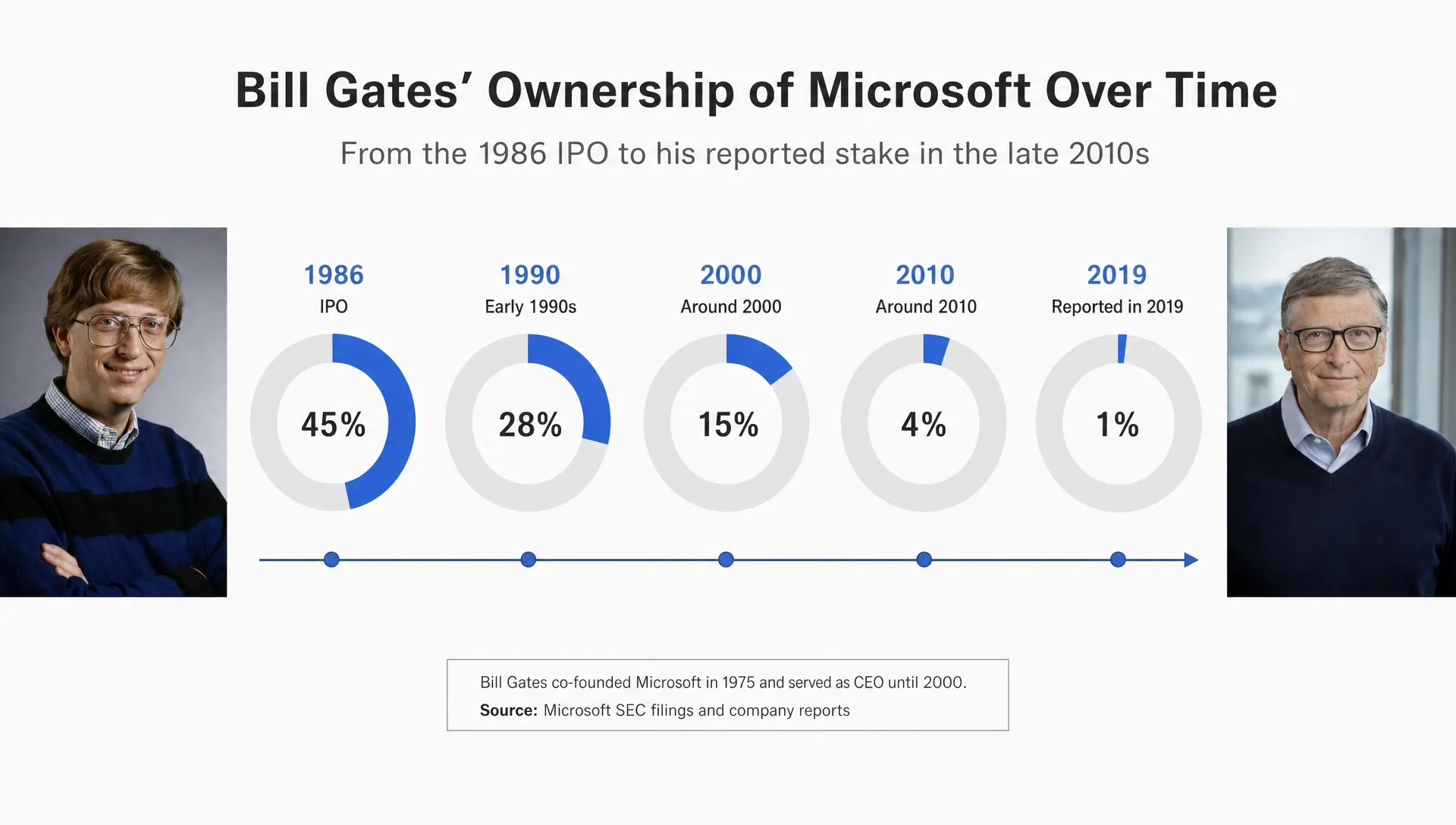
Public records do not provide a perfect continuous line from 1975 to 2026, especially after Gates stopped being a Microsoft director. Still, Microsoft proxy statements, SEC filings and widely reported company history give investors a useful timeline.
| Period | What changed | Approximate ownership context |
|---|---|---|
| 1975 to 1985 | Microsoft was private and founder-controlled | Gates was a dominant founder shareholder alongside Paul Allen and early employees |
| 1986 IPO | Microsoft went public on March 13, 1986 | Gates owned roughly the high 40% range before the offering and the mid 40% range after, depending on the share count used |
| 1990s | Microsoft’s market value surged and its stock split repeatedly | Gates remained the largest individual shareholder, though his percentage gradually declined |
| 2000 | Gates stepped down as CEO and Steve Ballmer became CEO | Gates still held a very large stake, but ownership was already moving lower through sales and diversification |
| 2008 | Gates left day-to-day Microsoft work to focus more on philanthropy | His role changed from operating leader to chairman and long-term shareholder |
| 2014 | Gates stepped down as chairman and became a technology adviser | After years of planned sales, reports put his stake near 4% and Ballmer was reported to have become the largest individual holder |
| 2019 | Microsoft’s proxy disclosed Gates’ board-era holding | The proxy listed roughly 103 million shares, about 1.3% of Microsoft at the time |
| 2020 to 2026 | Gates left Microsoft’s board | Because he is no longer a director and is below 5%, his full personal stake is not routinely disclosed in Microsoft’s proxy table |
The key point is that Bill Gates Microsoft ownership did not fall because of one single transaction. It declined through decades of normal founder behavior: selling into liquidity, giving shares to philanthropy, shifting personal wealth and reducing direct governance involvement.
Why the ownership percentage declined
When investors study Bill Gates Microsoft ownership, the first mistake is to compare raw share counts across decades without adjusting for stock splits. Microsoft has split its stock multiple times since the IPO, so an old share count and a modern share count are not directly comparable unless they are split-adjusted.
The second mistake is treating every sale as a judgment on Microsoft. Gates’ sales were widely understood to be part of long-term diversification and philanthropic funding, not a simple “sell Microsoft” call. A founder with most of his net worth in one company has different portfolio needs than an investor buying a few shares today.
Several forces reduced Gates’ percentage over time:
- Planned sales: Founders often sell stock gradually to reduce concentration risk.
- Charitable giving: Gates has transferred substantial wealth toward philanthropy, including through entities associated with the Gates Foundation.
- New share issuance: Employee compensation and corporate activity can change the ownership denominator over long periods.
- Governance changes: As Gates moved away from management and the board, his reporting obligations changed too.
Buybacks add another wrinkle. Microsoft has repurchased stock over time, which can increase the ownership percentage of shareholders who do not sell. In Gates’ case, ongoing sales and donations more than offset any percentage support from repurchases.
How Gates’ role at Microsoft changed
Bill Gates Microsoft ownership became less central to Microsoft’s day-to-day governance as Gates reduced his operating role. In 2000, he handed the CEO role to Steve Ballmer. In 2008, he stepped away from full-time work at the company. In 2014, when Satya Nadella became CEO, Gates also moved from chairman to technology adviser.
Those milestones matter because insider ownership has two parts: economic exposure and influence. A founder can own fewer shares but still have informal influence through reputation, board service, relationships and technical knowledge. Over time, Gates’ formal influence also declined. Microsoft announced in March 2020 that he would step down from the board to spend more time on philanthropic priorities, a change the company described in its board update.
For everyday investors, this is why ownership data needs context. A 1% founder stake in a trillion-dollar company can still represent a massive dollar position, but it does not carry the same governance power as a 45% stake in a newly public company.
If you want to research similar shifts yourself, start with proxy statements, Form 4 filings, Schedule 13D or 13G filings and 13F reports. Upside’s guide on how to find stock ownership changes in SEC filings explains where those records appear and how to interpret them.
What founder selling does and does not mean
Founder selling is often overinterpreted. A sale can mean many things: estate planning, taxes, charitable giving, diversification, liquidity needs or a prearranged trading plan. Bill Gates Microsoft ownership is a useful reminder that large sales can happen alongside excellent long-term company performance.
The better question is whether the sale changes the investment case. Did the founder lose operational involvement? Did the sale remove voting control? Did several insiders sell at once? Was the sale part of a long-running plan? Did business fundamentals change at the same time?
For investors with large concentrated positions of their own, tax treatment can also matter. Rules differ by country and investor type, so it can be worth speaking with qualified advisers, such as firms that provide professional tax and accounting services, before selling or donating a major stock position.
| Question to ask | Why it matters |
|---|---|
| Is the seller still active in the company? | A founder-CEO sale may carry a different signal than a retired founder sale |
| Is the sale one-off or recurring? | Planned recurring sales are often less informative than sudden large disposals |
| How much ownership remains? | A seller may still have substantial economic exposure after selling |
| Are other insiders buying or selling? | Clustered insider behavior can be more meaningful than one person’s trade |
| What is the company doing with capital? | Buybacks, dilution and compensation can all affect ownership percentages |
Why the exact current stake is harder to pin down
Bill Gates Microsoft ownership is easier to track when Gates was a Microsoft insider. Directors and certain officers must report many ownership changes. Large beneficial owners above 5% generally have separate disclosure obligations. Once a person is no longer a director, officer or 5% holder, public visibility can decrease.
That is the situation investors face after 2020. Gates left Microsoft’s board and his stake had already fallen far below the level that made him one of Microsoft’s controlling shareholders. Public filings may still reveal holdings through related investment entities or charitable trusts, but those disclosures are not the same as a simple personal ownership number.
Investors should separate three things:
- Personal beneficial ownership: Shares Gates personally controls or benefits from.
- Foundation or trust holdings: Shares held by charitable or investment vehicles that may have separate purposes.
- Publicly reported ownership: What investors can confirm from filings, which may be incomplete for a private individual below reporting thresholds.
Microsoft’s official filings can be searched through the SEC’s EDGAR database. The useful habit is to verify the filing type before relying on a number. A proxy table, Form 4 and 13F filing may all show different slices of the ownership picture.
What retail investors can learn from the Gates timeline
The biggest lesson from Bill Gates Microsoft ownership is that ownership percentage is not the same as conviction, control or expected return. A declining percentage may reflect personal financial planning rather than a negative company view.
Retail investors can apply the same logic to any founder-led or formerly founder-led stock. Look at the pattern, not just the transaction. A slow, transparent reduction over many years deserves a different interpretation than a surprise sale during a weakening business cycle.
It also helps to compare ownership against performance, valuation and capital allocation. If a founder is selling but the company is buying back shares, expanding margins and compounding free cash flow, the signal is mixed rather than automatically bearish. If insiders are selling into heavy dilution, weakening guidance and poor governance, the signal may deserve more caution.
This is where ownership research becomes more powerful when combined with portfolio comparison. Upside Invest is built around verified investor holdings, anonymous profiles, trend tracking and return metrics, so investors can see what real portfolios are holding rather than relying only on headlines. For a broader framework, see Upside’s guide to stock ownership data every investor should track.
How to build a better ownership view of Microsoft or any stock
Bill Gates Microsoft ownership is a famous case, but the research process is repeatable. You can use it for founder-led software companies, banks, retailers, chipmakers or any public company where insiders matter.
Start by identifying the share count, then separate insiders, founders, institutions, index funds and retail flows. Next, look for ownership changes across time. A single filing is a snapshot. A multi-year view shows whether ownership is concentrating, dispersing or simply rotating from one type of holder to another.
You can also compare ownership with risk-adjusted returns. A stock with heavy insider buying may still be expensive. A stock with insider selling may still outperform if fundamentals improve. The ownership layer is one input, not the entire decision.
If you want a step-by-step workflow, Upside’s article on how to build an ownership profile for any stock walks through a practical structure that fits this kind of research.
Frequently Asked Questions
How much of Microsoft did Bill Gates own at the IPO? Gates owned roughly the high 40% range before Microsoft’s 1986 IPO and the mid 40% range after the offering, depending on the share count and timing used. The exact percentage varies slightly across sources because IPO ownership can be measured before or after shares are sold to the public.
Does Bill Gates still own Microsoft stock? He is widely believed to still have exposure to Microsoft through personal, investment or philanthropic structures, but his exact personal stake is not routinely disclosed now that he is no longer a Microsoft director and is below the 5% reporting threshold.
Why did Bill Gates reduce his Microsoft ownership? The decline reflects decades of diversification, planned sales, charitable giving and a gradual move away from Microsoft management. Bill Gates Microsoft ownership became a smaller part of his public identity as his philanthropy and other investments grew.
Did Gates selling Microsoft shares mean he lost confidence in the company? Not necessarily. Founder sales can reflect tax planning, donations, liquidity or risk management. Microsoft’s long-term performance after many of Gates’ sales shows why investors should avoid reading every insider sale as a negative signal.
Who became Microsoft’s largest individual shareholder after Gates sold down his stake? Steve Ballmer was widely reported to have passed Gates as Microsoft’s largest individual shareholder around 2014, after Gates continued selling shares under long-running plans. Current rankings can be hard to confirm precisely because not every large individual holder has the same reporting obligations.
Bottom line
Bill Gates Microsoft ownership changed from a dominant founder stake to a much smaller, less visible holding over four decades. That shift tells investors more about founder wealth management and governance evolution than it does about a simple bullish or bearish view on Microsoft.
For retail investors, the practical takeaway is to track ownership changes with context. Look at who is selling, why they might be selling, how much they still own and whether the business fundamentals confirm or contradict the ownership signal. That is a stronger approach than reacting to a single headline about a famous investor’s stake.