How ESOP Stock Works and Why It Matters
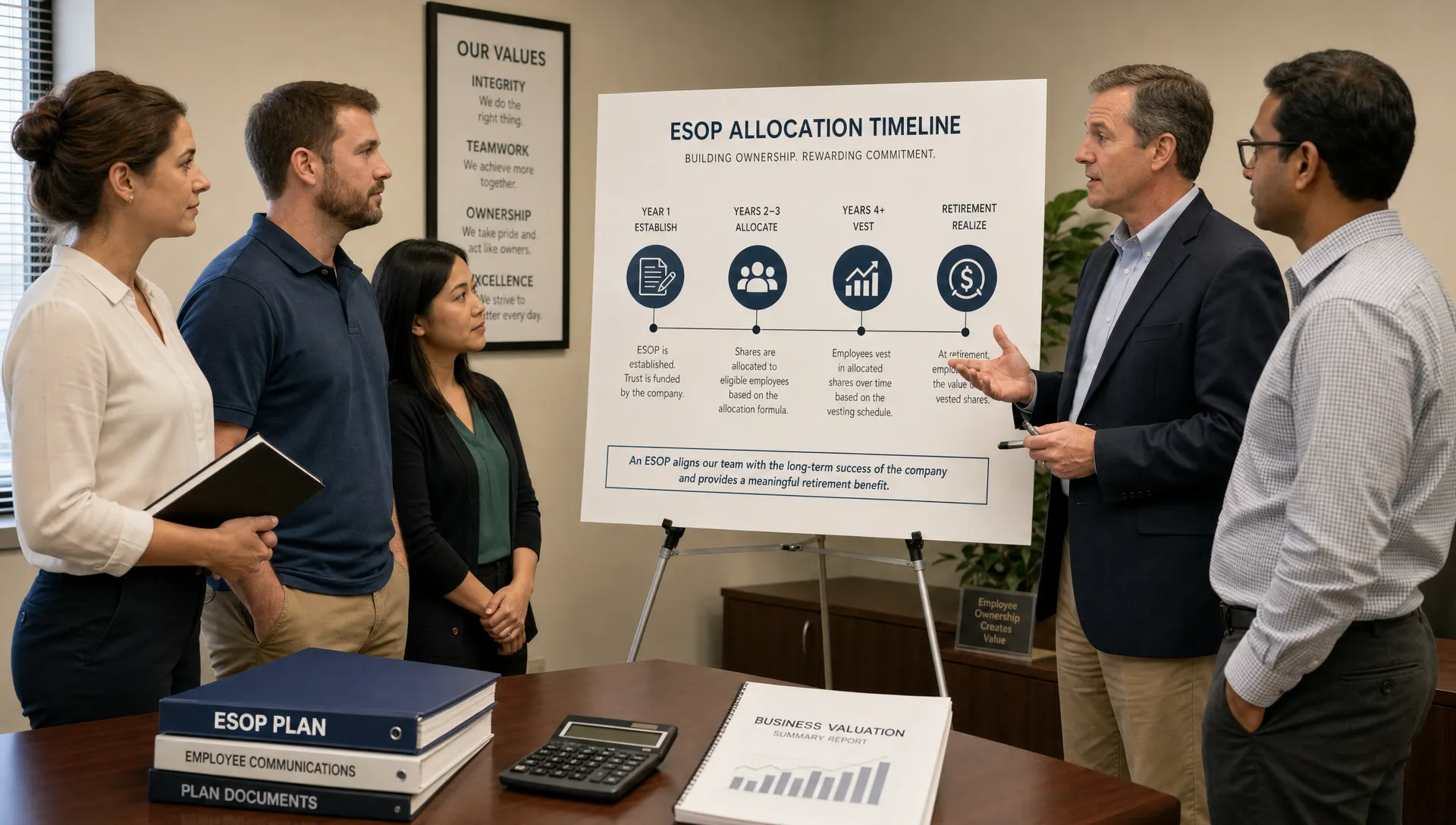
ESOP stock can be a powerful wealth-building mechanism, but it is often misunderstood. Employees may hear that they own part of the company and assume it works like stock in a brokerage account. Investors may see employee ownership and treat it as an automatic sign of alignment. Both interpretations are incomplete.
An employee stock ownership plan, or ESOP, is a retirement plan that holds company stock for employees through a trust. The stock can become a meaningful part of an employee's long-term compensation, while also shaping a company's capital structure, culture, and financial obligations. That is why ESOP stock matters not just to employees, but also to investors evaluating the quality of a business.
This guide focuses on the practical mechanics: how ESOP stock is created, allocated, valued, vested, distributed, and interpreted as an investing signal.
What ESOP stock actually is
ESOP stock is company stock held inside an employee stock ownership plan. The plan is typically structured as a tax-qualified retirement plan, and the shares are held in a trust on behalf of eligible employees. The IRS describes ESOPs as defined contribution plans designed to invest primarily in employer stock.
That distinction is important. In most cases, an employee does not receive freely tradable shares on day one. Instead, the ESOP account reflects an allocated interest in company stock, subject to plan rules, vesting, valuation, and distribution timing.
For public companies, ESOP stock may be tied to a market-traded share price. For private companies, the stock value is generally determined by an independent valuation process. That valuation becomes central to what an employee's ESOP account is worth and what the company may eventually owe when employees leave or retire.
If you want a broader foundation before going deeper, Upside has a separate guide that offers an ESOP explanation for investors and employees.
How ESOP stock works step by step
Although plan details vary, most ESOPs follow a recognizable lifecycle. Understanding this lifecycle helps employees avoid unrealistic expectations and helps investors see how employee ownership can affect a company's financial position.
- The company establishes an ESOP trust: The company creates a trust that will hold shares for eligible employees. The plan document defines eligibility, allocation formulas, vesting, distribution timing, and other important rules.
- The ESOP acquires company stock: The company may contribute shares directly, contribute cash so the ESOP can buy shares, or use a leveraged ESOP structure where the trust borrows money to purchase shares.
- Shares are allocated to employee accounts: Over time, shares are assigned to eligible employees according to a formula, often based on compensation or another plan-defined method.
- Employees vest in their ESOP accounts: Vesting determines how much of the allocated stock value an employee keeps if they leave the company before retirement.
- The stock is valued periodically: Public company stock can reference market prices, while private company ESOP shares usually require independent appraisal.
- Employees receive distributions later: Employees typically receive the value of vested ESOP stock after leaving the company, retiring, becoming disabled, or another plan-defined event.
- The company handles repurchase obligations: In private companies, the business may need to buy back shares from departing employees, creating a future cash-flow obligation.
The U.S. Department of Labor notes that ESOPs are retirement plans and are subject to federal rules. That means they are not simply informal bonus pools or founder promises. They are regulated benefit plans with fiduciary responsibilities.
ESOP stock is not the same as options, RSUs, or an ESPP
A common mistake is to treat every form of employee equity as interchangeable. ESOP stock, stock options, restricted stock units, and employee stock purchase plans can all connect employees to company value, but they work very differently.
| Feature | ESOP stock | Stock options | RSUs | ESPP |
|---|---|---|---|---|
| Main purpose | Retirement ownership plan | Right to buy shares at a set price | Stock-based compensation | Discounted employee share purchases |
| Employee usually pays upfront | Usually no | Yes, if exercising options | Usually no | Yes, through payroll deductions |
| Value depends on | Company stock value and vested account balance | Market value above exercise price | Share value when vested or delivered | Purchase discount and stock performance |
| Liquidity timing | Usually after separation, retirement, or plan event | After exercise and sale, if shares are liquid | Often at vesting or settlement | After purchase, subject to rules |
| Key risk | Concentration and valuation risk | Options can expire worthless | Tax and market price risk | Market decline after purchase |
This matters because ESOP stock can feel less immediate than RSUs or an ESPP. It may be valuable, but it is usually not cash you can access whenever you want. If you are comparing ESOPs with other equity compensation structures, Upside's guide to how employee stock ownership really works breaks down those differences in more detail.
Why ESOP stock matters for employees
For employees, ESOP stock matters because it can turn long-term company success into personal retirement wealth. Unlike some equity programs that require employees to purchase shares, ESOP allocations are often funded by the company through plan contributions. That can make the benefit especially meaningful for workers who might not otherwise invest directly in their employer.
The most obvious upside is wealth participation. If the company grows, improves profitability, and increases in value, vested employees may benefit through a higher ESOP account value. In a strong company, an ESOP can become a major retirement asset.
There is also a cultural effect. When employees understand how their work connects to company value, ownership can improve engagement. Research and resources from the National Center for Employee Ownership point to the scale of employee ownership in the U.S. and the role ESOPs play across thousands of companies. Still, ownership alone does not guarantee better outcomes. Communication, financial transparency, and sound management matter.
The biggest employee risk is concentration. If your job, salary, bonus potential, and ESOP value all depend on the same company, your financial life may be heavily tied to one business. That can work well when the company thrives, but it can be painful if the business struggles.
Employees should pay close attention to several plan details:
- Vesting schedule: This determines how much of the ESOP stock value you keep if you leave before becoming fully vested.
- Valuation method: Private company ESOP values depend on appraisal assumptions, not daily market trading.
- Distribution timing: You may not receive money immediately after leaving, and payments may be made over time.
- Diversification rights: Some participants may eventually be allowed to diversify part of their ESOP account, depending on age, service, and plan rules.
- Tax treatment: ESOP distributions are generally taxable, though rollover options may be available in some cases.
Because tax rules can be complex, employees should review the plan documents and consult a qualified tax professional before making distribution or rollover decisions.
Why ESOP stock matters for investors
For investors, ESOP stock matters because employee ownership can influence incentives, cash flow, governance, and valuation. It is not automatically bullish or bearish. It is a signal that needs context.
A well-designed ESOP can align employees with long-term business performance. If workers think and act like owners, the company may benefit from lower turnover, stronger retention, and better operational discipline. That is the positive story investors often associate with employee-owned companies.
But an ESOP can also introduce financial complexity. If the company borrowed money to fund a leveraged ESOP, debt repayment can affect cash flow. If the company is private, repurchase obligations can become substantial as employees retire or leave. If too much employee wealth is tied to internal stock value, governance and valuation conflicts can become more sensitive.
| Investor question | Why it matters |
|---|---|
| How much of the company is owned through the ESOP? | A larger ESOP stake can increase alignment, but may also affect control and capital allocation. |
| Is the ESOP leveraged? | Debt used to buy shares can create repayment pressure and change financial risk. |
| How is private company stock valued? | Appraisal assumptions can materially affect employee account values and repurchase obligations. |
| What is the repurchase obligation? | Future buybacks from departing employees can consume cash that might otherwise fund growth. |
| Does the culture support ownership? | ESOP structure alone is not enough if employees lack transparency or influence. |

When evaluating a public company, investors can look at filings to understand employee ownership, stock-based compensation, dilution, and plan obligations. When evaluating a private ESOP-owned company, the analysis is harder because information may be less available. In both cases, the point is the same: ESOP stock should be interpreted alongside profitability, balance sheet strength, management quality, and valuation.
How ESOP stock affects company value
An ESOP can affect company value in several ways. Some are strategic, some are financial, and some are behavioral.
From a strategic perspective, ESOPs are often used in succession planning. A founder or owner of a private company may sell shares to an ESOP as a way to transition ownership while preserving the company's independence. That can be attractive compared with selling to a competitor or private equity buyer, especially when the owner wants to protect employees and company culture.
From a financial perspective, leveraged ESOPs can change the balance sheet. The company may make contributions to the ESOP, and those contributions may be used to repay acquisition debt. Depending on the structure and company type, there can be tax advantages, but there can also be meaningful cash-flow demands.
From a behavioral perspective, employee ownership can support long-term thinking. The key word is can. Employees need to understand the ESOP, trust the valuation process, and see how daily decisions influence business outcomes. Without that, ESOP stock may feel abstract rather than motivating.
For investors, the best approach is to separate narrative from evidence. An employee-owned label sounds appealing, but the numbers still matter.
ESOP stock risks that are easy to overlook
ESOPs are often discussed in positive terms, and in many cases they deserve that reputation. Still, ESOP stock has risks that employees and investors should not ignore.
The first is valuation risk. Public shares have visible market prices, but private ESOP stock depends on appraisal models. Appraisals can be rigorous, but they still rely on assumptions about earnings, growth, discount rates, comparable companies, and company-specific risks.
The second is liquidity risk. An employee may see a meaningful account value on paper but have limited access until a qualifying event. Even then, distributions can be delayed or paid in installments according to plan rules.
The third is business concentration risk. Employees may already depend on the company for wages and health benefits. Adding retirement wealth to that same company increases exposure.
The fourth is repurchase risk for the company. If many employees retire or leave around the same time, the company may need significant cash to redeem shares. This can be manageable with planning, but it should not be ignored.
The fifth is governance risk. ESOP trustees and fiduciaries must act properly, especially in transactions involving company stock. When insiders, sellers, trustees, and employees all have different incentives, process quality matters.
A practical ESOP stock checklist
If you are an employee, your goal is to understand what you own, when it becomes yours, how it is valued, and when you can access it. Start with the summary plan description, annual account statements, vesting schedule, and distribution rules. Ask HR or the plan administrator for clarification if anything is unclear.
If you are an investor, your goal is to understand whether the ESOP strengthens or strains the business. Look at ownership percentage, leverage, contribution requirements, dilution, repurchase obligations, governance, and whether the company has a credible culture of employee ownership.
Here is a simple way to frame the analysis:
| Perspective | What to confirm | Why it matters |
|---|---|---|
| Employee | Vesting and distribution rules | Determines how much value you may actually receive and when. |
| Employee | Diversification options | Helps reduce overexposure to one employer. |
| Investor | ESOP ownership percentage | Shows how much of the company is tied to employee ownership. |
| Investor | Debt and repurchase obligations | Reveals potential pressure on future cash flow. |
| Both | Valuation process | Affects account values, fairness, and confidence in the plan. |
The deeper lesson is that ownership percentage alone is not enough. A small vested stake in a high-quality, growing company may be more valuable than a large paper allocation in a struggling business. To understand ownership more broadly, it can help to revisit what share of ownership means for everyday investors.
Frequently Asked Questions
Is ESOP stock real stock? Yes, ESOP stock represents shares of the employer held through an ESOP trust for eligible employees. However, it usually does not behave like freely tradable stock in a personal brokerage account.
Do employees have to buy ESOP stock? In many ESOPs, employees do not directly buy the stock. The company funds the plan through contributions, or the ESOP acquires shares through a transaction. Plan structures vary, so employees should review their specific documents.
Can ESOP stock lose value? Yes. ESOP account values can fall if the company's stock value declines. Private company valuations can change based on business performance, market conditions, and appraisal assumptions.
When can employees cash out ESOP stock? Employees usually receive distributions after retirement, separation from service, disability, death, or another plan-defined event. Timing and payment methods depend on the plan and applicable rules.
Is an ESOP a good sign for investors? It can be, but it is not enough by itself. Investors should evaluate the ESOP alongside profitability, debt, cash flow, governance, repurchase obligations, and the company's broader competitive position.
Bring ownership data into your investing process
ESOP stock matters because it connects employees, company performance, and investor analysis. For employees, it can be a meaningful path to retirement wealth. For investors, it can be a useful signal of alignment, culture, and capital structure, but only when interpreted with real data.
Upside Invest helps retail investors compare allocations, study verified investor holdings, track trends, and see what outperforming investors are buying and holding. If you want to move beyond surface-level narratives and understand how real portfolios are positioned, explore Upside Invest and bring more context into your investment decisions.