How Shares Show Your Ownership of a Company
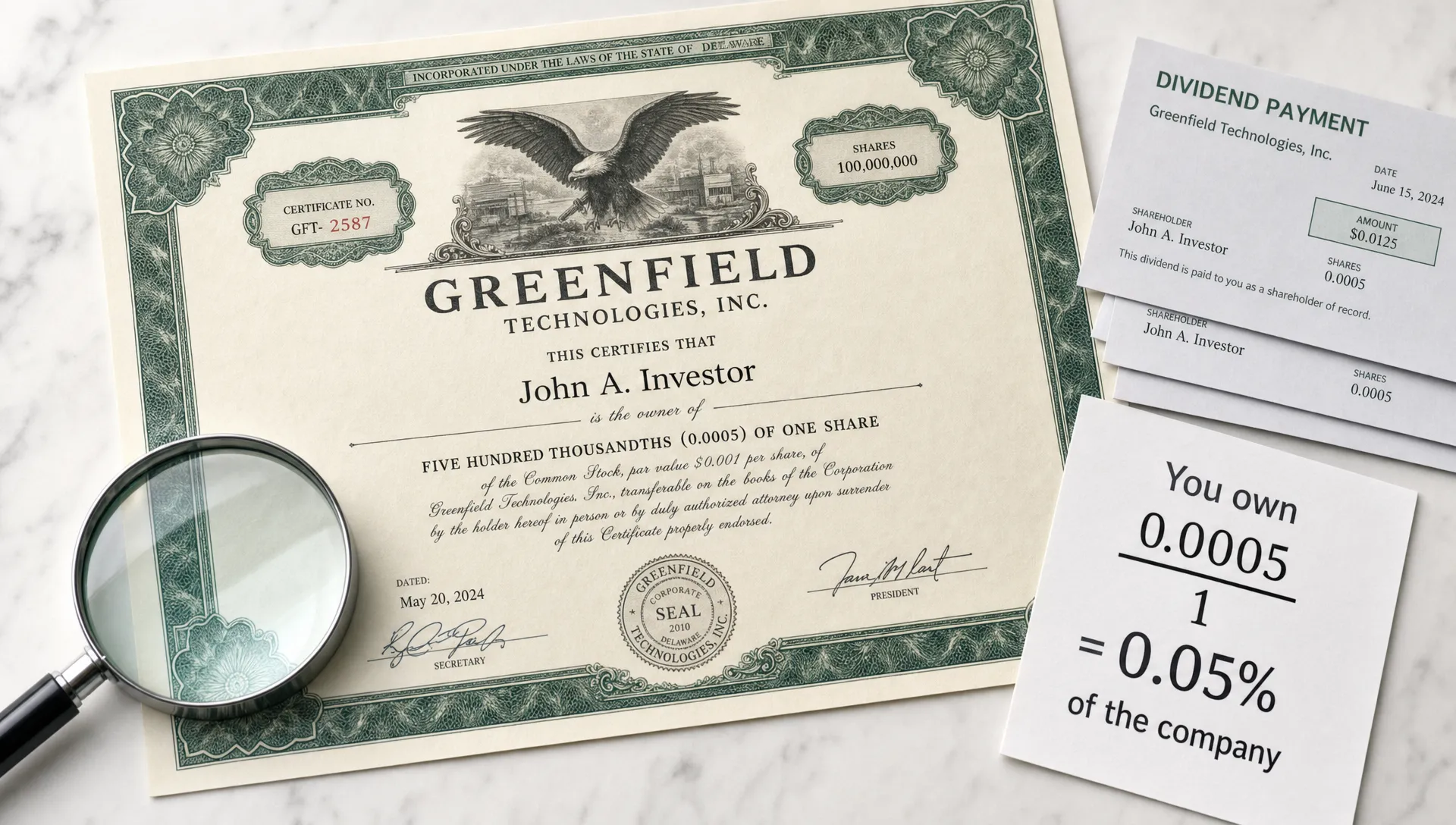
Buying a share can feel deceptively simple. You tap a ticker symbol, enter an order and a position appears in your brokerage account. Behind that small transaction is a real ownership claim, even if your piece of the business is tiny.
A share is one unit of equity in a company. When you own shares, you own part of the company through a legal and economic claim attached to those shares. You do not own the company’s cash, buildings or patents directly. You own an interest in the corporation that owns those assets.
That distinction matters for everyday investors. It explains why your returns depend not only on the business doing well, but also on how many shares exist, what rights those shares carry and whether your ownership stake changes over time.
Share ownership starts with a fraction
The simplest way to see how shares show ownership is to compare the number of shares you own with the total number of shares the company has issued.
The basic formula is:
Ownership percentage = your shares ÷ total shares outstanding
If a company has 1 billion shares outstanding and you own 100 shares, your ownership is 0.00001% of the company. That may sound almost meaningless, but it is still a real fractional claim on the same business as every other common shareholder, subject to the rights of your share class.
| Shares you own | Total shares outstanding | Your ownership percentage |
|---|---|---|
| 10 | 1,000,000,000 | 0.000001% |
| 1,000 | 1,000,000,000 | 0.0001% |
| 100,000 | 1,000,000,000 | 0.01% |
| 50,000,000 | 1,000,000,000 | 5% |
This is why share count alone does not tell you much. Owning 10 shares of one company may represent a larger ownership percentage than owning 1,000 shares of another company if the first company has far fewer shares outstanding.
What your shares usually give you
Shares in the ownership of the company matter because they attach you to the company’s economic results. For common stockholders, that usually means participation in upside if the business becomes more valuable, exposure to downside if the business loses value and possible dividends if the board decides to distribute cash.
In many public companies, common shares also carry voting rights. Shareholders may vote on directors, auditor approval, executive compensation proposals and major corporate actions. For many common stocks, the rule is one share, one vote. Some companies have dual class or non-voting share structures, so you should always check the specific rights attached to the stock you own.
Shares can also provide liquidity. If the company is publicly traded and there is enough market demand, you can usually sell your shares through a broker. That liquidity is part of what makes public stock ownership accessible. It gives investors a way to enter or exit an ownership position without negotiating directly with the company or other shareholders.
For a deeper look at the legal and economic side of this idea, Upside’s guide to what owning a share of a company really means explains why stock ownership is different from owning company assets directly.
What shares do not give you
Owning shares does not mean you can walk into a company office and claim a desk, a product sample or a portion of the company’s bank account. The company is a separate legal entity. Its assets belong to the corporation, not directly to individual shareholders.
Shareholders also do not run the business day to day. Management makes operating decisions, the board oversees management and shareholders influence governance mainly through voting, engagement or selling their shares. A small shareholder may have a real ownership claim, but not practical control.
Common shareholders are also behind creditors in the capital structure. If a company fails and its assets are liquidated, lenders and bondholders are paid before common shareholders. This is one reason common stock can offer strong upside, but also carries meaningful risk.
How the market turns ownership into a price
The market expresses company ownership through the share price. A stock price is the current market value of one share, but one share only makes sense when you know how many shares exist.
Market capitalization is calculated like this:
Market capitalization = share price x shares outstanding
If a company has 200 million shares outstanding and the stock trades at $50, the market capitalization is $10 billion. If you own 100 shares, your position is worth $5,000 at that price. Your percentage ownership is still 100 ÷ 200 million, but the dollar value of your claim changes as the market reassesses the company.
This is why a high share price does not automatically mean a company is bigger or more expensive than a lower priced stock. A company trading at $500 per share with 10 million shares outstanding has a $5 billion market capitalization. A company trading at $20 per share with 1 billion shares outstanding has a $20 billion market capitalization.
Per share metrics exist for the same reason. Earnings per share, free cash flow per share and book value per share all translate company level performance into the amount attributable to each share.
A simple way to think about ownership
Abstract fractions are easier to understand when you make them concrete. Financial literacy often improves when concepts are taught through examples, much like the way a personalized and adaptive learning environment can help students connect theory to real world situations.
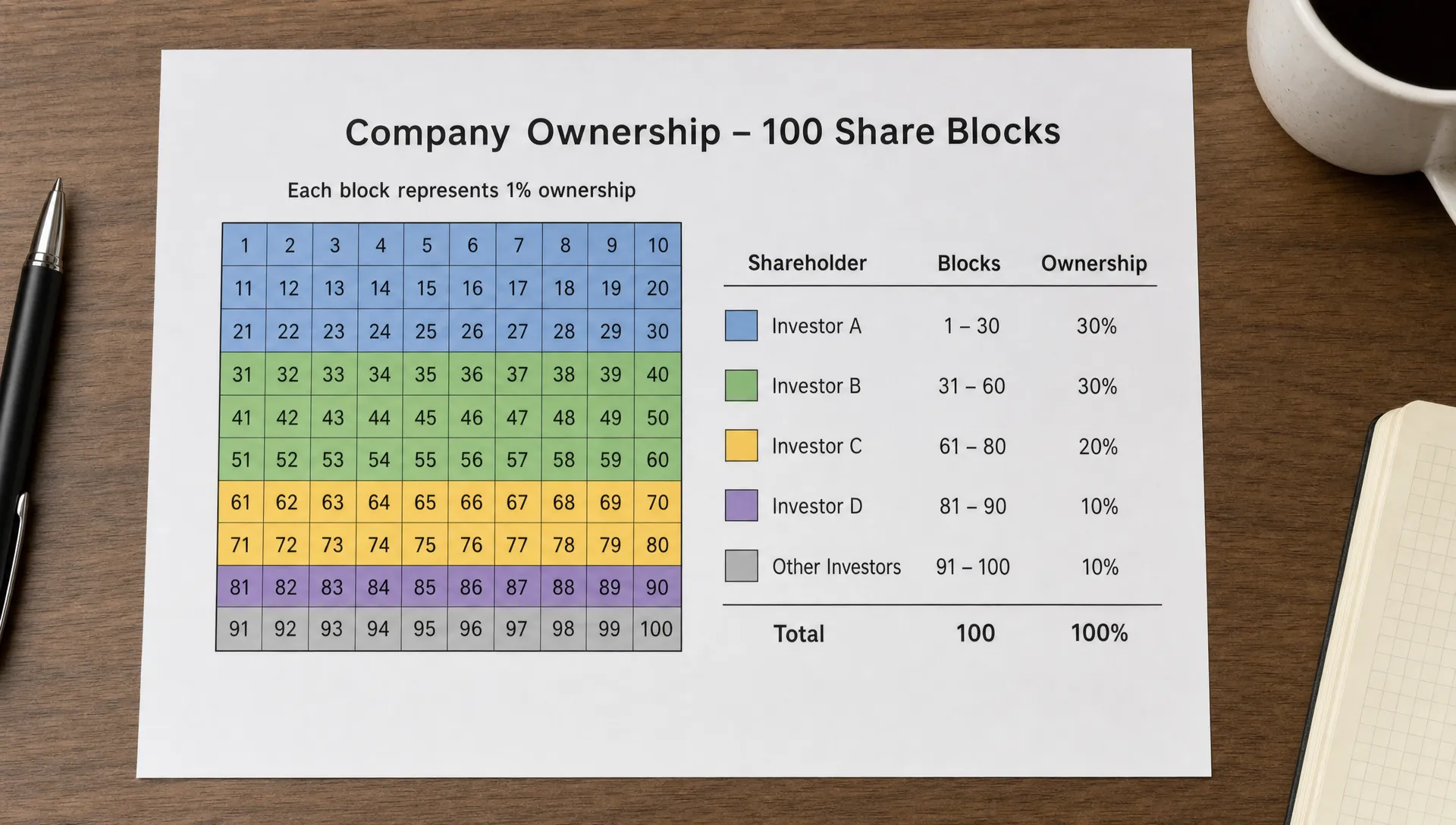
Imagine a small private company with 100 total shares. You buy 10 shares. You now own 10% of the company’s equity.
If the company earns $1,000 and the board pays all earnings as dividends, each share receives $10. Your 10 shares would receive $100. If the company instead reinvests the money to grow, you may not receive cash today, but your shares could become more valuable if the reinvestment succeeds.
Now imagine the company issues 100 new shares to raise capital. There are now 200 total shares. If you still own 10 shares, your ownership percentage drops from 10% to 5%. You own the same number of shares, but a smaller part of the company. That is dilution.
Why your ownership percentage can change
Your ownership percentage is not fixed unless the total share count stays fixed. Public companies can issue shares, repurchase shares, split shares or grant equity compensation to employees. Each action affects the relationship between your shares and the total share count.
| Corporate action | What happens | Effect on your ownership |
|---|---|---|
| New share issuance | The company sells or grants additional shares | Your percentage falls if you do not buy more |
| Share buyback | The company repurchases shares, often retiring them | Your percentage may rise if shares outstanding decline |
| Stock split | Each share is divided into more shares | Your percentage does not change by itself |
| Reverse split | Multiple shares are combined into fewer shares | Your percentage does not change by itself |
| Equity compensation | Options or restricted stock become shares over time | Existing holders can be diluted |
| Convertible securities | Debt or preferred shares convert into common stock | Common shareholders can be diluted |
Dilution is not always bad. A company may issue shares to fund an acquisition, strengthen its balance sheet or invest in growth. The key question is whether the value created is greater than the ownership given up.
Buybacks work the other way when done responsibly. If a company repurchases shares below intrinsic value and retires them, remaining shareholders own a larger percentage of the business. But buybacks can destroy value if a company overpays or uses cash that would have been better spent elsewhere.
Ownership rights can differ by share class
Not every share is identical. Some companies have multiple classes of stock with different voting power. One class might trade publicly with one vote per share, while another class held by founders has 10 votes per share. In that case, economic ownership and voting control are not the same.
Preferred shares are different again. They may have priority over common stock for dividends or liquidation value, but often have limited voting rights. Preferred stock can behave more like a hybrid between equity and debt, depending on its terms.
Before assuming your shares give you a certain level of influence, check the company’s share structure. Two investors can own the same economic percentage but have very different voting power if they hold different classes of stock.
How ownership thinking helps you invest better
Thinking like an owner changes how you evaluate stocks. Instead of asking only whether the price went up today, you start asking whether each share represents a better or worse claim on future cash flows.
Useful ownership questions include:
- Is the share count rising or falling over several years?
- Are insiders buying, selling or holding meaningful stakes?
- Is ownership concentrated among founders, institutions or retail investors?
- Are buybacks reducing shares outstanding or only offsetting stock compensation?
- Does the company have multiple share classes that separate voting control from economic ownership?
These questions help you avoid surface level analysis. A company can report strong revenue growth while issuing so many new shares that each shareholder’s claim grows much more slowly. Another company can grow modestly but steadily increase per share value through disciplined capital allocation.
If you want to go deeper, Upside’s breakdown of stock ownership data every investor should track covers the signals that reveal how ownership is shifting. For a repeatable workflow, you can also learn how to build an ownership profile for any stock before making an investment decision.
Common mistakes investors make about shares
One common mistake is confusing the number of shares owned with the size of the ownership stake. Owning 1,000 shares feels larger than owning 10 shares, but the percentage depends on the total share count.
Another mistake is judging a stock by share price alone. A $5 stock is not automatically cheap and a $500 stock is not automatically expensive. Valuation depends on the company’s market capitalization, earnings, cash flows, growth prospects, balance sheet and risk.
Investors also overlook dilution. If a company constantly issues shares, your piece of the business can shrink even if the stock chart looks active. Watch diluted shares outstanding, not just basic shares outstanding, especially for companies with heavy stock compensation or convertible securities.
Finally, voting rights are often misunderstood. A small shareholder has ownership, but that does not mean control. Influence depends on stake size, voting structure and whether other shareholders support the same governance outcome.
Frequently Asked Questions
Do shares mean I own part of a company? Yes. Shares represent a fractional legal and economic ownership claim in a company, usually through common or preferred stock. You own the shares, not the company’s assets directly.
How do I calculate my ownership percentage? Divide the number of shares you own by the total shares outstanding. If you own 1,000 shares and the company has 10 million shares outstanding, your ownership percentage is 0.01%.
Can my ownership percentage go down even if I keep my shares? Yes. If the company issues new shares and you do not buy more, your ownership percentage declines. This is dilution.
Does a stock split increase my ownership? No. A stock split changes the number of shares and the price per share, but it does not change your percentage ownership by itself.
Do all shares have voting rights? No. Some shares have one vote each, some have multiple votes and some have no voting rights. Always check the company’s share class structure.
See ownership through real investor behavior
Understanding shares is the first step. The next step is seeing how real investors use ownership in actual portfolios.
Upside Invest helps retail investors compare allocations, view verified investor holdings, track trends and learn from anonymous portfolio data. Use it to see what other investors are buying, holding and outperforming with, while keeping your own profile private.