How Tesla Stock Ownership Has Evolved

Tesla stock ownership has never been static. It has moved from a tightly held startup cap table to one of the most watched shareholder bases in public markets, shaped by founder stakes, stock-based compensation, secondary offerings, index funds, retail enthusiasm and Elon Musk’s own share sales. For investors, the evolution matters because ownership affects voting power, dilution risk, supply and demand for shares and the way the market reacts to insider moves.
Tesla is also unusual because its ownership story is tied to its identity. It is not just an automaker in the eyes of shareholders. It sits at the intersection of electric vehicles, batteries, autonomous driving, artificial intelligence, energy storage and high-profile founder leadership. That mix has made its shareholder base more passionate, more polarized and more visible than most large-cap companies.
Why Tesla Stock Ownership Has Changed So Much
At the simplest level, a company’s ownership changes whenever shares are issued, sold, repurchased, exercised through options or transferred between investors. Tesla has experienced nearly every major ownership-changing event a public company can go through: venture financing, an IPO, employee equity grants, large compensation awards, stock splits, index inclusion and major insider transactions.
The important point is that ownership percentage is not the same as share count. A shareholder can own more shares after a split and still own the same percentage of the company. A founder can sell billions of dollars in stock and still remain the largest individual holder. A passive fund can become a top shareholder not because it made an active bet, but because the company entered a major index.
For Tesla, those distinctions are essential. The company’s public float expanded as it matured, but its voting and narrative influence remained heavily shaped by a small number of visible holders, especially Musk. Tesla stock ownership became less about a single founder cap table and more about the balance between insiders, institutions, index funds and individual investors.
From Private Startup to IPO
Tesla was founded in 2003 by Martin Eberhard and Marc Tarpenning. Elon Musk joined as a major early investor after leading the Series A financing in 2004 and later became the company’s most visible executive. In the private years, ownership was concentrated among founders, early employees, venture investors and strategic backers.
That pattern is typical for young growth companies. Before public markets enter the picture, ownership is usually narrow and illiquid. Early shareholders carry high risk because the company may never reach scale, but they also receive the greatest upside if it does.
Tesla’s June 2010 IPO changed the ownership structure permanently. Public investors could buy shares, employees had a clearer path to liquidity and the company had access to a broader capital base. Insiders still mattered enormously, but Tesla stock ownership was no longer limited to early private-market participants.
| Era | Ownership shift | Investor takeaway |
|---|---|---|
| 2003 to 2009 | Founders, early executives and private investors held most shares | Control was concentrated and liquidity was limited |
| 2010 IPO | Public investors entered the cap table | Tesla gained broader access to capital and market pricing |
| 2013 to 2019 | More shares, employee equity and compensation awards expanded the base | Dilution and incentive alignment became key issues |
| 2020 to 2022 | Stock splits, retail demand and S&P 500 inclusion changed the shareholder mix | Passive funds and individual investors became more prominent |
| 2023 onward | Tesla traded as a mega-cap with intense focus on insider moves | Ownership analysis became a governance and sentiment tool |
The Founder Stake Became a Moving Target
Elon Musk’s ownership is the most scrutinized part of Tesla’s shareholder base. Early in the company’s public life, Musk had a very large founder-style stake. Over time, that position changed through a combination of dilution, option grants, option exercises, pledged shares, tax-related sales and later sales connected to broader personal financing needs.
This is why investors should separate three ideas: shares owned outright, options that may become shares and beneficial ownership reported under SEC rules. Those numbers can differ materially. SEC beneficial ownership often includes shares that a person has the right to acquire within a defined window, which can make an insider’s reported ownership look different from a simple count of shares held directly.
Tesla’s 2018 CEO compensation plan added another layer. The award was tied to market capitalization and operating milestones, making it one of the most debated executive pay packages in U.S. corporate history. Later legal disputes and shareholder votes kept attention on how much potential ownership Musk could control through options. Tesla stock ownership, in this context, is not just a question of who owns today’s shares, but who may receive or exercise equity in the future.
Stock Splits Changed the Share Count, Not the Economic Pie
Tesla completed a 5-for-1 stock split in 2020 and a 3-for-1 split in 2022. Splits can make shares feel more accessible because the price per share falls mechanically, but they do not increase a shareholder’s ownership percentage by themselves.
If an investor owned 10 shares before a 5-for-1 split, they owned 50 shares after it. The company was not five times cheaper in economic terms, and the investor did not own five times more of the company. Their slice of the pie stayed the same, assuming no other share issuance or sale occurred.
The behavioral effect can still be meaningful. Lower nominal share prices can attract smaller investors, options traders and more active retail participation. In Tesla’s case, splits occurred during a period when the company was already receiving extraordinary attention from individual investors. That helped make Tesla stock ownership a mainstream topic, not just a line item in institutional research reports.
S&P 500 Inclusion Brought a New Ownership Force
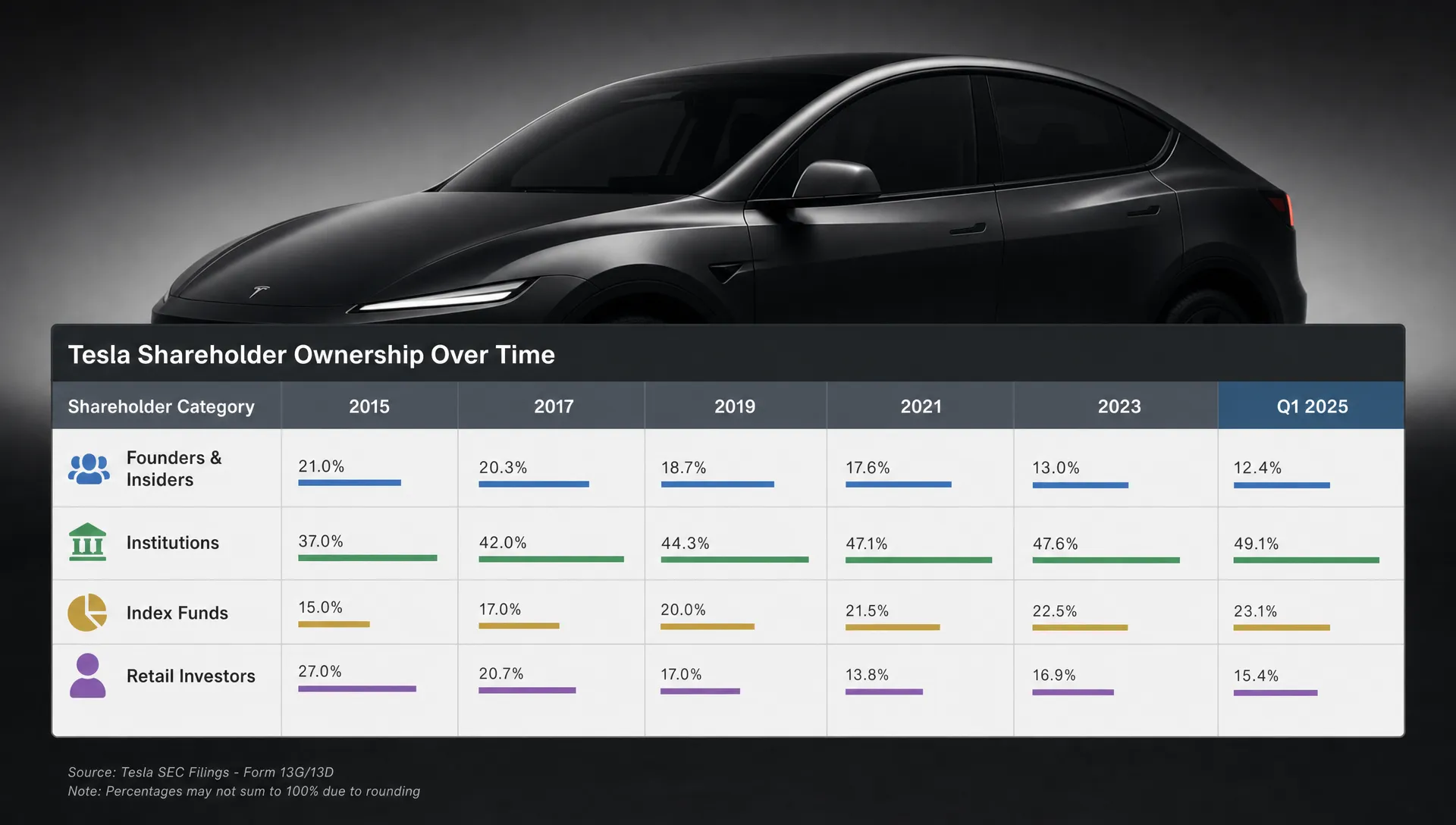
Tesla joined the S&P 500 in December 2020. That event mattered because index funds and exchange-traded funds tracking the index needed exposure to Tesla. When a company joins a major benchmark, passive ownership can rise sharply even if no portfolio manager has formed a unique view on the business.
This shift helped institutional ownership grow in a different way. Some institutions owned Tesla because analysts and portfolio managers wanted exposure to EV growth. Others owned it because their funds were designed to replicate an index. Vanguard, BlackRock and State Street have often appeared among Tesla’s largest institutional holders largely because they manage enormous index and ETF assets.
This creates a useful lesson for investors. Institutional ownership is not always a signal of conviction. A large passive position can reflect fund structure, not an active buy thesis. To interpret Tesla stock ownership correctly, investors need to distinguish active managers, passive index funds, insiders, hedge funds and retail holders.
Retail Investors Became Part of the Tesla Story
Tesla’s retail base has long been unusually engaged. Many individual investors did not view the stock only as a claim on future cash flows. They saw it as exposure to electric vehicles, clean energy, autonomy, robotics and a founder-led technology platform. That belief system helped create strong holding behavior among some shareholders, even during sharp drawdowns.
Retail ownership is harder to measure than insider or institutional ownership because many shares are held in brokerage accounts under street name. Public filings do not give a perfect real-time map of individual investor positions. That is one reason community-level portfolio data can add context when it is verified and privacy-preserving.
Upside Invest was built around that idea: seeing what verified investors are buying and holding without exposing private identities. For a stock like Tesla, comparing anonymous portfolio allocations can help investors understand whether they are unusually concentrated, underexposed or simply following a broader crowd. It does not replace fundamental analysis, but it adds a layer that traditional ownership filings often miss.
Ownership Also Reflects Tesla’s Capital Allocation Choices
Tesla has repeatedly used equity as a strategic tool. It raised capital when growth opportunities were large, paid employees and executives partly in stock and benefited from a high market valuation that made equity financing less expensive than it might have been for a weaker company.
Capital allocation is not unique to Tesla. Every company decides what to build internally, what to outsource and how much equity or debt to use while growing. A consumer brand, for example, might choose a specialized custom sportswear manufacturer rather than owning factories, while Tesla has often leaned into vertical integration across vehicles, batteries, software and charging infrastructure. For shareholders, the question is whether those choices improve long-term returns per share.
That is why dilution analysis matters. Issuing shares can be positive if the capital raised produces high returns. It can be negative if new shares fund weak projects or excessive compensation. Tesla stock ownership has evolved alongside those tradeoffs, making share count and incentive structure worth tracking over time.
How to Read Tesla Ownership Today
A good ownership review starts with public filings. The proxy statement shows directors, executives and large beneficial owners. Form 4 filings show insider purchases and sales. Form 13F filings show many institutional holdings, though they arrive with a delay and do not show every position type. The annual report and quarterly filings help investors track shares outstanding and potential dilution.
If you want a repeatable process, Upside’s guide on how to build an ownership profile for any stock is a useful framework. For Tesla specifically, investors should look at both current ownership and the direction of change.
The most useful questions are straightforward:
- Are insiders buying, selling or mostly holding?
- Is institutional ownership rising because of active demand or passive index flows?
- Are options and equity awards increasing the fully diluted share count?
- Are retail investors becoming more concentrated or less exposed?
- Are large holders changing positions before or after major business developments?
For filing research, it also helps to know where each signal appears. Insider transactions do not show up in the same filing as institutional portfolio updates. If you are new to that workflow, start with Upside’s explanation of finding stock ownership changes in SEC filings.
What Ownership Changes Can Signal
Ownership changes are not automatic buy or sell signals. Musk selling shares may affect sentiment, but the reason for the sale matters. A passive fund adding shares may look bullish, but it could simply reflect index mechanics. A hedge fund reducing a position may reflect risk management rather than a negative view of Tesla’s future.
Still, ownership shifts can reveal pressure points. Heavy insider selling can weaken confidence if it appears disconnected from taxes or diversification. Rising short interest can indicate skepticism, though it can also set up volatility if sentiment turns. Increasing passive ownership can reduce the percentage of shares actively traded by fundamental investors, which may change how the stock reacts to news.
Tesla stock ownership is especially important because the company’s valuation often depends on expectations far beyond current vehicle sales. Investors debate autonomy, software margins, energy storage growth, robotaxis and robotics. When a stock prices in ambitious future outcomes, who owns it and how strongly they hold can influence volatility.
What Everyday Investors Should Take From Tesla’s Ownership History
The biggest lesson is that ownership is dynamic. A shareholder base can shift from founders to growth investors, then to institutions and index funds, without the company’s brand identity changing overnight. Tesla’s evolution shows how ownership can mature even when the stock remains emotionally charged.
For everyday investors, the practical takeaway is to watch ownership together with fundamentals. Share count, insider transactions, institutional concentration, index flows and retail positioning all add context. None should be read alone.
It is also worth tracking your own exposure. Tesla can become a large portfolio position quickly because of price swings. If you own Tesla directly and also hold broad index funds, growth funds or thematic ETFs, your true exposure may be larger than it looks. Upside’s guide to stock ownership data every investor should track can help you think through those layers.
Frequently Asked Questions
Who owns the most Tesla stock? Elon Musk has historically been the most important individual Tesla shareholder, while large asset managers such as Vanguard, BlackRock and State Street have often appeared among the largest institutional holders because of index and ETF exposure. Always check the latest proxy and 13F filings for current figures.
Did Tesla stock splits change investor ownership percentages? No. Tesla’s 2020 and 2022 stock splits increased the number of shares each holder owned, but they did not change each investor’s percentage ownership by themselves.
Why does Elon Musk’s Tesla ownership look different across sources? Sources may use different definitions. Some count only shares held directly, while SEC beneficial ownership can include exercisable options and other rights to acquire shares.
Is institutional ownership always bullish for Tesla? Not necessarily. Some institutional ownership reflects active conviction, but a large portion can come from index funds that must hold Tesla because it is part of a benchmark.
How can retail investors track Tesla ownership changes? Retail investors can monitor proxy statements, Form 4 insider filings, 13F institutional filings, shares outstanding and verified portfolio data from platforms that aggregate investor holdings privately.
The Bottom Line
Tesla’s ownership history mirrors its transformation from venture-backed startup to global mega-cap. Early control was concentrated, the IPO opened the cap table, stock-based compensation and capital raises changed the share base, index inclusion brought passive giants and retail investors became a defining part of the story.
For investors, the key is not to memorize a single ownership percentage. It is to understand the forces moving that percentage over time. With a platform like Upside Invest, you can compare your portfolio against verified investor behavior, track positioning trends and make ownership analysis part of a broader investment process.