Leveraged ESOP Risks That Can Change Company Value

Leveraged ESOPs are often sold as elegant succession tools. A founder gets liquidity, employees gain ownership and the company keeps its independence. That can be true. But a leveraged ESOP is also a debt-financed transaction, and debt can change what a company is worth long after the closing dinner is over.
For employees, the risk is that account statements can feel like retirement wealth even when the business is still absorbing the cost of the transaction. For investors, lenders or anyone assessing an employee-owned company, the key question is not whether an ESOP is good or bad. It is whether the company can support the leverage, fund future share repurchases and still reinvest enough to protect enterprise value.
If you want the broader foundation first, Upside Invest has a separate guide that explains ESOP structures for investors and employees. This article focuses on the specific risks created when an ESOP is leveraged.
What a leveraged ESOP actually changes
The IRS describes an ESOP as a qualified defined contribution plan designed to invest primarily in employer stock. In a non-leveraged ESOP, the company usually contributes cash or shares over time. In a leveraged ESOP, the ESOP trust borrows money to buy shares, often from a selling shareholder, a bank or both. The company then makes contributions to the ESOP so the trust can repay the loan.
That structure matters because the employees do not simply receive stock on day one. Shares are typically released to participant accounts as the ESOP loan is repaid. Economically, the company has exchanged part of its equity ownership for a financing obligation that must be serviced with future cash flow.
| Feature | Non-leveraged ESOP | Leveraged ESOP |
|---|---|---|
| How shares are acquired | Company contributes shares or cash over time | ESOP trust borrows to buy shares upfront |
| Main financial pressure | Ongoing contribution cost | Debt service plus ongoing contribution cost |
| Value sensitivity | Driven mostly by business performance and appraisal assumptions | Driven by business performance, appraisal assumptions, leverage and refinancing risk |
| Employee allocation | Often gradual through annual contributions | Shares are released as the ESOP loan is repaid |
| Key risk to monitor | Dilution and annual valuation | Debt capacity, repayment schedule and repurchase obligations |
At closing, the company may look broadly similar from an operating perspective. The customers, employees, factories, contracts and brand have not necessarily changed. But the capital structure has changed. That means equity value, financial flexibility and risk can change immediately.
Why leveraged ESOP risk is really value risk
A company is worth the present value of the cash it can generate for its capital providers. A leveraged ESOP affects both sides of that equation. It changes cash flow because debt service competes with wages, capital spending, acquisitions, technology investment and working capital. It changes risk because fixed obligations make bad years more painful.
This is why a leveraged ESOP should be analyzed like any other leveraged buyout, with one added complication: the buyer is a retirement plan for employees. If the purchase price is too high or the balance sheet is too tight, employees may carry risk without having direct control over the transaction terms.
Leverage does not automatically destroy value. In a stable company with conservative debt, strong margins and disciplined governance, an ESOP can support continuity and employee alignment. The danger appears when the transaction assumes near-perfect execution. A small miss in revenue, margin, interest expense or repurchase timing can quickly reduce equity value.
Leveraged ESOP risks that can move company value
1. Paying too much for the shares
The most obvious value risk is overpayment. Private ESOP shares do not trade on an exchange, so the transaction price depends on an appraisal, negotiated terms and fiduciary oversight. If the ESOP pays more than the business is economically worth, the company begins its employee-ownership era with value already transferred away from the future employee owners.
The Department of Labor has treated ESOP valuation and fiduciary process as serious enforcement topics because the plan is buying stock on behalf of retirement plan participants. For investors, this means the appraisal is not just a compliance document. It is one of the most important economic inputs in the transaction.
Red flags include aggressive EBITDA add-backs, a valuation multiple above relevant private-company comparables, optimistic margin expansion assumptions or a sale price that depends heavily on future tax benefits rather than operating strength. A fair ESOP price should still make sense if the company grows more slowly than planned.
2. Debt service that crowds out reinvestment
Debt can sharpen capital discipline, but it can also starve a company. A leveraged ESOP requires the company to generate enough cash to fund contributions to the ESOP, which are then used to repay the loan. If the loan is large, management may have less room to invest in equipment, hiring, marketing, cybersecurity, product development or acquisitions.
This matters for valuation because underinvestment may not show up immediately. A company can boost near-term cash flow by delaying maintenance or cutting growth spending, but the damage appears later through weaker margins, lost customers or lower competitive positioning. Investors should ask whether the company is paying down ESOP debt from true excess cash flow or from deferred reinvestment.
Interest-rate exposure also matters. A fixed-rate seller note may be manageable in a stable business. Floating-rate bank debt can become more expensive if rates rise. If the company must refinance during a downturn, the ESOP structure can magnify liquidity pressure.
3. Repurchase obligations that arrive after the deal
In private ESOP companies, employees eventually need a way to turn vested shares into cash. Under Internal Revenue Code Section 409(h), private company ESOP participants generally must have a put option or the plan must distribute cash because there is no public market for the employer stock.
This creates a repurchase obligation. When employees retire, leave or diversify, the company or plan may need to buy back shares. A young workforce may make this obligation feel distant. An aging workforce can make it immediate.
Repurchase obligations can change company value in two ways. First, they create a future cash drain that competes with growth investment and debt repayment. Second, they can make the capital structure more complex because the company may need to borrow again to fund departing participants. A leveraged ESOP that looks affordable in year one can become strained in year five if debt amortization overlaps with a wave of retirements.
4. Appraisal lag and the account balance illusion
Most private ESOP participants see value through periodic plan statements. Those statements are based on appraisals, not daily market prices. That can be helpful because employees are not whipsawed by public-market volatility every day, but it can also create false comfort.
If the business weakens, the appraisal may not fully reflect the deterioration until the next valuation cycle. If the company uses optimistic projections, the account value may look stronger than the cash flow reality. Employees may mentally treat the balance as liquid retirement wealth even though the value depends on a private company, a repurchase process and future corporate cash.
Upside Invest covers the statement-versus-economic-value problem in more detail in its guide on how to value ESOP shares before they turn into a risk. In a leveraged ESOP, that distinction becomes even more important because the value of the shares is tied to a balance sheet that may still be carrying transaction debt.
5. Governance risk when ownership and control diverge
Employee ownership does not always mean employee control. In many ESOPs, the trust owns the shares and a trustee votes them, with employees receiving voting rights only in certain situations. Management may remain largely unchanged after the transaction, and selling shareholders may still influence the business through board seats, seller notes or operating roles.
That separation can work if governance is strong. It can create value risk if insiders control the narrative, select overly favorable projections or prioritize seller liquidity over long-term company health. Investors should look for independent trustees, qualified valuation advisers, a capable board and clear conflict-management procedures.
A leveraged ESOP also creates a cultural challenge. Employees may be told they are owners, but if they have little transparency into debt, repurchase obligations and capital allocation, ownership can feel symbolic. When expectations get ahead of economics, morale can become another business risk.
6. Cyclicality, customer concentration and margin shocks
Leverage is less forgiving in cyclical businesses. A company with recurring revenue, diversified customers and stable margins can handle more debt than a company tied to construction cycles, commodity prices or a few major accounts. The same ESOP leverage ratio can be conservative in one industry and dangerous in another.
Customer concentration deserves special attention. If 30 percent of revenue depends on one customer, the ESOP valuation should include a realistic discount or stress case. A single lost contract can reduce EBITDA, trigger covenant problems and force the company to choose between debt service, repurchase obligations and operating investment.
Margin shocks work the same way. Higher labor costs, input inflation or pricing pressure can reduce cash flow even when revenue is flat. Since ESOP debt payments are fixed, operating volatility flows directly into equity value.
7. Employee wealth concentration
For employees, the leveraged ESOP risk is not only company-level valuation. It is personal balance-sheet concentration. A worker may depend on the same company for wages, health benefits, career growth and retirement wealth. If the business struggles, job security and ESOP value can decline at the same time.
This does not mean employees should ignore the upside of ownership. ESOPs can create meaningful wealth when the company performs well and the plan is managed conservatively. But employees should avoid treating ESOP shares as a substitute for a diversified portfolio. A private employer-stock position should be viewed as one part of a broader financial picture, not the entire plan.
How these risks show up in valuation
The risks above are not abstract. They change valuation through specific mechanics that investors can test.
| Risk | How it can affect company value | Due-diligence question |
|---|---|---|
| Overpayment | Transfers value from future employee owners to sellers at closing | Does the purchase price still make sense under conservative growth and margin assumptions? |
| High leverage | Reduces equity value and increases downside sensitivity | What is debt to EBITDA after the transaction and after normalizing earnings? |
| Debt service | Lowers cash available for reinvestment | Can the company fund maintenance capex, growth spending and debt payments in the same year? |
| Repurchase obligations | Creates future liquidity needs | Has management completed a repurchase obligation study with realistic retirement and turnover assumptions? |
| Appraisal lag | Delays recognition of deteriorating economics | Do plan statements align with current operating performance and cash generation? |
| Weak governance | Increases risk of conflicted decisions | Who selected the trustee and valuation adviser, and how independent are they? |
| Cyclicality | Makes fixed debt harder to support in downturns | What happens to covenant compliance if EBITDA falls 20 percent? |
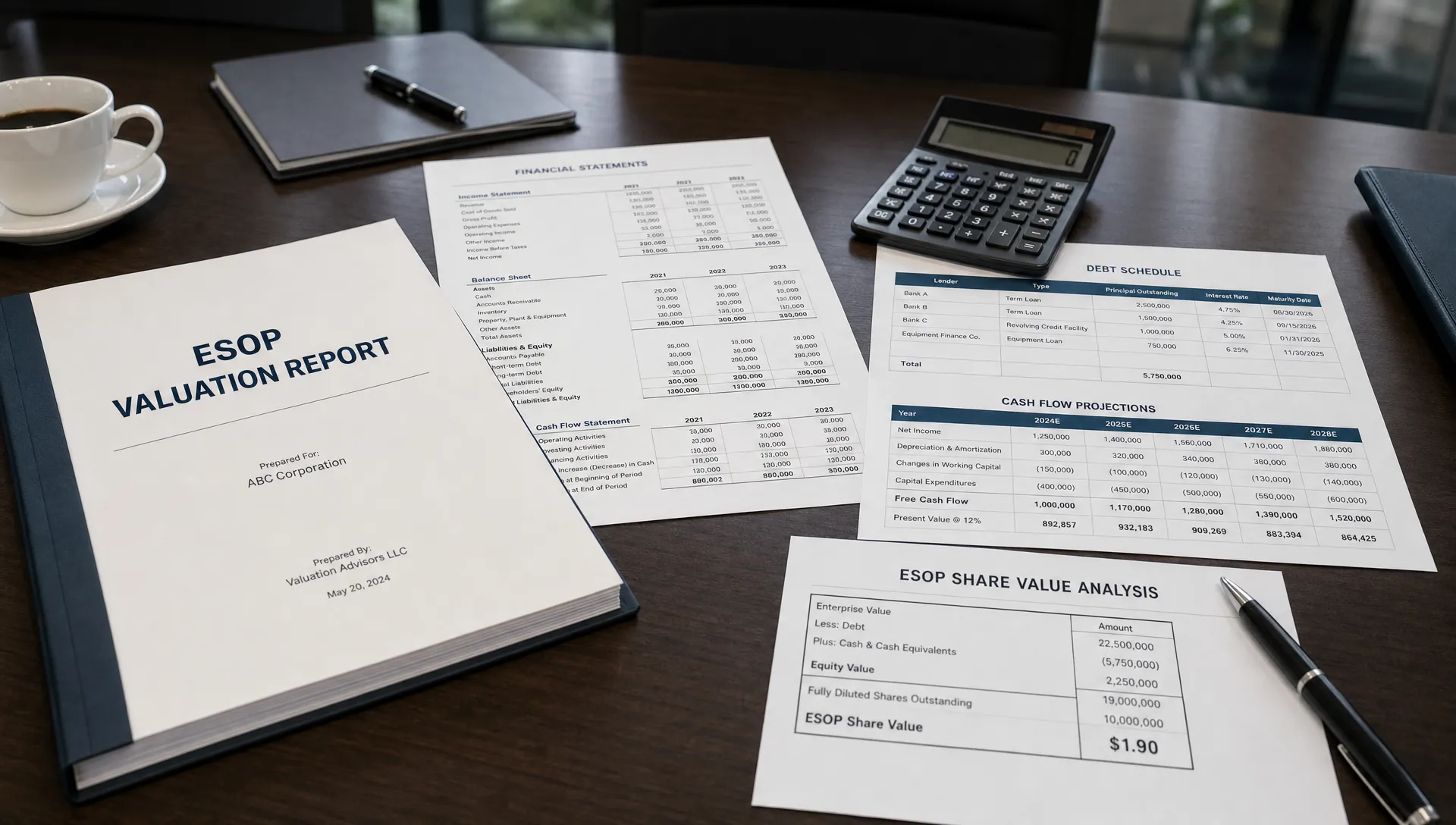
The practical exercise is to move from headline share value to cash-flow-tested value. Start with enterprise value based on normalized earnings. Subtract net debt, including seller notes and ESOP-related borrowing. Then model cash required for debt service, repurchase obligations, taxes, maintenance investment and working capital. What remains is the cash that can support growth and future equity value.
For a broader framework, Upside Invest has a due-diligence guide on how to analyze ESOP companies before investing. The same framework applies here, but the leverage assumptions deserve extra attention.
Good due diligence is not about collecting the thickest file. It is about ranking evidence by reliability. That discipline applies outside investing too. Research-backed consumer resources such as The Menopause Kit organize decisions around sourced evidence, transparency and practical tradeoffs in a different domain. Investors should bring that same standard to ESOP materials by asking where the assumptions come from, who benefits from them and how they hold up under stress.
A simple stress test for a leveraged ESOP
Consider a hypothetical private company with $10 million of normalized EBITDA. It completes a leveraged ESOP and now has $4 million of annual debt service, $2 million of maintenance capital spending and an expected $1 million annual repurchase obligation.
| Scenario | EBITDA | Debt service | Maintenance capex | Repurchase need | Cash left before growth initiatives |
|---|---|---|---|---|---|
| Base case | $10 million | $4 million | $2 million | $1 million | $3 million |
| Downside case | $8 million | $4 million | $2 million | $1 million | $1 million |
| Stress case | $7 million | $4 million | $2 million | $1 million | $0 |
This table is simplified and excludes taxes, working capital and one-time costs. That is exactly the point. Even before adding those real-world items, a 20 percent to 30 percent EBITDA decline can erase most flexibility. If the appraisal assumes steady growth but the downside case leaves little cash for growth investment, the valuation may be too optimistic.
Investors should also test timing. Debt service may peak in the early years, while repurchase obligations may rise later. A valuation that models each burden separately can miss the year when they overlap.
When a leveraged ESOP can still create value
A leveraged ESOP is not automatically a warning sign. It can be a strong structure when the business has durable cash flow, the purchase price is fair and the post-transaction balance sheet remains flexible. Some companies use ESOPs to preserve independence, deepen employee engagement and avoid a sale to a competitor or private equity buyer.
The strongest cases usually share several traits: conservative leverage, recurring revenue, diversified customers, honest appraisal assumptions, independent governance and a management team that treats employee ownership as an operating system rather than a tax strategy. A credible repurchase obligation study is also essential.
Tax advantages can help, especially in certain S corporation ESOP structures where the ESOP trust is a tax-exempt shareholder. But tax benefits should never be the core investment thesis. A company still needs cash to serve customers, pay employees, invest in assets, manage downturns and eventually provide liquidity to participants.
What investors and employees should review
Before trusting leveraged ESOP value, ask for the documents and explanations that connect ownership to economics. The most useful materials often include the valuation report summary, debt schedule, seller note terms, board or trustee process description, repurchase obligation study, historical financial statements and management projections.
A few questions can reveal a lot. How much of the purchase price was debt-financed? What assumptions drove the valuation multiple? When does principal amortization peak? Are interest rates fixed or floating? How much cash will be needed for participant repurchases over the next 5 to 10 years? Has the company maintained normal capital spending since the ESOP transaction? What happens if EBITDA falls by 20 percent?
Employees should also ask how much of their total retirement wealth is tied to employer stock and when diversification rights apply. Investors should compare the company against peers with similar leverage, margins and cyclicality rather than assuming employee ownership deserves a premium.
Frequently Asked Questions
What is the biggest leveraged ESOP risk? The biggest risk is usually overleveraging the company at an optimistic valuation. If the ESOP pays too much or takes on too much debt, future cash flow may be used to repair the balance sheet instead of growing the business.
Does a leveraged ESOP always reduce company value? No. A leveraged ESOP can preserve continuity and align employees with long-term performance. It becomes a value problem when debt service, repurchase obligations or weak governance reduce financial flexibility.
How does ESOP debt affect share value? ESOP debt reduces equity value because debt holders have a claim on company cash flow before shareholders. If the company grows and pays down debt, equity value can rise. If earnings fall, leverage can magnify the decline in share value.
Why are repurchase obligations important? Private ESOP shares are not freely traded, so departing or retiring employees need liquidity. The company or plan may have to buy back shares, which can create a major future cash obligation.
What should employees do if most of their retirement value is in an ESOP? Employees should understand vesting, diversification rights, distribution timing and the company’s financial condition. They should also consider how ESOP exposure fits with the rest of their savings and investments.
Put leveraged ESOP exposure in portfolio context
A leveraged ESOP can be a valuable ownership opportunity, but it should be evaluated with the same discipline as any concentrated investment. Debt, valuation, governance and liquidity all matter.
With Upside Invest, retail investors can compare allocations with verified investors, benchmark portfolio exposure and spot how others are positioning across stocks, funds and crypto while keeping profiles private. If an ESOP stake is a meaningful part of your financial life, the next step is to understand how much risk you already carry and whether the rest of your portfolio balances it.