Ownership of Shares in a Company Explained Simply
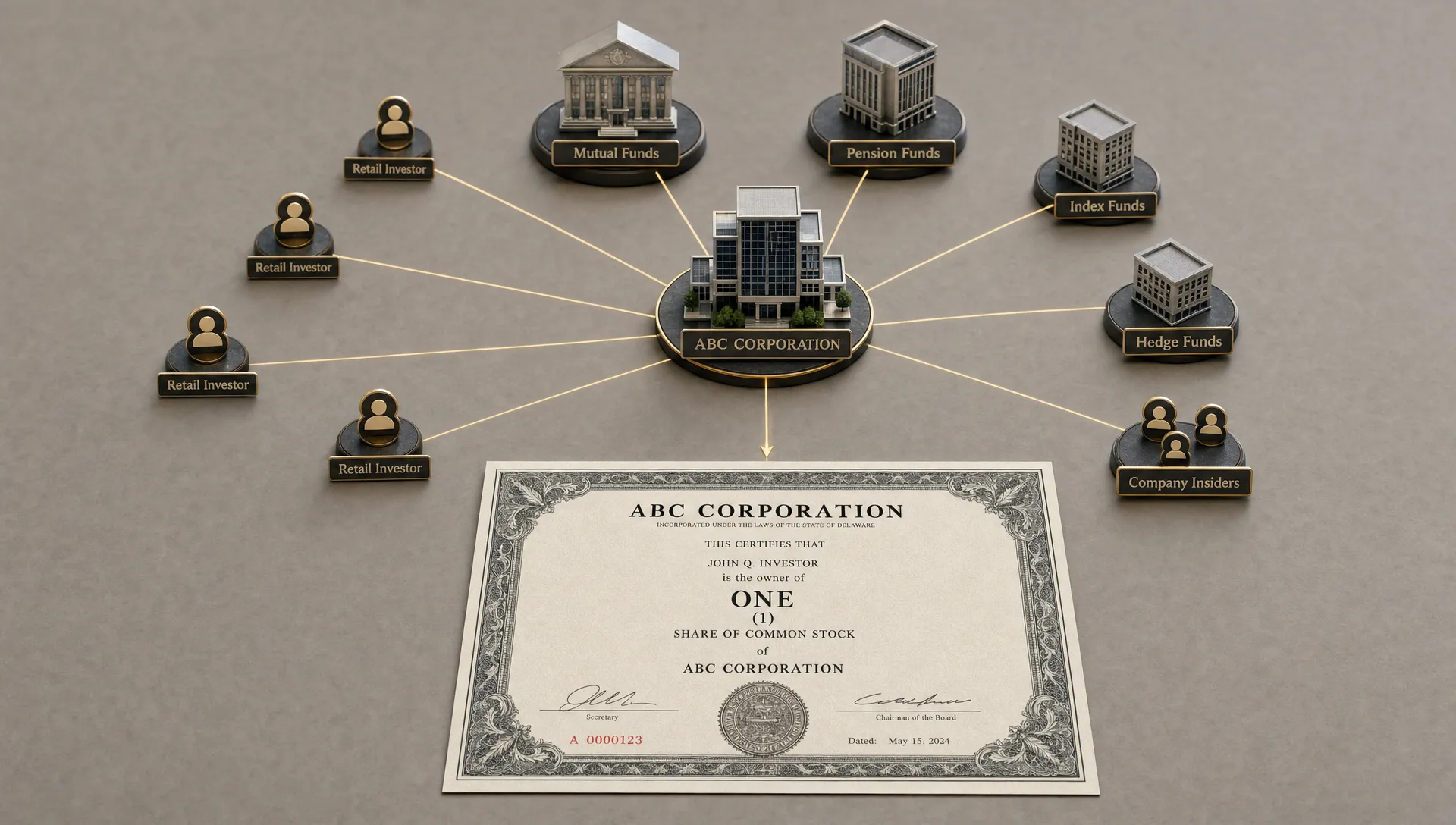
Buying a share is often described as “owning a piece of a company.” That is true, but it can also be misleading if you picture yourself owning a desk, a factory, or a slice of the company’s bank account.
In practical terms, ownership of shares in a company means you own an equity interest in that company. Your share represents a small claim on the company’s future profits, voting power in certain decisions, and potential economic benefits if the business grows or returns cash to shareholders.
For everyday investors, the key is not just knowing that a share represents ownership. It is understanding what that ownership gives you, what it does not give you, and how it should influence the way you evaluate an investment.
What does ownership of shares in a company actually mean?
A company can be divided into units of ownership called shares. When you buy one or more shares, you become a shareholder. If the company is publicly traded, those shares can usually be bought and sold through a brokerage account.
The simplest way to think about it is this:
Your ownership percentage = your shares owned ÷ total shares outstanding
If a company has 100 million shares outstanding and you own 100 shares, you own 0.0001% of the company. That may sound tiny, and it is. But you still participate in the same basic ownership structure as larger investors, just at a smaller scale.
This matters because stock investing is not just betting on a ticker symbol moving up or down. You are buying a financial stake in a real business. Over time, your results are tied to how that business performs, how much investors are willing to pay for its future, and how management treats shareholders.
If you are still learning the vocabulary, this beginner-friendly guide to shares explained in plain English is a useful companion before going deeper into ownership mechanics.
What do shareholders usually get?
Share ownership can come with several rights and benefits, though the exact details depend on the company, the share class, and the country where the company is incorporated.
For most retail investors who buy common stock in public companies, the main shareholder benefits are economic participation, potential voting rights, and access to company information.
| Shareholder feature | What it means in plain English | Why it matters |
|---|---|---|
| Economic ownership | You may benefit if the company becomes more valuable | This is the main reason most people invest in stocks |
| Dividends | Some companies distribute cash to shareholders | Dividends can provide income, but they are not guaranteed |
| Voting rights | Common shareholders may vote on certain corporate matters | Voting can influence board elections and major decisions |
| Residual claim | Shareholders have a claim after debts and obligations are paid | This explains both the upside and the risk of stock ownership |
| Transferability | Public shares can usually be sold through the market | Liquidity makes public stocks easier to enter and exit |
These rights are important, but they are not unlimited. Owning shares does not mean you can walk into headquarters and make business decisions. Day-to-day control belongs to management, while strategic oversight usually belongs to the board of directors.
What you do not own when you buy shares
A common beginner mistake is assuming that share ownership gives direct ownership over company assets. It does not work that way.
If you buy shares of an airline, you do not own a specific seat on a plane. If you buy shares of a retailer, you do not own a shelf in one of its stores. The company owns those assets. You own shares issued by the company.
This distinction matters because companies also have liabilities. They may owe money to lenders, suppliers, employees, tax authorities, and bondholders. Shareholders sit behind those claims. If a company fails and goes through liquidation, shareholders are generally paid only after creditors have been satisfied, and in many bankruptcies common shareholders receive little or nothing.
That is why stocks have higher long-term return potential than many lower-risk assets, but also higher risk. As a shareholder, you participate in the upside of business success, but you are also exposed to the downside if the company disappoints.
Common stock vs preferred stock
Most investors are familiar with common stock. It is the standard type of share traded on major exchanges and the type most often discussed when people talk about buying stocks.
Preferred stock is different. It often behaves more like a hybrid between stock and debt. Preferred shareholders may receive fixed dividends and may have priority over common shareholders for certain payments, but they usually have less upside if the company grows dramatically. They may also have limited or no voting rights.
For beginners, common stock is usually the main focus because it is what most public-company shareholders own. Still, knowing that different share classes exist helps you avoid assuming all shares are equal.
Some companies also issue multiple classes of common stock. One class may have one vote per share, while another may have ten votes per share or no votes at all. This is especially common among founder-led technology companies that want public capital while allowing insiders to retain control.
How share ownership connects to voting power
Voting rights are one of the clearest signs that shareholders are owners, but voting power is not always proportional in the way beginners expect.
If a company has one class of common shares with one vote per share, your voting power generally matches your ownership percentage. If you own 1% of the shares, you control roughly 1% of the vote.
But if the company has multiple share classes, insiders may control a much larger percentage of the vote than their economic ownership suggests. For example, founders could own a minority of the total economic interest while still controlling a majority of voting power through high-vote shares.
This is not automatically good or bad. Concentrated voting power can allow long-term leaders to avoid short-term market pressure. It can also reduce accountability if outside shareholders disagree with management decisions.
Before buying a stock, investors should understand whether they are getting both economic exposure and meaningful voting power, or mostly economic exposure.
How shareholders make money
Shareholders generally make money in two main ways: capital gains and dividends.
A capital gain happens when you sell a share for more than you paid. If you buy a stock at $50 and sell it at $75, your gain is $25 per share before taxes and fees. Capital gains depend on both business performance and market expectations. A company can grow profits while its stock falls if investors expected even better results.
Dividends are cash payments that some companies make to shareholders. Mature, profitable businesses are more likely to pay dividends, while younger growth companies often reinvest cash into expansion. Dividends can be attractive, but they are never guaranteed. A company can reduce or suspend its dividend if conditions change.
There is also a third, less obvious way shareholders can benefit: share repurchases. When a company buys back its own shares, the total number of shares outstanding may decline. If profits stay the same or grow, each remaining share can represent a larger claim on earnings. Buybacks are not always good, especially if a company overpays for its own stock, but they can increase per-share value when done responsibly.
Why share count matters more than the number of shares you own
Owning 1,000 shares is not automatically better than owning 10 shares. What matters is the percentage of the company those shares represent and the value of the business behind them.
A company with a $10 stock is not necessarily cheaper than a company with a $500 stock. The stock price alone tells you very little. You need to compare the price to earnings, cash flow, assets, growth, debt, and the number of shares outstanding.
Market capitalization is a helpful starting point:
Market capitalization = share price × shares outstanding
If a company has 1 billion shares outstanding and trades at $20, its market capitalization is $20 billion. That gives you a rough estimate of what the market thinks the company’s equity is worth.
This is why stock splits do not make a company fundamentally cheaper. If a company splits each share into two, shareholders own twice as many shares, but each share represents half the previous ownership claim. Your total percentage ownership remains the same.
For a deeper look at ownership percentage, dilution, and how share count affects everyday investors, Upside has a related guide on what share of ownership means for everyday investors.
Dilution: when your ownership percentage shrinks
Dilution happens when a company issues new shares, reducing the ownership percentage of existing shareholders.
This is not always bad. If a company issues shares to fund a valuable acquisition, raise growth capital, or compensate employees in a way that creates long-term value, dilution may be worthwhile. But if a company repeatedly issues shares just to cover losses or survive, existing shareholders may see their claim on future profits shrink.
Imagine a company has 100 million shares outstanding and earns $100 million. That is $1 of earnings per share. If the company later has 200 million shares outstanding and still earns $100 million, earnings per share fall to $0.50. The business earns the same total profit, but each share now represents a smaller claim.
Investors should pay attention to diluted share count, not just the basic share count. Diluted share count includes the potential impact of stock options, restricted stock units, convertible securities, and other instruments that could become shares.
What ownership data can tell you
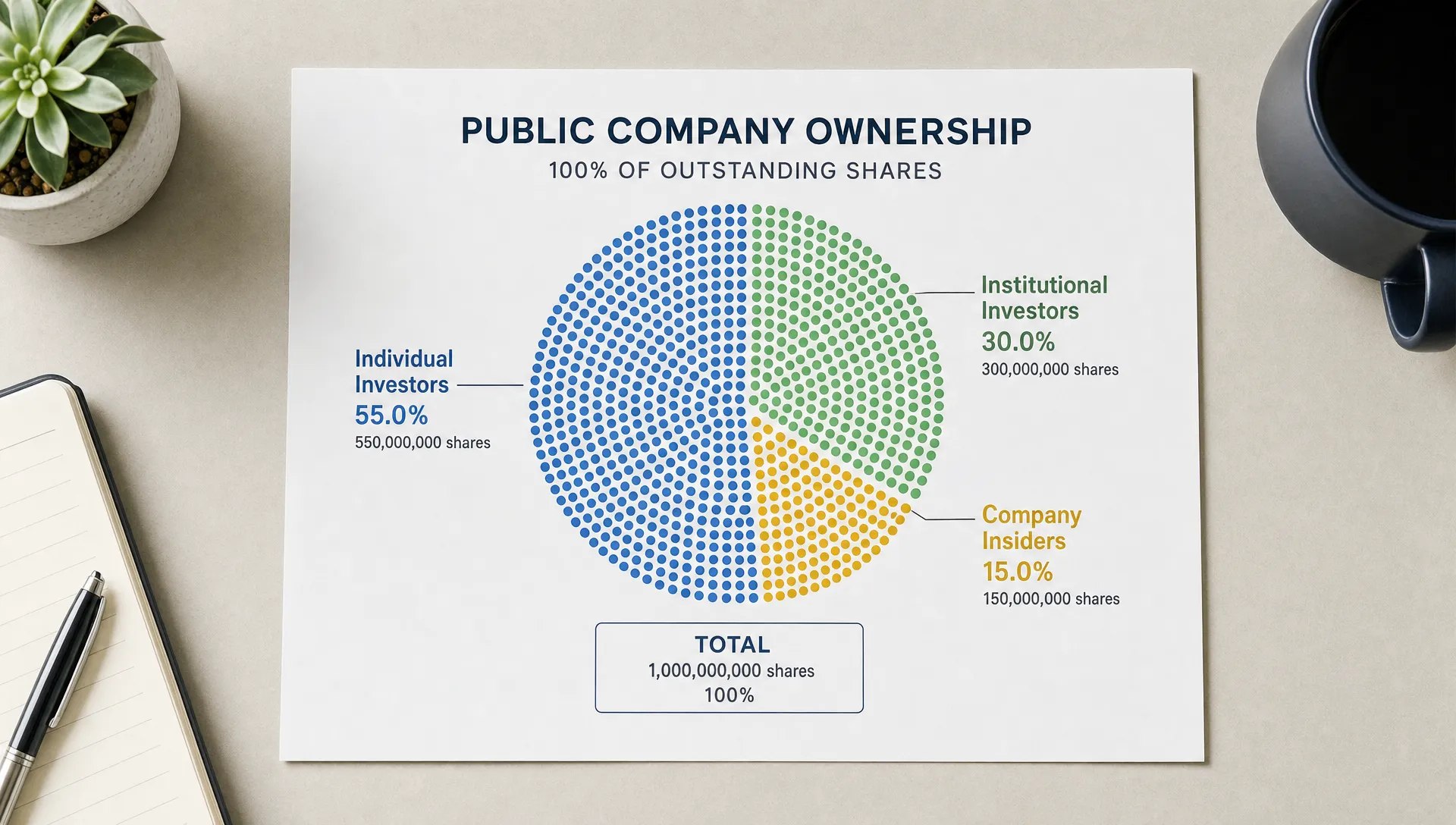
Ownership of shares in a company becomes more useful when you look beyond your own position and study who else owns the stock.
Insider ownership can show whether founders, executives, and directors have meaningful financial alignment with shareholders. Institutional ownership can show whether large funds are involved. Short interest can indicate how many investors are betting against the stock. Float can help explain how easily a stock trades and how sensitive it may be to buying or selling pressure.
None of these signals should be used alone. High insider ownership can be positive if leaders are capable and shareholder-friendly, but it can be negative if it creates weak accountability. Heavy institutional ownership can signal confidence, but it can also mean crowded positioning. A high short interest can warn of real problems, or it can create conditions for sharp rallies if expectations improve.
The point is to treat ownership data as context, not a shortcut. If you want to build that habit, Upside’s guide to stock ownership data every investor should track explains the main signals worth watching.
Fractional shares still count as ownership
Many modern brokerages allow investors to buy fractional shares. Instead of buying one full share of a company trading at $800, you might buy $50 worth.
A fractional share is still economic ownership, but the details can vary by broker. You may receive proportional dividends if the company pays them. Voting rights can be more complicated, because the broker may aggregate fractional holdings or limit voting on partial shares.
For most long-term investors, fractional shares are valuable because they make diversification easier. You do not need enough cash to buy full shares of every company you like. You can allocate based on position size rather than share price.
This is another reason to focus on dollars invested, portfolio weighting, and business quality instead of the raw number of shares you own.
How to think like an owner, not a ticker trader
The biggest mindset shift is to stop asking only, “Will this stock go up next week?” and start asking, “Would I want to own this business at this price?”
That owner mindset changes the questions you ask. You begin to care about revenue quality, margins, competitive advantages, debt, management incentives, capital allocation, dilution, and valuation. You also become more patient, because business value usually compounds over years, not days.
A simple owner-focused checklist can help:
- What does the company sell, and why do customers choose it?
- Is the company profitable or on a credible path to profitability?
- How much debt does it carry relative to cash flow?
- Are insiders meaningfully invested alongside shareholders?
- Is the share count stable, shrinking, or rising quickly?
- What price am I paying compared with the company’s realistic future earnings?
This does not mean every investment must be held forever. It means your buy and sell decisions should be connected to business fundamentals and portfolio strategy, not just price movement.
Comparing your ownership with other investors
One challenge for retail investors is that portfolio decisions can feel isolated. You may know what you own, but not how your allocation compares with other investors who are navigating similar choices.
That is where anonymous portfolio benchmarking can be useful. Upside Invest helps retail investors see what verified investors are buying, holding, and outperforming with, while keeping profiles private and anonymous. Instead of relying only on headlines or social media opinions, you can compare allocations, spot trends, and evaluate investor behavior using real portfolio data.
This does not replace your own research. It adds context. Seeing how other investors allocate across stocks, funds, sectors, and themes can help you challenge your assumptions and understand where your portfolio is concentrated or underexposed.
Frequently Asked Questions
Does owning shares mean I own part of the company? Yes. Owning shares means you own an equity interest in the company. However, you do not directly own specific company assets. The company owns its assets, and shareholders own shares issued by the company.
Do shareholders get paid when a company makes money? Not automatically. A profitable company may reinvest earnings, pay dividends, buy back shares, reduce debt, or hold cash. Shareholders benefit when those decisions increase the value of their shares or provide cash distributions.
Can I vote if I own one share? Often, yes, if the share class has voting rights. One share may equal one vote in many companies, but some companies have multiple share classes with different voting power. Fractional share voting can also depend on your broker.
What happens to shareholders if a company goes bankrupt? Shareholders are generally last in line after creditors, bondholders, employees, suppliers, and other obligations. Common shareholders may receive little or nothing if the company’s assets are not enough to cover higher-priority claims.
Is it better to own more shares? Not necessarily. The number of shares you own matters less than the value of your position, the percentage ownership it represents, and the quality and valuation of the company behind those shares.
The simple takeaway
Ownership of shares in a company means you have a financial stake in a business. That stake can give you upside through price appreciation, dividends, and improved per-share value, but it also exposes you to business risk, dilution, weak governance, and market volatility.
The smartest investors do not treat shares as lottery tickets. They treat them as ownership claims. They study what they own, how much they own, who owns alongside them, and whether the price makes sense.
If you want a clearer view of your own portfolio, Upside Invest helps you compare your holdings with verified investors, track real allocation trends, and make more informed ownership decisions while keeping your profile private and anonymous.