Ownership of Stock and Why It Matters to Returns

Price gets most of the attention in investing. Ownership is what gives that price meaning.
When you buy a stock, you are not just buying a symbol that moves up or down on a chart. You are buying a legal and economic claim on a business, with rights that can include voting power, potential dividends, and participation in long-term value creation. The ownership of stock matters because returns ultimately come from what that claim becomes worth over time.
For retail investors, this is a powerful shift in perspective. Instead of asking only, “Will this stock go up?” a better question is, “What do I own, how can my ownership claim grow or shrink, and who controls the decisions that affect my returns?”
That ownership lens can help you understand why two stocks with similar revenue growth can produce very different shareholder results. It can also help you avoid situations where a company grows while individual shareholders get diluted, ignored, or exposed to unnecessary risk.
What ownership of stock actually represents
A share of common stock usually represents a fractional ownership interest in a company. In practical terms, that means you own a small piece of the company’s residual economic value after obligations to creditors and other senior claims are considered. The SEC’s investor education resources explain that common stock can provide voting rights and the possibility of dividends, though neither price appreciation nor dividend payments are guaranteed.
This distinction matters. Stockholders are owners, but they do not own the company’s assets directly. If a company owns factories, patents, software, cash, or inventory, those assets belong to the corporation. Your shares give you a claim on the corporation’s value, not the right to walk away with a piece of equipment or cash from the bank account.
Your ownership percentage depends on how many shares you own relative to the total share count. If you own 100 shares of a company with 100 million shares outstanding, your ownership is tiny, but the economic logic is the same as it is for a large shareholder. If the company becomes more valuable on a per-share basis, your ownership claim can become more valuable too.
If you want a deeper plain-English breakdown of ownership percentage, voting rights, dividends, and share count, Upside’s guide to what share of ownership means for everyday investors is a useful companion to this return-focused discussion.
Why ownership matters to returns
Stock returns are not random scoreboard numbers. Over long periods, they tend to reflect a combination of business performance, capital allocation, investor expectations, and changes in each shareholder’s claim on the company.
A simple way to think about stock returns is this:
- The business creates or destroys value.
- Management decides how to use cash.
- Share count changes affect each investor’s slice of the business.
- The market changes how much it is willing to pay for that ownership claim.
That last point is why returns can differ from business performance in the short term. A great company can produce weak stock returns if investors paid too much at the start. A struggling company can rally if expectations were extremely low and conditions improve. But over longer periods, ownership quality and per-share economics become harder to ignore.
Research from Hendrik Bessembinder has shown that long-term stock market wealth creation has historically been highly concentrated among a relatively small number of exceptional companies. His paper, Do Stocks Outperform Treasury Bills?, is often cited because it highlights an uncomfortable truth: simply owning stocks is not the same as owning the stocks that create most of the market’s long-term wealth.
That is why ownership analysis matters. You are not just looking for activity, news, or popularity. You are trying to understand whether the business and its ownership structure can translate success into shareholder returns.
| Return driver | How ownership connects | What investors should watch |
|---|---|---|
| Earnings growth | Owners benefit when profits rise on a per-share basis | Revenue quality, margins, earnings per share |
| Free cash flow | Owners may benefit through reinvestment, dividends, or buybacks | Cash conversion, capital spending, debt needs |
| Dividends | Owners receive direct cash distributions if approved | Payout ratio, dividend sustainability |
| Buybacks | Owners may own a larger percentage if share count falls | Buyback price, share count trend, debt used |
| Dilution | Owners may own a smaller percentage if share count rises | Stock compensation, acquisitions, secondary offerings |
| Valuation | Owners gain or lose as the market reprices the claim | Multiples, expectations, interest rates, sentiment |
The hidden math of dilution and buybacks
One of the most overlooked parts of stock ownership is share count. Investors often focus on company-level growth, such as sales or total net income, but your return depends on what happens per share.
Imagine a company increases net income from $100 million to $120 million. That sounds like 20% growth. But if the share count rises from 100 million shares to 130 million shares, earnings per share fall from $1.00 to about $0.92. The company grew, but each share’s claim on earnings shrank.
Dilution is not always bad. A company may issue shares to acquire another business, compensate employees, or raise capital for projects that create more value than the dilution costs. But dilution should always be evaluated. If management repeatedly increases share count without improving per-share value, stockholders may not benefit even if the company becomes larger.
Buybacks work in the opposite direction, at least in theory. When a company repurchases shares, remaining shareholders can own a slightly larger percentage of the business. But buybacks are not automatically good either. Repurchasing overvalued stock, borrowing too aggressively to fund buybacks, or offsetting heavy stock compensation can reduce the benefit.
The key question is not, “Did the company grow?” It is, “Did each share’s economic claim improve?”
Who owns alongside you can shape outcomes
Ownership of stock is not only about your individual position. It is also about the broader shareholder base.
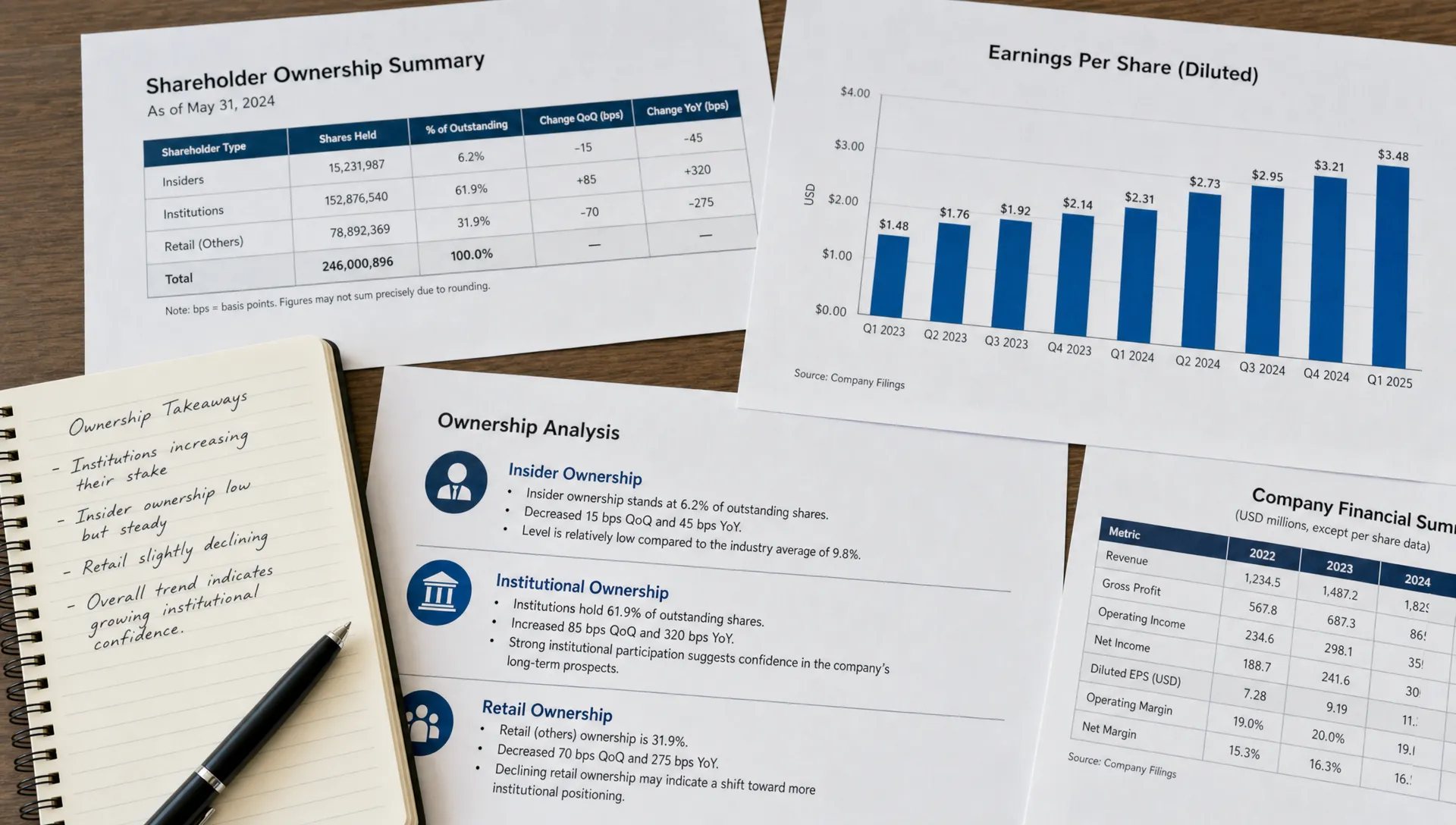
Insiders, founders, institutions, index funds, activist investors, employees, and retail investors can all influence how a stock behaves. They may have different time horizons, incentives, risk tolerance, and levels of control.
High insider ownership can be a positive signal when leaders are economically aligned with shareholders. If executives and founders have meaningful personal wealth tied to the stock, they may be more focused on long-term value creation. But insider control can also become a risk if it limits accountability, protects poor management, or weakens minority shareholder rights.
Institutional ownership can suggest professional interest, liquidity, and market validation. However, it should not be interpreted blindly. Some institutions are passive index funds that own shares because of benchmark rules. Others are short-term traders, quantitative funds, or active managers with specific mandates. For more nuance, Upside’s guide on how to read institutional ownership of a stock explains why the headline percentage alone can be misleading.
The composition of the shareholder base can affect returns in several ways. A company with patient long-term owners may have more room to invest through volatility. A stock dominated by short-term holders may react sharply to quarterly results. A company with a small public float can move quickly in either direction because fewer shares are available for trading.
Ownership quality depends on rights, not just percentages
A large ownership percentage does not automatically mean strong protection. The quality of ownership depends on the rights attached to the shares and the governance structure around them.
Investors should pay attention to voting rights, dual-class share structures, board independence, related-party transactions, shareholder dilution approvals, and management’s capital allocation record. These issues may sound technical, but they directly affect returns because they determine who makes decisions and whose interests are prioritized.
This principle is not unique to public equities. In intellectual property-heavy businesses, for example, the economic value of ownership often depends on the ability to monitor and enforce IP rights, identify unauthorized usage, and convert rights into licensing revenue. For shareholders, the equivalent question is whether the company’s structure, disclosures, and governance protect the economic claim attached to each share.
Weak ownership rights can turn a promising business into a poor investment. If minority shareholders have little influence, if management issues shares carelessly, or if controlling owners extract value unfairly, the public stockholder may not fully participate in the company’s success.
Strong ownership rights do not guarantee returns, but they improve the odds that value creation reaches shareholders rather than being lost through poor incentives or governance.
How ownership changes can become return signals
Ownership data can help investors spot shifts in conviction, supply, and potential pressure on a stock. It should not be used as a standalone buy or sell signal, but it can add context to a broader investment thesis.
Insider buying may suggest confidence, especially when purchases are open-market transactions made with personal funds. Insider selling is more complex. Executives sell for many reasons, including taxes, diversification, estate planning, or scheduled trading plans. A single sale may mean little, while repeated large sales alongside weakening fundamentals deserve closer attention.
Institutional accumulation may indicate growing professional interest. But because many institutional disclosures arrive with a lag, investors should avoid treating them as real-time signals. The better question is whether ownership changes align with improving fundamentals, valuation support, or a credible catalyst.
Float changes can also matter. A shrinking float caused by buybacks can support per-share value if the business remains strong and repurchases are disciplined. A rising float from repeated equity issuance can pressure returns unless the new capital earns attractive returns.
To build a more complete checklist, Upside’s article on stock ownership data every investor should track covers signals such as insider ownership, institutional holdings, float, dilution, and short interest.
A practical framework for retail investors
You do not need to become a corporate governance lawyer to use ownership analysis well. A practical framework can help you connect ownership of stock to expected returns.
Start with the economic claim. Ask whether revenue, margins, cash flow, and reinvestment opportunities can realistically increase value per share. A company can be exciting, innovative, and widely discussed, but the stock still needs a path to per-share economic improvement.
Next, examine the share count. Look at whether shares outstanding are rising, falling, or staying relatively stable. If dilution is significant, ask what shareholders are receiving in exchange. If buybacks are significant, ask whether they are reducing shares meaningfully or merely offsetting stock-based compensation.
Then, study incentives. Management teams tend to behave according to what they are rewarded for. Compensation tied to revenue growth alone can encourage expansion without profitability. Compensation tied to per-share value, return on invested capital, or long-term stock performance may be better aligned, though every plan needs context.
After that, evaluate the shareholder base. Are insiders meaningfully invested? Are institutions accumulating or leaving? Is ownership concentrated in a way that helps governance, or does it reduce accountability? Are retail investors chasing momentum without understanding fundamentals?
Finally, compare the opportunity with alternatives. Owning a stock always has an opportunity cost. If you allocate capital to one company, you are choosing not to allocate it elsewhere. A strong ownership thesis should explain not only why the stock might rise, but why this ownership claim is attractive relative to other available choices.
How portfolio benchmarking makes ownership more useful
Ownership analysis becomes more powerful when it is connected to portfolio context. A stock may look attractive in isolation but increase your concentration in one sector, factor, theme, or risk profile. Another stock may look less exciting but improve diversification or give you exposure to a type of business you do not already own.
This is where investor intelligence can help. Upside Invest is built around anonymous, verified portfolio sharing, allowing retail investors to compare allocations, see what verified investors are buying and holding, and evaluate trends without relying only on headlines or social media claims.
The goal is not to copy another investor blindly. It is to understand how real investors are positioning, where conviction is building, and whether your own portfolio reflects the ownership exposures you actually want. When combined with fundamental analysis, ownership data can help you make more informed decisions about concentration, diversification, and risk.
Common mistakes investors make about stock ownership
One common mistake is confusing brand familiarity with ownership quality. A company can make products you love and still be a poor investment if the valuation is too high, margins are weak, or shareholders are diluted.
Another mistake is focusing only on price movement. A stock that rises quickly may feel validating, but short-term price action does not prove that ownership value is improving. Likewise, a falling stock may create opportunity if the business is strengthening and the market has overreacted.
A third mistake is treating all shareholders as equally protected. Share classes, voting rights, and control structures can create very different outcomes for different owners. Retail investors should know whether they are buying into a one-share, one-vote structure or a company where control is concentrated elsewhere.
The final mistake is ignoring time horizon. Ownership is most meaningful when paired with a clear holding period and thesis. If you are buying for long-term compounding, your focus should be different from someone trading a short-term catalyst.
Frequently Asked Questions
What does ownership of stock mean for returns? Ownership of stock gives you a claim on a company’s future economic value. Returns can come from price appreciation, dividends, buybacks, and improved per-share fundamentals, but they can also be reduced by dilution, weak governance, or overvaluation.
Is owning more shares always better? Not necessarily. The number of shares you own matters less than your ownership percentage, the value of each share’s claim, and the price you paid. Ten shares of a high-quality company can be better than hundreds of shares in a business that destroys value.
How does dilution affect stock returns? Dilution increases the share count, which can reduce each existing share’s claim on earnings, cash flow, and voting power. Dilution can be acceptable if the company uses the new shares to create even more value, but repeated dilution without strong returns can hurt shareholders.
Does insider ownership mean a stock will outperform? No. Insider ownership can align management with shareholders, but it is only one signal. Investors should also consider governance, valuation, business quality, capital allocation, and whether insider control improves or weakens accountability.
Should retail investors track institutional ownership? Yes, but with context. Institutional ownership can reveal professional interest and changes in market positioning, but filings may be delayed and institutions have different strategies. It is best used alongside fundamentals and valuation.
Turn ownership into a better investing lens
The ownership of stock matters because every share represents a claim on future value. Your returns depend on how that claim changes through business performance, cash distribution, dilution, buybacks, governance, and market expectations.
For retail investors, the advantage comes from asking better questions. What do I own? Who controls the outcome? Is per-share value improving? Who else owns this stock, and what does that tell me about conviction or risk?
Upside Invest helps investors bring those questions into portfolio context with verified investor holdings, anonymous portfolio comparison, trend tracking, and community benchmarking. Use ownership as more than a definition. Use it as a framework for making smarter investment decisions.