Trend Trading for Beginners: A Practical Risk-First Guide

A useful starting point for trend trading for beginners is not finding the fastest-rising stock. It is deciding how much you can lose, what would invalidate a trade and whether you can follow the same rules when prices move against you.
Trend trading means taking positions in the direction of an established price move, then exiting according to a predefined plan. It does not require predicting the next market winner. It does require accepting that some signals will fail and that an exit may happen at a worse price than expected.
This guide focuses on a beginner-friendly learning path: unleveraged, long-only practice using daily charts. The goal is to build a repeatable process before risking meaningful money, not to turn trading into a substitute for a diversified investment plan.
The foundation of trend trading for beginners
A trend is a sustained directional movement, not simply a strong day. An upward trend often includes higher swing highs and higher swing lows, although the pattern can be messy rather than smooth.
Trend traders try to participate while that direction persists. They generally enter after some evidence of strength, which means they will not consistently buy at the bottom or sell at the top.
The difficult part is distinguishing a continuing move from temporary noise. No indicator solves that problem completely.
| Market condition | What you might observe | Beginner response |
|---|---|---|
| Upward trend | Rising swing highs and lows across several sessions | Research a defined long-entry setup |
| Sideways market | Repeated reversals within a similar price range | Avoid forcing a trend trade |
| Downward trend | Falling swing highs and lows | Stay out under a long-only practice plan |
| Unclear conditions | Conflicting signals or unusually erratic movement | Keep the candidate on a watchlist |
Doing nothing is a valid trading decision. You do not need a position whenever the market is open.
Separate trading capital from money you need
A risk-first approach to trend trading for beginners starts with money that can remain at risk without disrupting essential spending or long-term goals.
Keep emergency savings, upcoming bills and known major expenses outside your trading budget. Borrowing to fund an experiment makes both the financial risk and the pressure to recover losses worse.
Consider a family preparing to move abroad. Rental deposits, school costs and a relocation buffer should not depend on successful trades. If Australia is the destination, rental and school relocation support can help with move planning, while the money needed for those commitments stays separate from speculative positions.
Also distinguish your long-term portfolio from your trading account. A diversified retirement holding and a short-term trend position can have different purposes and exit rules. Moving a losing trade into the “long-term investment” category after the fact is not a strategy.
Choose a timeframe you can actually manage
Daily charts are a reasonable starting point if you cannot monitor markets throughout the session. You can review completed daily prices at a scheduled time rather than reacting to every intraday fluctuation.
That does not eliminate risk. Positions held overnight can gap down after earnings, economic announcements or unexpected news. A slower decision cycle reduces monitoring demands, not necessarily losses.
Choose a narrow practice universe, such as a small watchlist of liquid, unleveraged stock ETFs or large-company shares. Liquidity helps with execution but does not make an asset safe. Avoid adding options, leveraged products and short selling while you are still learning basic order handling.
The practical advantage of trend trading for beginners is that you can make the process observable: one timeframe, one entry setup and one exit method are easier to review than several competing strategies.
Write one testable setup, not a prediction
Your practice plan should distinguish a trend filter, which identifies eligible candidates, from an entry trigger, which specifies when a trade becomes actionable.
For example, you might require the daily close to be above a rising 50-day moving average, then look for a close above the highest closing price of the previous 20 completed sessions. Those settings are illustrative, not evidence of profitability.
Define “rising” precisely, such as the moving average being higher than it was five sessions earlier. Exclude the current session from the prior 20-session comparison. Otherwise, your rules become difficult to reproduce.
Record the signal after the close and simulate entry during the following session. Do not assume you could have bought at the signal day's closing price after seeing the completed signal. That introduces hindsight into your results.
If the next session opens sharply higher, your plan should allow you to skip the trade rather than chase it.
Calculate the possible loss before the share count
Position sizing connects your trade idea to your financial limits. Start with a planned dollar risk, then calculate how many shares fit within it.
For trend trading for beginners, a small hypothetical example makes this clearer than a general instruction to “manage risk.”
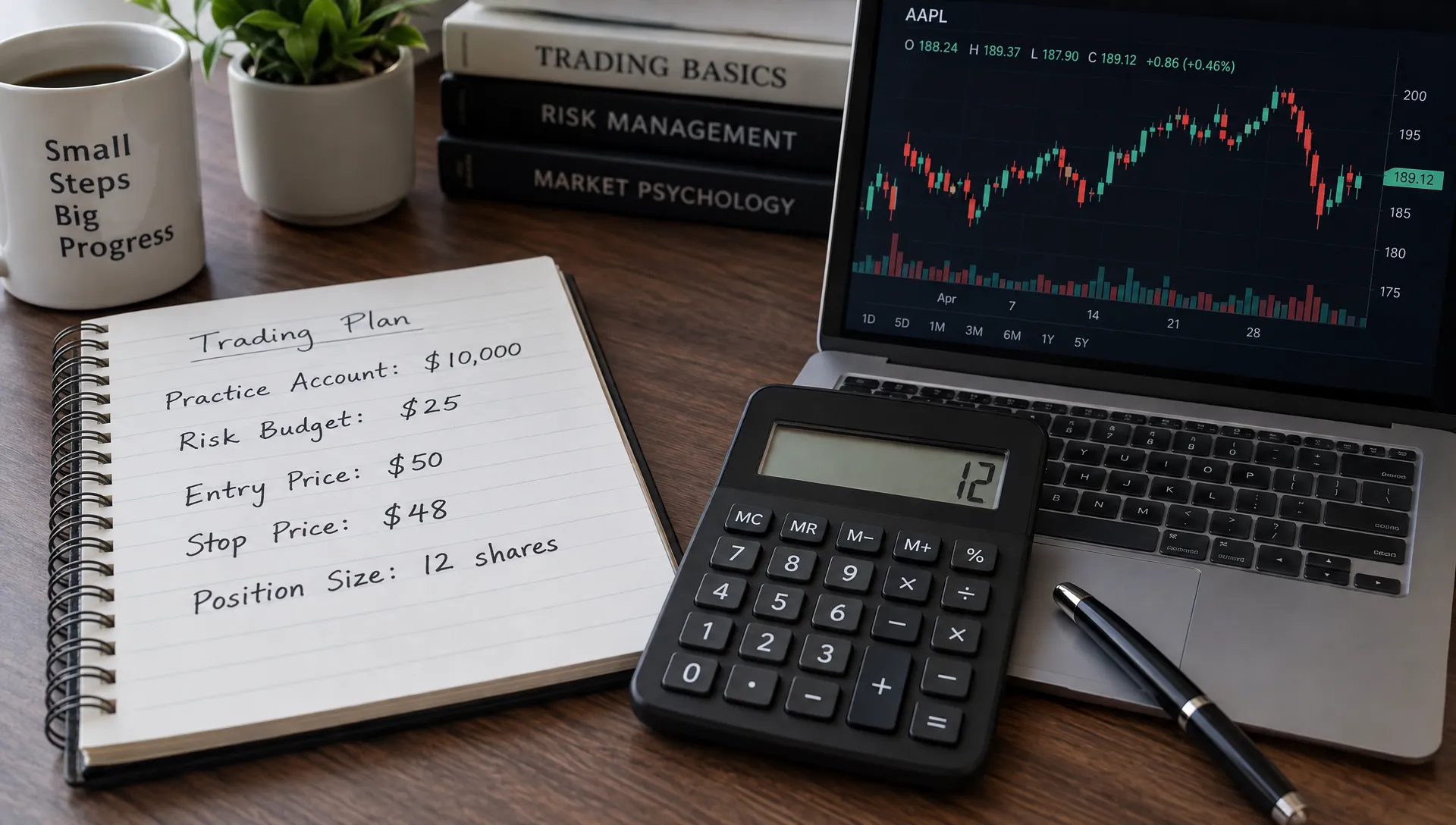
Suppose your practice account is $10,000 and you choose a planned risk of 0.25% per trade. That gives you a $25 risk budget. This percentage is an illustration, not a universal recommendation.
You plan to enter at $50 and place a protective stop at $48 because your written setup is invalid below that level.
Shares = planned dollar risk ÷ distance from entry to stop
Here, $25 ÷ $2 gives 12.5 shares. If using whole shares, round down to 12. The position costs $600 and its planned price-based loss at the stop is $24, before fees and execution differences.
The stop belongs at a level that invalidates the setup, not at an arbitrary distance chosen to permit more shares. If that distance makes the trade impractical, reduce the position or skip it.
For a deeper explanation of stop placement and sizing, Upside's guide to technical trend trading rules for managing risk extends these mechanics.
A stop is not a guaranteed loss limit
A stop order typically becomes a market order when triggered. The execution price can differ substantially from the stop price in a fast market or after a gap. The SEC's explanation of stock order types also describes why a stop-limit order can remain unfilled.
Your $24 planned loss could therefore become a larger realized loss. Allow for fees, spreads and slippage when evaluating a strategy.
Portfolio exposure matters too. Several technology stocks may respond to the same market event. Five positions with small individual risk budgets do not necessarily provide five independent sources of risk.
Set an overall exposure limit and check overlapping holdings. Do not increase size merely because several similar charts look attractive.
Rehearse the entire trade before using real money
Paper trading is most useful when it tests decisions, not just whether prices eventually rise. Include entry timing, order choice, position size, exit handling and missed opportunities.
A sensible rehearsal for trend trading for beginners follows the same sequence each time:
- Before entry: Record the signal, planned execution method, invalidation level and maximum acceptable position size.
- During the trade: Follow the exit rule and document any departure from the plan.
- After exit: Record the fill assumptions, costs, result and whether you followed your rules.
Keep your exit method simple. You could test a protective stop with a trailing rule based on completed daily prices. Specify when the trailing level updates and never lower it merely to give a losing long position more room.
If an exit condition requires a daily close, do not pretend that it provided protection earlier in the session. Different exit methods produce different exposures and need separate evaluation.
A fixed review time makes this process easier to maintain. Upside's guide to building a trend trader daily routine explains how to structure checks without watching every price movement.
Use a journal to judge execution, not just profit
Start with a practical observation period or a modest target number of paper trades. Neither a few weeks nor 20 completed trades establishes a durable edge. The immediate purpose is to expose unclear rules and execution mistakes.
Record each outcome in dollars and in units of initial planned risk, often called R. If your initial planned risk was $25, a $50 gain is +2R and a $25 loss is -1R. A gap-related $40 loss is -1.6R, not -1R.
An honest review of trend trading for beginners should examine more than the percentage of winning trades. Look at average wins, average losses, trading costs, the largest peak-to-trough decline and rule adherence.
A strategy can win frequently but lose money if occasional losses are much larger than gains. It can also look successful on paper because fills were unrealistically favorable.
When you change a rule, label the change and test it going forward. Repeatedly adjusting settings to explain past results can produce a strategy that fits history without surviving new conditions.
Use investor holdings as research context, not instructions
Portfolio data can help you understand what other investors hold, which sectors attract attention and how your allocations compare. It cannot tell you whether someone else's trade fits your timeframe or risk budget.
Upside provides verified investor holdings, portfolio comparison tools, trend tracking and private anonymous profiles. Those features can add context to your research, but verification does not make an investor's next decision correct.
For example, several portfolios holding the same stock might prompt you to investigate concentration or sector exposure. It should not replace your entry signal. Their purchase prices, objectives and reasons for holding may differ from yours.
For trend trading for beginners, the useful question is not “Who should I copy?” It is “What does this information help me check?”
Top-performer rankings deserve similar care. Strong past returns may reflect concentration, a favorable market period or risks that are difficult to see from a ranking alone. Compare relevant periods and exposures rather than treating the highest return as a recommendation.
Common mistakes to catch before increasing size
The most damaging beginner mistakes often happen after entry: moving a stop lower, adding to a position without a predefined rule or increasing size to recover a recent loss.
Another mistake is confusing a successful trade with a sound process. An impulsive entry can make money, while a well-planned trade can lose. Your journal should distinguish those outcomes.
Before moving from simulation to live trading, confirm that you can place and cancel orders correctly, explain your maximum planned exposure and follow exits without improvising. If you proceed, start small enough that execution differences are affordable. Paper results are preparation, not a promise of live performance.
Frequently asked questions
How much money do I need to start? There is no universal minimum. Broker requirements, share prices, costs and position-sizing constraints matter. Begin with simulation, then use only risk capital if you decide to trade live. A small account is not a reason to use leverage.
Is trend trading the same as day trading? No. Trend trading describes an approach to price direction. Day trading describes opening and closing positions within the same session. A trend-based position can instead last days, weeks or months.
What is the best indicator for a beginner? No indicator is best across every market. A simple price structure or moving-average filter is enough to begin testing. Trend trading for beginners benefits more from clear rules and realistic execution assumptions than from adding indicators that repeat similar information.
Should I stop after several losing trades? Follow a pause rule written before trading. A pause can give you time to check execution, exposure and changing market conditions. Do not respond by doubling size or rewriting the strategy solely to recover losses.
Start with a plan you can audit
Before your next practice trade, write down the entry condition, invalidation level, position size and exit rule. If any part is unclear, keep the idea on your watchlist.
When you want broader portfolio context, explore Upside's verified investor holdings and portfolio comparison tools. Use that information to investigate allocations and exposure while keeping trade decisions anchored to your own risk limits.
This guide is educational and does not provide personalized investment advice.