What GameStop Institutional Ownership Signals to Investors

Investors often search for gamestop institutional ownership because GME is not a normal stock story. The company sits at the intersection of retail enthusiasm, institutional portfolio rules, short interest, balance sheet changes and viral market narratives. Institutional ownership can help investors separate durable sponsorship from noise, but it is not a standalone buy or sell signal.
Why GameStop institutional ownership is a noisy signal
GameStop is different from a typical mid-cap or consumer discretionary stock because its shareholder base has been shaped by years of intense retail participation. Since the 2021 meme-stock surge, GME has often traded less like a traditional turnaround story and more like a stock where positioning, liquidity and crowd behavior matter as much as quarterly results.
That does not make institutional data useless. It makes the interpretation harder. For that reason, GameStop institutional ownership needs to be separated into passive exposure, active conviction and short-term portfolio mechanics. A broad index fund holding GME because it belongs in a benchmark sends a very different signal from a concentrated active manager building a position over several quarters.
This is where many investors make the wrong leap. They see a well-known asset manager on the holder list and assume endorsement. In reality, large institutions often own thousands of stocks for index, ETF or risk-control reasons. The better question is not whether institutions own GameStop, but which institutions own it, whether their positions are growing and whether the ownership trend matches fundamentals.
What GameStop institutional ownership actually measures
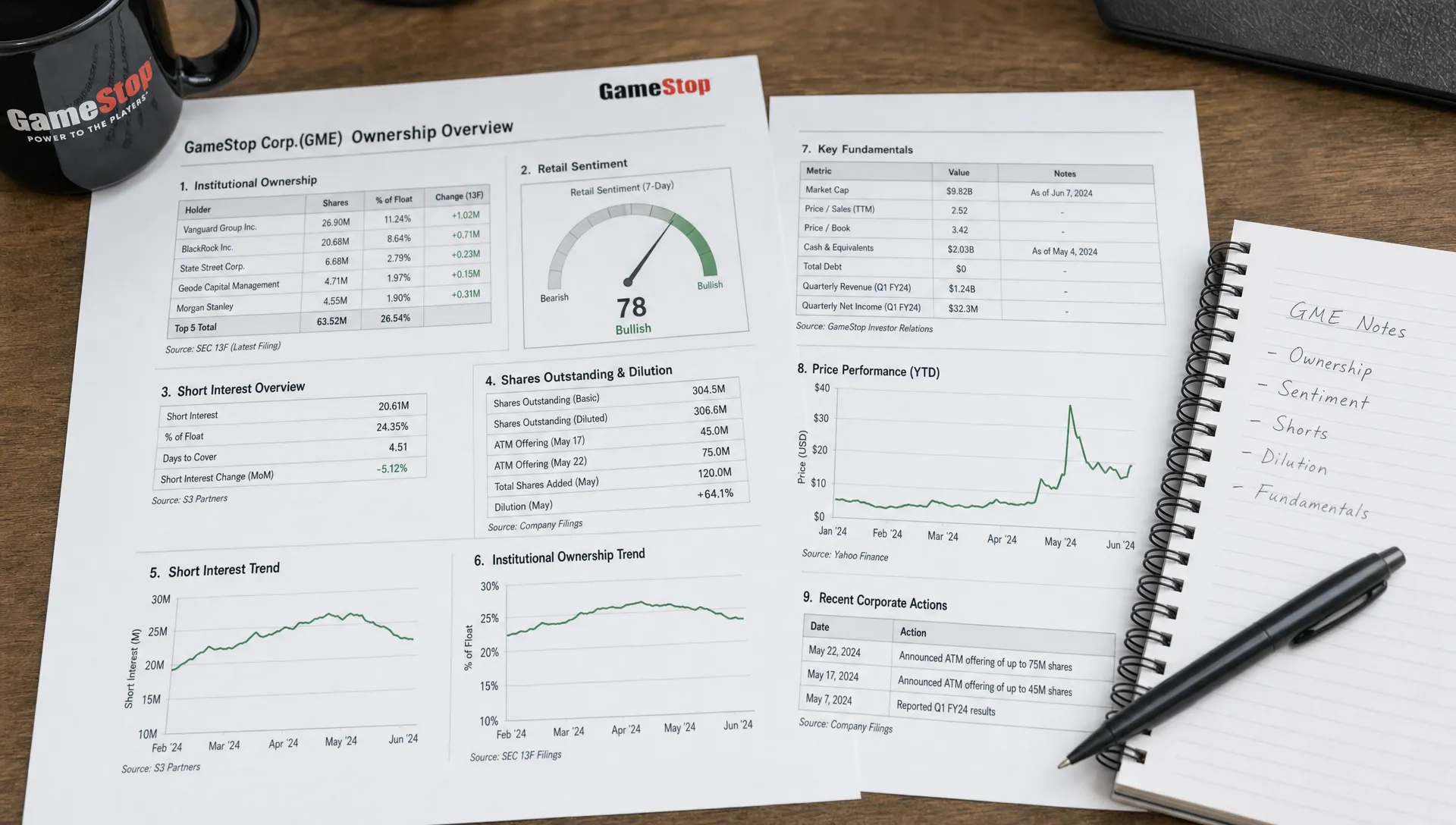
Institutional ownership generally refers to shares held by professional investors such as mutual funds, ETFs, pension funds, hedge funds and investment advisers. In the United States, much of the public data comes from Form 13F filings, which are filed quarterly by institutional investment managers that meet SEC reporting thresholds.
Those filings are useful, but they are delayed. A 13F can arrive up to 45 days after a quarter ends, which means the market may already know, react to or move beyond the position shown in the filing. If you want a broader explanation of the metric before applying it to GME, Upside has a useful guide on reading institutional ownership without over-weighting the headline percentage.
When GameStop institutional ownership changes, the first question is whether the move came from a change in shares held or a change in shares outstanding. If the company issues new shares, the ownership percentage can move even when some funds did not buy or sell much. That matters for GME because share count, cash raised and investor dilution have all been part of the stock’s recent debate.
| Ownership signal | What it can suggest | What it does not prove |
|---|---|---|
| Rising number of institutional holders | Broader professional interest | That managers are high-conviction buyers |
| Larger passive fund positions | Index or ETF inclusion impact | A bullish fundamental view |
| Active manager accumulation | Possible conviction or event-driven interest | That the thesis is correct |
| Falling reported ownership | Reduced exposure or portfolio rebalancing | That all institutions are bearish |
| High holder concentration | A few institutions influence flows | Stable long-term support |
Passive holders can look like conviction
A major trap in GME analysis is treating passive ownership as if it reflects a fresh vote of confidence. Index funds and ETFs often hold companies because their mandate requires exposure to a benchmark. They may add or reduce shares because of fund inflows, outflows, index rebalancing or float adjustments, not because a portfolio manager suddenly changed their view of GameStop’s business.
In GameStop institutional ownership data, a large passive holder can create the appearance of institutional support even if no active manager is making a fundamental call. That is why the composition of ownership matters as much as the percentage. A stock can have meaningful institutional ownership and still face skepticism from active managers who care about earnings quality, strategic direction and valuation.
The opposite is also true. Lower institutional ownership is not always a warning sign if the investor base includes long-term insiders, retail holders and specialized funds with a clear reason to stay. Upside has covered why stocks with very high institutional ownership are not automatically safer, and that point is especially relevant for narrative-heavy stocks like GME.
GameStop-specific context investors should add
GameStop remains a retailer in a changing video game market, but the investment conversation is broader than store sales. Investors also watch the company’s cash position, share issuance, cost structure, management decisions and any signs that capital is being deployed in a way that can improve long-term returns.
That context matters because GameStop institutional ownership can rise for reasons that have little to do with the operating turnaround. A fund might buy after volatility resets, an ETF might rebalance or an event-driven manager might see optionality in the balance sheet. None of those signals should be read in isolation from revenue trends, margins, dilution and governance.
The discipline is the same in any decision that depends on trust and verification. Whether an investor is comparing filings or a traveler is evaluating a specialized provider such as a Uganda Safari 2026 operator, the useful habit is checking who is behind the claim, how current the information is and what evidence supports it.
What rising ownership may signal
Rising GameStop institutional ownership is most useful when it coincides with broader institutional breadth. If more active managers are building positions over multiple quarters, and those positions are not merely benchmark-driven, that can suggest improving professional interest. It still does not guarantee upside, but it may show that more investors are willing to underwrite the risk.
The quality of buyers matters. A diversified passive fund adding shares is not the same signal as a respected active manager taking a position large enough to matter to its portfolio. Investors should also check whether institutions are adding common shares, reducing exposure elsewhere or using options in ways that complicate the picture.
A constructive reading becomes stronger when ownership changes line up with business evidence. For GME, that could mean improved profitability, clearer capital allocation, stronger cash discipline or a strategy that investors can model with more confidence. If the only reason for the move is price momentum, the signal is weaker.
What falling ownership may signal
Falling GameStop institutional ownership can be just as nuanced. It might reflect active managers losing confidence, but it can also result from rebalancing, redemptions, benchmark changes or a rising share count. A decline in percentage ownership is not automatically bearish unless the underlying share count and holder behavior confirm real selling.
Investors should look for clusters of selling rather than one isolated reduction. If several active funds cut exposure across multiple quarters, that deserves attention. If passive managers change positions in ways that match fund flows, the signal is less specific to GameStop.
The most concerning pattern is a combination of declining active ownership, weak fundamentals, insider selling and heavy dilution. The more signals point in the same direction, the more useful the ownership data becomes. When signals conflict, investors should slow down rather than force a clean conclusion.
How to use GME ownership data in a real research process
The best use of GameStop institutional ownership is comparative, not absolute. Investors should compare GME with other specialty retailers, turnaround candidates and high-volatility stocks to see whether professional ownership looks unusual for its risk profile. A single percentage tells you very little until it is placed beside float, market cap, liquidity and ownership concentration.
For a current snapshot of price action, community holder statistics and platform-level investor interest, you can review the GME security page on Upside. That kind of view is helpful because ownership signals are easier to interpret when they sit next to real portfolio behavior, performance metrics and investor positioning.
A practical framework looks like this:
| Question | Why it matters for GME |
|---|---|
| Are active managers adding over multiple quarters? | Repeated buying can be more meaningful than a one-time position |
| Are passive holders driving most of the ownership? | Passive exposure may not reflect conviction |
| Has share count changed? | Dilution can distort ownership percentages |
| Are retail holders still highly engaged? | GME’s investor base can affect liquidity and volatility |
| Do fundamentals support the ownership trend? | Institutional buying without business improvement may be fragile |
Common mistakes when reading the signal
One mistake is assuming that every large institution has a deep fundamental thesis. Another is assuming that institutions always know more than retail investors. Institutions have process advantages, but they also face mandates, liquidity constraints and risk limits that can make their behavior less informative than it appears.
Another mistake is ignoring the time lag. GameStop institutional ownership data may describe what a fund held weeks ago, not what it holds today. In a volatile stock, that difference matters. A position can be built, hedged or reduced before most investors ever see the filing.
Investors should also avoid treating institutional ownership as a substitute for position sizing. Even if the signal is constructive, GME can still move sharply on news, social media momentum, options activity or broader risk appetite. Ownership data belongs in the research stack, not at the top of the decision tree.
Frequently Asked Questions
Is GameStop institutional ownership bullish? Not by itself. It can be bullish if active managers are steadily accumulating shares and the business case is improving, but passive ownership or delayed filing data can make the signal look stronger than it is.
Do 13F filings show real-time GME buying? No. Form 13F filings are quarterly and delayed, so they show historical positions. They also do not fully explain cost basis, short exposure, hedges or the manager’s current intent.
Can institutional ownership fall even if some funds are still buying? Yes. Percentages can change because of share issuance, passive fund flows, rebalancing or changes in the denominator. Always compare shares held, not just the headline percentage.
Should retail investors copy institutions in GameStop? Copying ownership data without understanding the mandate behind each holder is risky. Retail investors should use the data to ask better questions, then compare it with fundamentals, valuation, volatility and their own portfolio goals.
Use ownership data as context, not a script
GameStop institutional ownership can signal changes in professional interest, but it cannot replace a full investment thesis. The useful signal comes from patterns: who is buying, whether they keep buying, whether share count is changing and whether the business is creating enough evidence to support the market narrative.
Upside Invest is built for that kind of context. By combining verified investor holdings, anonymous portfolio comparison, trend tracking and performance metrics, investors can see how others are positioned without relying only on stale filing headlines. For GME, that broader view can help turn a noisy ownership number into a more grounded research input.