Why Penny Stocks With High Institutional Ownership Need Scrutiny
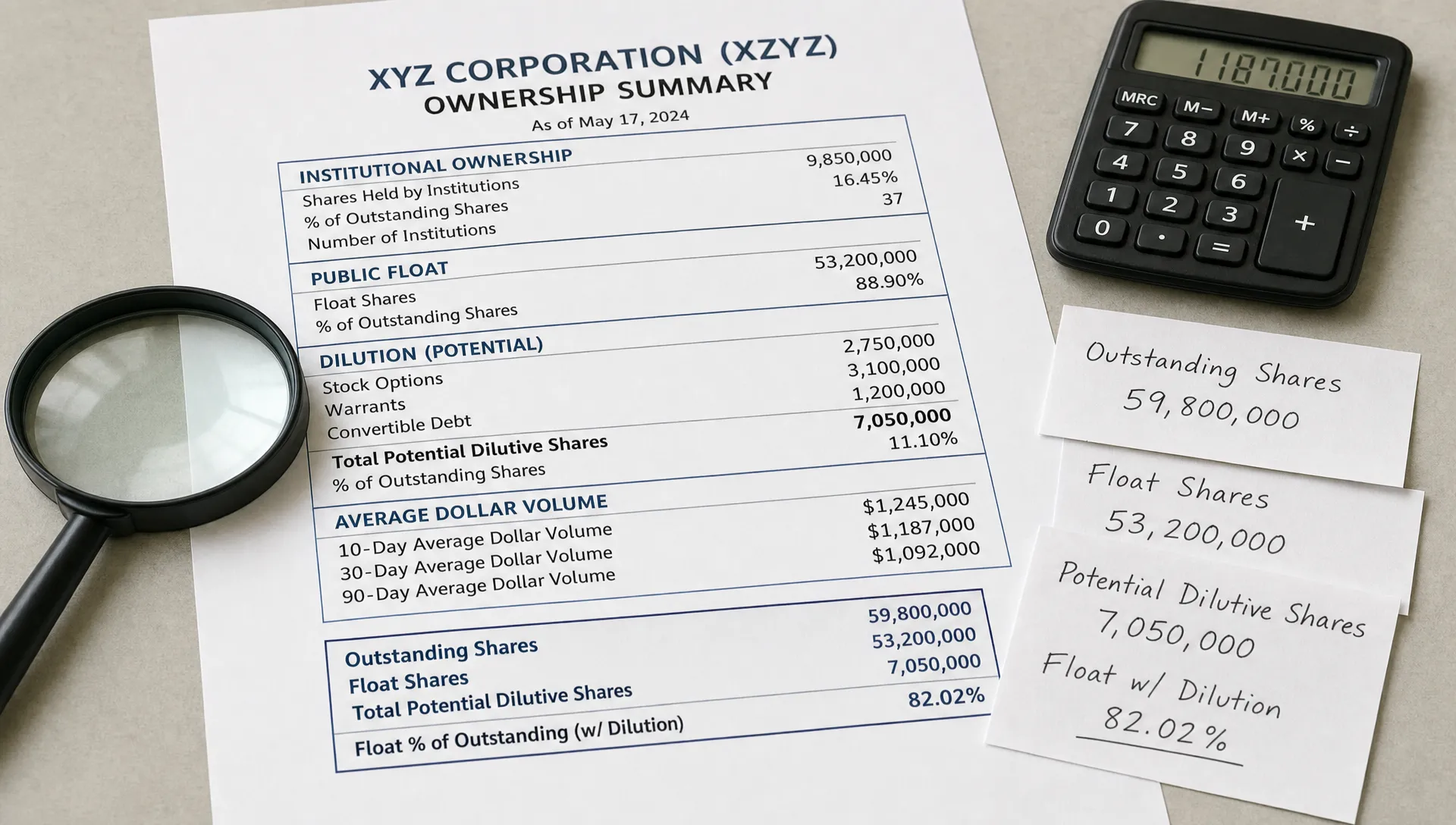
High institutional ownership can look like one of the cleanest shortcuts in stock research. If professional investors own a large share of a company, the thinking goes, they must have done the diligence. In large, liquid companies, that assumption is already incomplete. In penny stocks, it can be dangerous.
Penny stocks with high institutional ownership need scrutiny because the headline percentage can overstate conviction, understate exit risk and hide the details that matter most: float, dilution, filing lag, liquidity and who the holders actually are.
A high ownership number is not useless. It can point you toward stocks that have attracted serious capital, specialist microcap funds or activist attention. But it should be treated as a research prompt, not a buy signal.
Why institutional ownership is harder to read in penny stocks
A penny stock is usually thought of as a low-priced, speculative security, often trading below $5 per share. Some trade on major exchanges. Others trade over the counter. Either way, the category tends to include companies with smaller market caps, thinner trading volume, more financing risk and less analyst coverage than larger public companies.
Those traits change the meaning of institutional ownership.
In a mega-cap stock, a few large funds may own billions of dollars of shares and still represent only a modest portion of the float. In a penny stock, a relatively small dollar position can represent a large percentage of available shares. A fund owning $5 million of a $40 million company may look highly committed by percentage, even if the position is small for the fund.
The data can also be stale. Institutional ownership is often compiled from filings such as 13F reports, which are filed after quarter end. By the time a retail investor sees the number on a data platform, the institution may have trimmed, exited or hedged in a way that is not visible in the ownership snapshot.
If you need a broader foundation before analyzing low-priced names, Upside Invest has a guide on how to read institutional ownership of a stock that explains why the percentage alone can mislead.
What high institutional ownership can actually mean
High institutional ownership can mean several different things. Some are constructive. Others are neutral or even risky. The job is to classify the ownership before you assign meaning to it.
| Holder pattern | What it may signal | Why it needs scrutiny |
|---|---|---|
| Passive index or ETF ownership | The stock may be included in a small-cap, sector or thematic basket | Buying may be rules-based rather than conviction-based |
| Microcap specialist funds | The company may have attracted investors who understand smaller stocks | Specialist funds can exit quickly if liquidity, financing or governance deteriorates |
| Activist or concentrated holders | Investors may be pushing for strategic change | Control battles, dilution disputes or asset sales can create volatility |
| Broad institutional breadth | More institutions may be watching the company | Breadth can still come from tiny positions that do not imply strong conviction |
| Deal-related ownership | Institutions may have participated in financing, restructuring or a merger situation | Warrants, convertibles or lockups can complicate the cap table |
The same ownership percentage can tell two very different stories. A 55% institutional ownership level spread across long-term microcap funds is not the same as 55% held mostly by passive vehicles, arbitrage desks or recent financing participants.
That distinction matters because penny stocks are more vulnerable to sharp repricing when one large holder changes its mind. In a thinly traded stock, even a modest institutional sale can pressure the price for weeks.
The biggest risks hiding behind the headline number
Filing lag can turn old conviction into a current trap
Ownership data is not real-time. In the United States, many institutional positions are reported through 13F filings, which generally arrive up to 45 days after the end of a calendar quarter. That means a position disclosed in mid-May could reflect holdings from March 31.
In a liquid blue-chip stock, that delay may not matter as much. In a penny stock, one financing announcement, delisting notice, trial update, customer loss or reverse split proposal can change the investment case overnight.
A high ownership figure based on old data can therefore create false comfort. Investors should always ask when the data was last updated, what period it reflects and whether any major events occurred after the reporting date.
Float math can exaggerate the signal
Institutional ownership is usually shown as a percentage of shares outstanding or float. In penny stocks, the difference matters. Shares outstanding include all issued shares, while float attempts to measure the shares actually available for public trading.
A company with heavy insider ownership, restricted shares or strategic holders may have a small float. If institutions own a meaningful portion of that float, the stock can become extremely sensitive to order flow. This may create upside when demand appears, but it can also intensify downside when holders sell.
High ownership can look like support. In practice, it may mean there are fewer natural buyers left if sentiment turns.
Liquidity risk cuts both ways
Institutions have portfolio rules, risk limits and redemption pressures. If a fund needs to reduce exposure, it may not care that the stock is thinly traded. It needs to sell.
For penny stocks, average daily dollar volume is often more useful than share volume. A stock that trades 2 million shares per day at $0.25 only trades $500,000 in daily dollar volume. A single institutional position worth several million dollars may be difficult to exit without moving the price.
This is why a high institutional ownership screen should always be paired with liquidity analysis. Look at dollar volume, bid-ask spreads, trading halts, exchange status and the number of days it would take a large holder to exit based on average volume.
Passive ownership is not the same as research conviction
Some investors assume institutional ownership means a professional analyst reviewed the company and built a thesis. Sometimes that is true. Often it is not.
Passive funds may hold a penny stock because it sits inside an index. Quant funds may own it because it fits a factor model. ETFs may hold it because of sector exposure. Those positions can disappear if the company is removed from an index, fails listing requirements or no longer fits the model.
In those cases, high institutional ownership is mechanical. It does not mean the institution believes the company is undervalued.
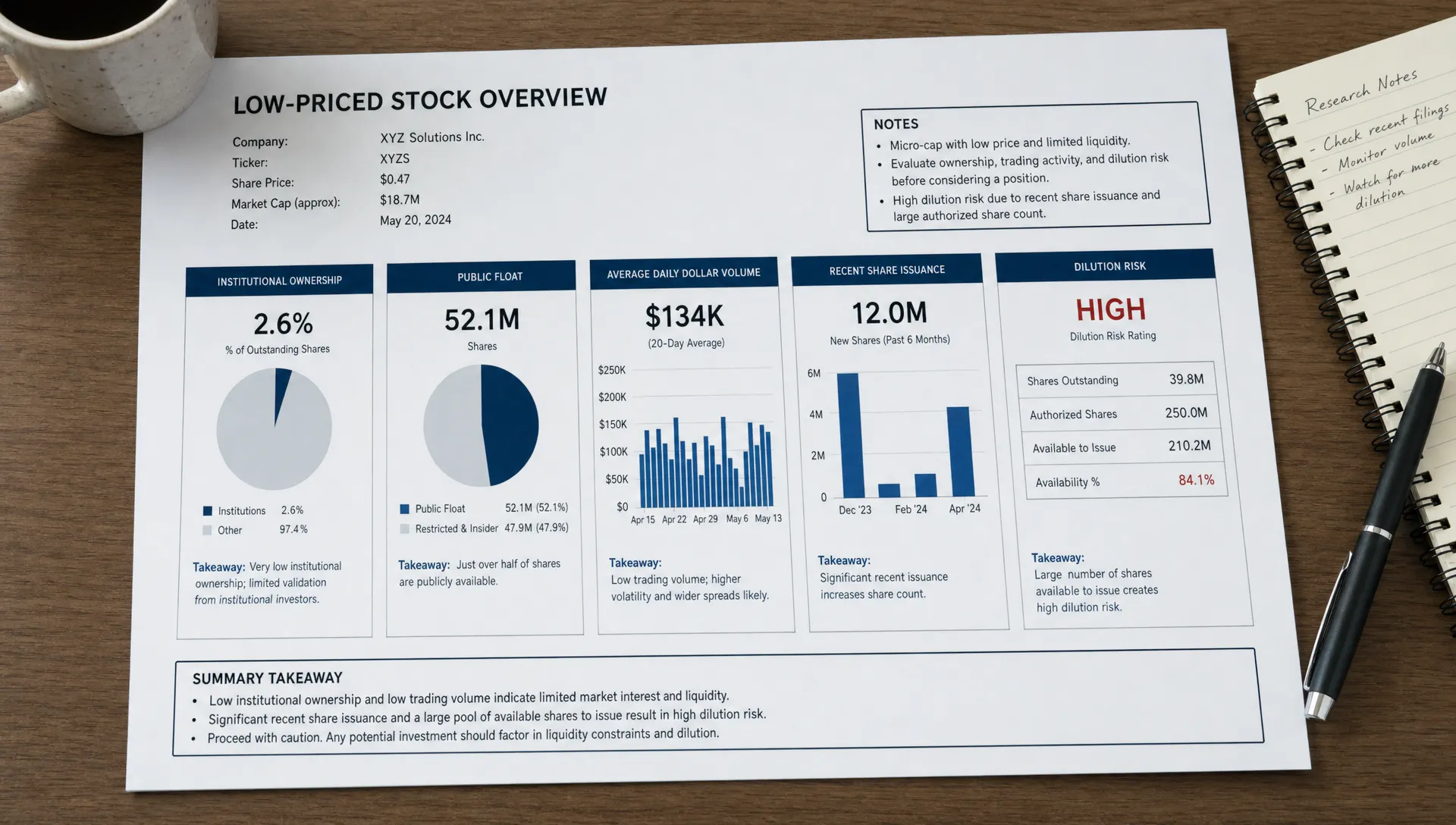
Dilution can overwhelm ownership signals
Many penny stocks rely on external financing. That can include secondary offerings, private placements, convertible notes, warrants or at-the-market programs. These tools may be necessary for survival or growth, but they can dilute existing shareholders.
Institutional participation in a financing can look bullish at first. A fund putting new money into the company may suggest confidence. But the terms matter. If the deal includes discounted shares, reset provisions, warrants or convertible securities, future selling pressure may be built into the structure.
A retail investor should read recent financing documents, shelf registrations and prospectus supplements when available. The question is not only who owns the shares today. It is also how many shares may exist tomorrow.
A practical due diligence framework
The goal is not to avoid every penny stock with high institutional ownership. The goal is to separate useful confirmation from misleading comfort.
Verify the source and timing
Start by identifying where the ownership number comes from. Is it based on 13F filings, 13D or 13G beneficial ownership filings, proxy statements, company disclosures or a third-party aggregator? Each source answers a different question.
13F data can show long positions held by large investment managers, but it does not show short exposure and may not capture the full economic picture. 13D and 13G filings can identify major beneficial owners above certain thresholds. Proxy statements may provide insider and major holder context. Company investor presentations can be helpful, but they should not be the only source.
Good investing research starts with visibility into the underlying records. The same principle applies in business operations, where firms such as DataOngoing's AI and NetSuite consulting team focus on turning opaque system data into clearer audit trails and actionable insight. Investors should bring that same mindset to ownership data: trace the number back to its source before relying on it.
Convert percentages into dollars and shares
A percentage can feel more impressive than it is. Convert institutional ownership into actual shares and approximate dollar value.
If a well-known fund owns 8% of a $25 million penny stock, the position may be only $2 million. That could be meaningful for the company, but negligible for the fund. A small position for the institution may not deserve the same weight as a top holding.
This also helps you estimate exit risk. Compare the position size with average daily dollar volume. If a holder owns $6 million of stock and the company trades $300,000 per day, the exit could be disruptive.
Classify the holders
Not all institutions behave the same way. Separate holders into categories such as passive managers, microcap specialists, activist funds, hedge funds, family offices, venture-linked investors or deal participants.
Then look for alignment. A long-term microcap investor that has owned the stock through multiple filings may provide a stronger signal than a holder that appeared after a financing and has no clear history with the company. Persistent ownership is usually more informative than a one-quarter spike.
Upside has written more broadly about why the highest institutional ownership stocks are not always safer, and that caution becomes even more important in lower-priced names.
Compare ownership with insider behavior
Institutional buying can be encouraging, but insider behavior adds context. If institutions are buying while insiders are selling heavily, you need to understand why. Insider sales are not always bearish, but repeated sales near financings, promotions or weakening fundamentals deserve attention.
On the other hand, insider ownership combined with stable institutional ownership can suggest stronger alignment. The key is to evaluate the whole ownership profile rather than isolating one metric.
For a broader checklist of related signals, including insiders, float, short interest and dilution, review Upside's guide to stock ownership data every investor should track.
Track change, not just the snapshot
The direction of ownership often matters more than the current level. A penny stock with 40% institutional ownership that has been rising for several quarters may be more interesting than a stock with 70% ownership that is declining.
Look for consistency across reporting periods. Are the same holders adding? Are new specialist investors appearing? Is ownership broadening or narrowing? Are large holders exiting into retail enthusiasm?
A static percentage misses those dynamics. Trend analysis can reveal whether institutional ownership represents growing conviction, stale ownership or a crowded trade beginning to unwind.
Red flags that deserve extra caution
Some patterns do not automatically disqualify a stock, but they should slow you down.
| Red flag | Why it matters |
|---|---|
| High ownership paired with very low dollar volume | Large holders may struggle to exit without pressuring the price |
| Institutional ownership jumped after a discounted financing | The ownership may reflect deal mechanics more than open-market conviction |
| Ownership data is old and major news has occurred since | The current holder base may look very different |
| Multiple reverse splits or repeated share issuance | Dilution may be a recurring part of the business model |
| Heavy passive ownership with weak fundamentals | The stock may be vulnerable to index removal or rules-based selling |
| Institutions own a lot but insiders own very little | Alignment may be weaker than the headline number suggests |
| One or two holders dominate the float | A single decision can have an outsized impact on price |
The most concerning situations combine several of these risks. For example, a penny stock with high institutional ownership, repeated dilution, low dollar volume and stale filings may be more fragile than the ownership percentage suggests.
What a healthier setup can look like
High institutional ownership can still be a positive signal when the details support it.
A healthier setup may include stable or increasing ownership across several quarters, a mix of credible specialist investors, reasonable liquidity, improving fundamentals, limited recent dilution and insider alignment. It is also better when ownership is not overly concentrated in one fund that could become a forced seller.
Company quality still matters most. Institutional ownership should complement analysis of revenue growth, cash runway, margins, debt, product traction, governance and valuation. A weak business does not become strong because a fund owns it.
The most useful question is not whether institutions are present. It is whether their presence improves the probability-weighted investment case after you account for liquidity, dilution and timing.
How retail investors can use the signal without overtrusting it
For retail investors, the best use of high institutional ownership is as a filter for deeper work. It can help you prioritize names that may have attracted professional attention, but it should not replace independent judgment.
A simple process works well:
- Treat high ownership as a reason to investigate, not a reason to buy.
- Check whether the data is current, filing-based and float-adjusted.
- Identify who owns the shares and why they might own them.
- Compare position size with trading volume to estimate exit pressure.
- Review recent dilution, insider activity and major corporate events.
- Track changes over time rather than relying on one snapshot.
This keeps the signal in its proper role. It can point you toward an opportunity, but it cannot tell you whether the opportunity is attractive at the current price.
Frequently Asked Questions
Are penny stocks with high institutional ownership safer? Not automatically. High institutional ownership can indicate professional interest, but it can also reflect passive index buying, financing participation, stale filings or concentrated positions that create exit risk.
What is considered high institutional ownership for a penny stock? There is no universal threshold. The number should be judged relative to float, market cap, average dollar volume, holder quality and the company's financing history.
Why can institutional ownership data be misleading? The data may lag by weeks, exclude important economic exposures and fail to distinguish between passive holders, active specialists, hedge funds or deal-related investors.
Should I buy a penny stock because a major fund owns it? No. A major fund's position may be small relative to its overall portfolio, and its reasons for owning the stock may not match yours. Use the holding as one input in a broader due diligence process.
What should I check before trusting the ownership number? Check the filing date, source, float calculation, holder type, recent dilution, insider activity, liquidity and whether ownership is increasing or decreasing over time.
Make ownership data part of your process
Penny stocks with high institutional ownership can be worth researching, but the ownership number is only useful when you know what sits behind it. The strongest investors look at holder quality, timing, float, liquidity and dilution before drawing conclusions.
If you want to compare your allocation with verified investor behavior, Upside Invest helps you explore anonymous verified holdings, portfolio comparisons, trend tracking, top performer rankings and AI portfolio recommendations while keeping profiles private.