A Robo Investing Comparison for Hands-Off ETF Investors
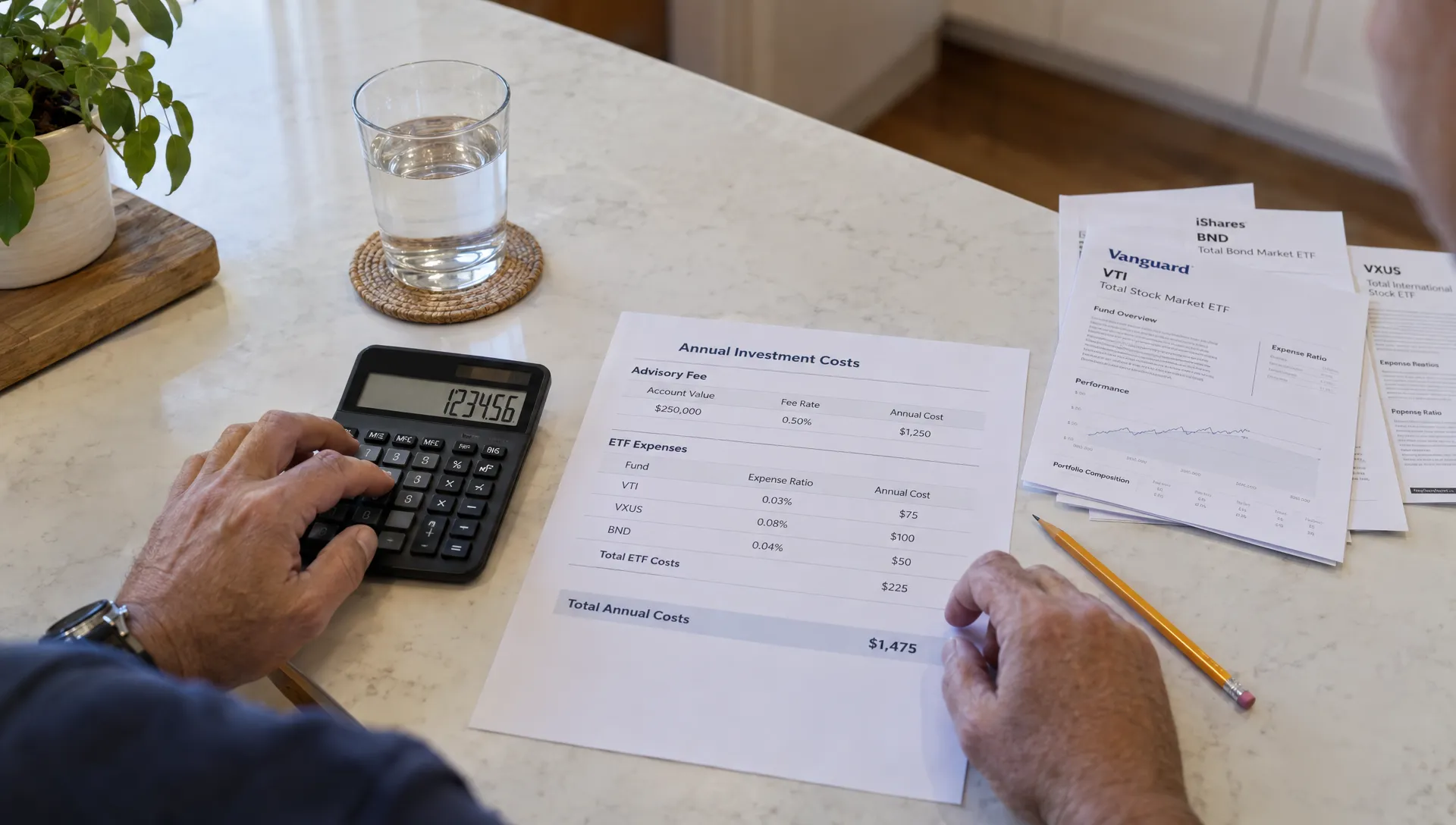
For hands-off ETF investors, a useful robo investing comparison starts with what happens after you deposit money: which funds you own, how much stays in cash, what you pay and how reliably the service keeps your portfolio on track. The best fit is not necessarily the platform with the lowest advertised advisory fee or the strongest recent return.
Betterment, Wealthfront, Schwab Intelligent Portfolios and Vanguard Digital Advisor are sensible starting points for a shortlist. Each offers automated portfolio management, but their pricing structures, investment choices and cash policies deserve separate attention.
The practical answer: Start with the service that matches your account type and desired level of involvement, then compare its total cost against a similar portfolio elsewhere. Treat tax features and access to advice as benefits to evaluate, not automatic reasons to pay more.
The comparison below focuses on diversified ETF investing rather than automated stock picking. Provider fees, account eligibility and program terms can change, so check the linked official pages before opening or transferring an account.
What belongs in a robo investing comparison?
A robo-advisor typically recommends an allocation from a questionnaire, invests your deposits and rebalances the account. That can remove recurring decisions without removing investment risk.
For a hands-off investor, the important differences are these:
| Provider | Why it belongs on an ETF shortlist | Main trade-off to examine |
|---|---|---|
| Betterment | Automated diversified portfolios with portfolio and tax-management options | How its pricing applies to your balance and contribution schedule |
| Wealthfront | Automated ETF investing with a strong emphasis on taxable-account features | Whether the selected strategy remains ETF-based and suits your tax situation |
| Schwab Intelligent Portfolios | ETF portfolio management without an advisory fee in its standard offering | Required cash allocation, ETF expenses and the economics of cash |
| Vanguard Digital Advisor | Automated investing built around Vanguard funds | Available portfolio options, account eligibility and the applicable advisory cost |
These are best-fit categories, not a performance ranking. Different stock, bond and cash allocations can explain more of a return difference than the platform managing them.
Betterment: Start here if you want portfolio options
Betterment is worth examining if you want automated investing but also want to compare different portfolio approaches. Its offering includes a core diversified approach alongside other investment options, with availability depending on the account and service selected.
In a robo investing comparison, evaluate Betterment’s applicable pricing tier before focusing on portfolio extras. A monthly charge can have a different impact on a small account than a percentage-based fee.
Use Betterment’s official pricing page to check how your balance and recurring deposits affect the charge. Also distinguish the digital service from any offering that includes additional human advice.
For a hands-off investor, customization is useful only when it serves a clear preference. More portfolio choices do not automatically improve diversification or make investing easier.
Wealthfront: Examine it closely for taxable ETF investing
Wealthfront’s automated investing offering is a relevant candidate if you want a managed ETF portfolio and are particularly interested in tax-loss harvesting. Review the account-specific availability and terms of those tools rather than assuming every investment product works the same way.
Its broader investment lineup also makes product selection important. An automated ETF portfolio and a direct-indexing strategy are not interchangeable: direct indexing can involve owning individual stocks rather than obtaining the exposure solely through funds.
A robo investing comparison should separate those products before evaluating fees or tax benefits. If your goal is a straightforward ETF account, compare that specific offering against the equivalent service elsewhere.
Check Wealthfront’s current pricing and disclosures, then ask whether the tax features address a problem you actually have. An IRA investor, for example, does not receive the same current tax benefit from harvesting investment losses as an investor in a taxable account.
Schwab Intelligent Portfolios: Look beyond the zero advisory fee
Schwab markets its standard Intelligent Portfolios offering without an advisory fee. That is a meaningful distinction, but it does not mean the entire arrangement has no costs or trade-offs.
Underlying ETFs have operating expenses. The portfolio also includes a required cash allocation, which deserves attention alongside the stock and bond holdings.
Cash can support withdrawals and reduce volatility. It can also reduce participation in rising markets compared with a more fully invested portfolio. Its effect depends on the allocation, interest earned and market conditions, so treating every dollar of cash as a hidden fee would be misleading.
Review Schwab’s Intelligent Portfolios explanation and disclosures for its cash policies and program requirements. Compare the resulting stock, bond and cash mix with competing recommendations, not just the advisory-fee line.
Vanguard Digital Advisor: Consider it for a fund-centered approach
Vanguard Digital Advisor belongs on the shortlist for investors who want automated portfolio management built around Vanguard funds. The key decision is whether its available account types, investment options and planning features match what you need.
For this part of your robo investing comparison, examine the applicable advisory charge together with underlying fund expenses and any fee offsets described in the disclosures. Do not assume that a familiar fund brand makes the managed service the cheapest option for every balance.
The Vanguard Digital Advisor page explains the service and its current requirements. Confirm which investment approach you would actually receive, especially if you have preferences about active management or portfolio customization.
A narrower menu can suit someone who wants fewer decisions, provided the resulting allocation fits their goals.
Compare total costs in dollars, not just percentages
An advisory fee is only one component of the cost. Fund expenses, subscription charges and account-related fees can also affect the amount you keep.
For illustration, consider a hypothetical $25,000 account with a 0.25% annual advisory fee and a weighted average ETF expense ratio of 0.08%. These figures are examples, not quotes from a particular provider.
| Illustrative cost | Calculation | Approximate annual amount |
|---|---|---|
| Advisory fee | $25,000 × 0.25% | $62.50 |
| ETF operating expenses | $25,000 × 0.08% | $20.00 |
| Combined ongoing cost | $25,000 × 0.33% | $82.50 |
Actual charges depend on account values during the year. ETF expenses are reflected in fund performance rather than normally appearing as a separate brokerage bill.
A useful robo investing comparison calculates these costs at your expected balance, not the balance used in a provider’s marketing example. Repeat the calculation for your likely balance in a few years if you expect substantial contributions.
Small accounts need a separate subscription check
A flat monthly fee can look modest while representing a substantial percentage of a small account. A hypothetical $5 monthly charge is $60 annually, equivalent to 1.2% of a $5,000 balance before fund expenses.
That same $60 equals 0.12% of a $50,000 balance. The pricing structure matters as much as the headline amount.
Check for transfer-out charges, closure fees and optional service costs too. These may not affect annual performance every year, but they can make switching providers more expensive than expected.

Evaluate tax tools according to the account you own
Tax-loss harvesting generally involves selling an investment at a loss and purchasing a replacement to maintain market exposure. The realized loss may offset capital gains and, within applicable limits, ordinary income.
The value depends on your tax circumstances, available losses and future transactions. Harvesting can defer taxes rather than eliminate them, because replacement holdings may have a lower cost basis.
For a taxable investor, a robo investing comparison should examine harvesting eligibility, replacement-fund practices and coordination with investments held elsewhere. For an IRA investor, allocation, fees and withdrawal planning usually deserve more attention than harvesting claims.
Watch for wash sales across accounts
A robo-advisor may not see purchases in another brokerage account, your IRA or a spouse’s account. Those purchases can matter under the wash-sale rules.
The relevant period generally includes the 30 days before and 30 days after a loss sale when substantially identical securities are acquired. A different ETF ticker alone does not establish that two investments are sufficiently different for tax purposes.
The IRS discussion of investment income and wash sales is a useful starting point. Ask the provider what it monitors and what remains your responsibility, particularly if you hold similar funds in several places.
Do not count projected tax savings as a guaranteed fee rebate. A tax feature can be useful without delivering the same benefit every year or to every investor.
Test how hands-off the service really is
Automation should reduce maintenance, not simply automate purchases. Before funding an account, understand how the service handles recurring deposits, portfolio drift and eventual withdrawals.
Rebalancing is especially important. A provider might use new deposits, trades or a combination to restore the target allocation. Different methods can have different tax consequences in a taxable account.
Your robo investing comparison should also distinguish customer support from personalized financial advice. Help resetting a password is different from discussing retirement withdrawals, a concentrated employer-stock position or a change in household income.
Ask practical questions before opening the account:
- Deposits: How quickly are contributions invested, and can the schedule be changed easily?
- Withdrawals: What must be sold, how long can delivery take and what tax consequences might follow?
- Support: Can you speak with someone, and does that conversation include investment advice?
- Transfers: Can existing holdings move in without being sold, and which assets might require liquidation?
For transfers, be particularly careful with appreciated investments. Moving cash after selling holdings is not economically equivalent to transferring securities in kind. Obtain a clear explanation of what the receiving service would do before authorizing a move.
Choose the allocation before judging the returns
A provider recommending more stocks may outperform a more conservative competitor during a strong equity market. That does not establish that its investment process is better.
Compare recommended stock, bond and cash weights first. Then examine international exposure, bond credit quality and concentration. Two portfolios with the same stock percentage can still behave differently.
This is where a robo investing comparison benefits from looking beneath fund names. Several ETFs can hold overlapping securities, while a short fund list can still provide broad diversification. Upside’s guide to comparing ETF portfolios before adding another fund explains how to examine those exposures.
If you review historical results, use comparable periods and establish whether returns include advisory fees. Also check whether the figures represent actual accounts, model portfolios or backtests. They are not interchangeable.
For a fairer evaluation, compare portfolio performance with an appropriate benchmark rather than defaulting to the S&P 500 for every allocation.
A practical way to make the final choice
Narrow the field to two services that support your account type and preferred investment approach. Complete their allocation questionnaires accurately, then place the recommendations side by side.
Calculate the annual dollar cost, identify required cash and confirm which tax tools apply to you. Finally, review support and transfer procedures.
Choose the option whose trade-offs you understand and can live with through a market decline. If the selection depends on one provider’s recent outperformance, revisit whether you are comparing similar levels of risk.
Frequently asked questions
What is the best robo investing platform for ETF investors? There is no universal winner. Betterment and Wealthfront are useful starting points for comparing automated ETF investing and tax tools. Schwab deserves consideration if you understand its cash allocation, while Vanguard may suit investors seeking its fund-centered approach. Your account type and total cost should drive the final choice.
Does Charles Schwab charge a robo-advisor fee? Schwab markets its standard Intelligent Portfolios service without an advisory fee. Underlying ETF expenses and required cash still matter. Additional services can have different pricing, so confirm which program you are considering.
Is robo investing worth paying for? It can be if automated deposits, allocation management and rebalancing help you maintain a suitable plan. A robo investing comparison should weigh that convenience against the lower explicit cost potentially available from managing a simple ETF portfolio yourself.
Should ETF investors include Fidelity Go in their shortlist? Fidelity Go is a relevant automated investing alternative, but it generally uses Fidelity Flex mutual funds rather than an ETF-only portfolio. If ETFs are a firm requirement, distinguish the investment vehicle before comparing fees. Mutual funds are not inherently unsuitable simply because they fall outside this article’s ETF focus.
Add context without taking over portfolio management
Selecting a robo-advisor does not mean you need to monitor it every day. A periodic review can help you confirm that the allocation still fits your goals and that fees remain reasonable.
Upside Invest provides verified investor holdings, anonymous portfolio sharing and portfolio comparison tools. Those can add context when you want to examine allocations and understand how other investors are positioned.
Use that information for research and benchmarking, not as a reason to copy a top performer or override your plan after every market move. Verified holdings do not establish suitability or guarantee future returns. The goal of hands-off investing is a manageable process, not a new stream of trading decisions.