Compare Portfolio Performance to a Benchmark Without Bias

Comparing your portfolio to a benchmark should make your decisions clearer. Too often, it does the opposite. Investors pick the S&P 500 after a good year, switch to a global index after a bad one, ignore deposits that changed their return or celebrate outperformance that came from taking far more risk than the benchmark carried.
A fair benchmark is not the index that makes you feel smart. It is the standard you would have accepted before knowing the result.
If you want to compare portfolio performance to a benchmark without bias, the process starts before the performance report. You need to define the portfolio's job, match the benchmark to that job, measure returns consistently and separate skill from risk exposure. Done well, benchmarking becomes a decision tool rather than a scoreboard.
What unbiased benchmarking really means
Bias-free benchmarking does not mean the benchmark is perfect. No index or peer group can fully capture your goals, tax situation, risk tolerance, cash needs and behavioral constraints. It means your comparison is honest enough to answer the question you are asking.
For most retail investors, an unbiased benchmark should meet four standards. It should be chosen in advance, match the assets and risks you actually own, use the same return measurement rules as your portfolio and remain stable long enough to evaluate a full market cycle.
The most useful benchmark is often called a policy benchmark. It represents the simple, low-maintenance alternative you could reasonably hold instead of your current portfolio. If your active choices cannot beat that alternative after considering risk and effort, the benchmark has done its job by revealing that.
Start with the question your benchmark should answer
Before choosing an index, define what you are trying to learn. Investors often skip this step and end up comparing against whatever market number appears on the news.
A benchmark can answer different questions:
- Did my portfolio outperform a simple passive alternative?
- Did I earn enough return for the risk I took?
- Did my stock selection add value or did I just ride a sector trend?
- Did my allocation perform better than similar investors with comparable constraints?
Those are not the same question. A portfolio with 70 percent global stocks, 20 percent bonds and 10 percent cash should not be judged only against a US large-cap equity index. It may lag during a tech-led bull market and still be doing exactly what it was designed to do. On the other hand, a concentrated US growth portfolio should not hide behind a conservative blended benchmark if it is taking equity-like risk.
The benchmark should reflect your stated objective, not your preferred narrative.
Choose a benchmark that matches what you actually own
The easiest way to create bias is to compare unlike things. If your portfolio holds international stocks, bonds, small caps, sector funds and cash, a single broad US stock index is probably too narrow. If your portfolio is almost entirely US mega-cap technology stocks, a global balanced benchmark may be too forgiving.
A better approach is to map your portfolio by asset class, geography, currency, market capitalization and major sector exposure. Then choose either one close benchmark or a blended benchmark that reflects those weights.
| Portfolio profile | More reasonable benchmark | Why it is fairer |
|---|---|---|
| US large-cap stock portfolio | US large-cap total return index | Matches the core market universe |
| Global stock portfolio | Global equity total return index | Includes both US and non-US exposure |
| 60 percent stocks and 40 percent bonds | 60/40 blended stock and bond benchmark | Reflects the portfolio's risk mix |
| Sector-heavy portfolio | Relevant sector index plus a broad market comparison | Separates sector exposure from selection skill |
| Portfolio with crypto allocation | Predefined crypto basket or documented BTC and ETH blend | Avoids choosing the winning coin after the fact |
| Income-focused portfolio | Broad asset benchmark plus income and drawdown measures | Captures both return and the income objective |
The key word is predefined. If you use a blended benchmark, set the weights before the evaluation period. A 70/30 stock and bond benchmark can be fair. A benchmark that changes every quarter to explain away underperformance is not.
Lock the benchmark before looking at results
A benchmark chosen after the fact is usually a defense mechanism. If your portfolio beats the S&P 500, you compare to the S&P 500. If it trails the S&P 500 but beats a dividend index, the dividend index suddenly feels more relevant. That is hindsight bias in a clean spreadsheet.
Write down your benchmark rules before reviewing performance. This does not need to be a formal investment policy statement. A simple note is enough: portfolio objective, target allocation, benchmark index or blend, rebalancing rule, evaluation period and the metrics you will use.
The same discipline shows up outside investing, where a performance marketing agency such as OPTYO defines KPIs before judging campaign results. Without preselected metrics, it becomes too easy to reward whatever happened to look good after the fact.
Investors need the same guardrail. Decide what success means before the market gives you a result to rationalize.
Measure return the same way on both sides
Even a well-chosen benchmark can mislead if your return calculation is inconsistent. The biggest issue for retail investors is cash flow timing. If you add money before a rally, withdraw before a decline or buy more during a drawdown, your personal return can differ sharply from the portfolio's underlying investment return.
There are two common return measures:
| Return method | What it measures | Best use |
|---|---|---|
| Time-weighted return | Performance of the investments without the effect of external deposits or withdrawals | Comparing a portfolio strategy to a benchmark |
| Money-weighted return | Your actual investor experience based on the timing and size of cash flows | Evaluating personal outcomes and behavior |
If you are judging the quality of your portfolio strategy, time-weighted return is usually cleaner. It reduces the distortion from deposits and withdrawals. If you are judging your lived outcome, money-weighted return matters because it captures when you actually put money to work.
You also need consistency on dividends, fees, taxes and currency. A benchmark price index that excludes dividends is not comparable to a portfolio return that includes reinvested dividends. A US dollar benchmark can distort the picture for an investor whose base currency is different. A pre-tax benchmark may be useful for strategy evaluation, but it will not fully explain your after-tax wealth.
A clean comparison should state these assumptions clearly. If you cannot explain how the return was calculated, do not put too much weight on the result.
Compare risk, not just return
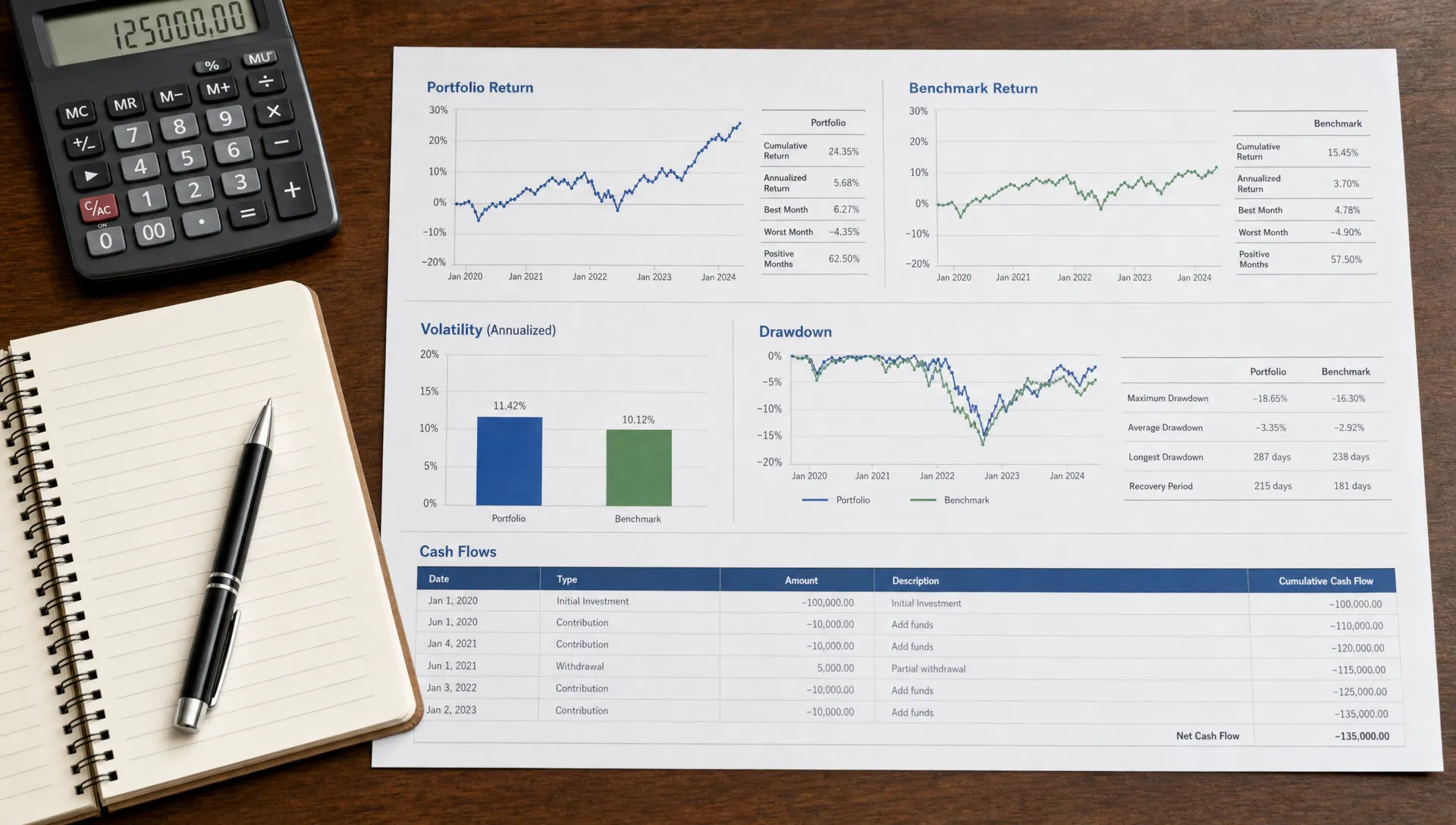
Return is only half the comparison. A portfolio that earns 14 percent when its benchmark earns 10 percent may look strong, but the conclusion changes if it required double the volatility, larger drawdowns or heavy concentration in one theme.
At minimum, compare portfolio and benchmark performance across these dimensions:
- Total return over the same period
- Volatility or standard deviation
- Maximum drawdown
- Sharpe ratio or another risk-adjusted measure
- Beta to the benchmark
- Sector, asset class and single-position concentration
- Overlap between funds, ETFs and individual holdings
This is where many benchmark comparisons become useful. They reveal whether you truly added value or simply loaded up on the hottest risk factor. A deeper portfolio comparison can reveal hidden risk, especially when several funds own the same underlying stocks or when a supposedly diversified portfolio depends on one market theme.
Watch for the most common benchmark biases
Benchmark bias usually enters through small choices that feel harmless. A different start date, a slightly more convenient index or a peer group that excludes failed investors can change the conclusion.
| Bias | How it appears | Cleaner practice |
|---|---|---|
| Hindsight bias | Choosing the benchmark after seeing results | Set the benchmark before the period starts |
| Cherry-picked dates | Starting the comparison at the most flattering point | Use fixed periods such as year-to-date, 1 year, 3 years and 5 years |
| Survivorship bias | Comparing only to funds or investors that still exist | Include complete data where possible and be cautious with peer rankings |
| Style drift | Changing strategy while keeping the old benchmark | Update the benchmark only when the portfolio objective truly changes |
| Cash drag confusion | Penalizing a portfolio for cash when cash is part of the plan | Include a cash allocation in the benchmark if cash is intentional |
| Risk mismatch | Comparing a high-risk portfolio to a lower-risk index | Compare both return and risk-adjusted return |
The hardest bias to catch is the one that flatters your identity as an investor. If you think of yourself as a long-term stock picker, you may downplay sector concentration. If you think of yourself as conservative, you may tolerate chronic underperformance as safety even when the portfolio is still taking equity risk. Good benchmarking makes those stories testable.
Use peer comparisons carefully
Market benchmarks are helpful, but they are not the only useful reference point. Peer comparisons can show what other investors with similar portfolios are buying, holding and outperforming with. That context is valuable because it reflects real behavior rather than a theoretical index.
The danger is turning peer performance into a popularity contest. If you compare yourself only to the top performers of the last month, you will likely chase recent winners. If you compare against anonymous portfolios without knowing whether they are verified, diversified or aligned with your risk level, the signal can become noise.
Peer benchmarking works best when it is verified, anonymized and segmented by relevant traits. A concentrated crypto-heavy portfolio should not be compared to a diversified retirement allocation. A dividend investor should not judge every decision against high-beta growth traders. Upside Invest is built around this type of context, and this guide to how Upside helps you benchmark your portfolio explains how verified investor data can complement traditional market indexes.
Used well, peer data does not replace your benchmark. It adds another lens. The index tells you what the market did. Verified peer behavior can help show how real investors positioned around that market.
A bias-resistant benchmarking workflow
You do not need a complex institutional process to benchmark fairly. You need a repeatable one.
- Define the portfolio's job: Decide whether the portfolio is meant for growth, income, capital preservation, speculation or a blend of goals.
- Map current exposures: Break holdings into asset classes, sectors, geographies, currencies and major themes.
- Select a benchmark or blend: Choose an index or weighted blend that resembles the portfolio's intended risk profile.
- Document benchmark rules: Write down the benchmark, weights, rebalancing schedule and evaluation periods before reviewing results.
- Use consistent return math: Decide whether you are using time-weighted or money-weighted returns, then apply it consistently.
- Compare risk and return together: Review excess return, volatility, drawdown, Sharpe ratio, beta and concentration.
- Separate allocation from selection: Ask whether results came from asset mix, sector exposure, security selection or cash timing.
- Review on a set schedule: Use quarterly or semiannual reviews for decisions, while treating daily and weekly moves as noise.
This workflow prevents the most damaging mistake: changing the rules every time the market changes the story.
When should you change your benchmark?
A benchmark should be stable, but not frozen forever. You should change it when your portfolio's purpose changes in a durable way. Moving from aggressive growth to retirement income is a real reason. Adding a permanent international allocation may be a real reason. Replacing one growth ETF with another growth ETF is probably not.
When you do change the benchmark, document the date and reason. Do not rewrite history. Old performance should still be judged against the benchmark that was in place at the time. Future performance can be judged against the new one.
This record matters because portfolio strategy evolves. The problem is not evolution. The problem is pretending the new benchmark was your standard all along.
How often should benchmark comparisons drive decisions?
Benchmarking should inform decisions, not force constant trading. A single month of underperformance rarely proves that your strategy is broken. Even a good portfolio can lag during periods when its style is out of favor.
Look for persistence and explanation. If your portfolio trails because international stocks lagged US stocks and your benchmark includes international exposure, that may be normal. If it trails because several funds overlap heavily, fees are high or you are repeatedly buying after momentum spikes, the benchmark is pointing to a fixable issue.
A useful review cadence for many retail investors is monthly monitoring and quarterly decision-making. That gives you enough information to notice drift without reacting to every market swing.
Frequently Asked Questions
What is the best benchmark for my portfolio? The best benchmark is the one that matches your portfolio's objective, asset mix, geography and risk level. For many investors, a blended benchmark is fairer than a single stock index.
Should I compare my portfolio to the S&P 500? You should use the S&P 500 only if it is a reasonable match for your portfolio. If you own bonds, international stocks, cash, crypto or small caps, a broader or blended benchmark may be more honest.
How do deposits and withdrawals affect benchmark comparisons? Deposits and withdrawals can distort personal returns because timing matters. Use time-weighted return to evaluate the portfolio strategy and money-weighted return to understand your personal investor experience.
Is beating the benchmark enough? Not always. You also need to compare risk. Beating a benchmark by taking much higher volatility, larger drawdowns or extreme concentration may not be true outperformance.
Are peer benchmarks useful? Yes, if the peer data is verified and relevant. Peer comparisons are most useful when they show how similar investors are positioned, not when they encourage you to chase the latest top performer.
Benchmark with more context and less guesswork
The goal is not to find a benchmark you can beat. The goal is to find a benchmark that tells the truth.
Upside Invest helps investors compare portfolios with verified investor holdings, anonymous profiles, return and Sharpe metrics, trend tracking and portfolio comparison tools. Instead of relying only on broad indexes or social media claims, you can see how real verified investors are positioned and use that context to make more informed decisions.
If you want a clearer way to evaluate your portfolio, explore Upside Invest and start benchmarking with better evidence, not hindsight.