ESOP Ownership vs Traditional Equity Structures
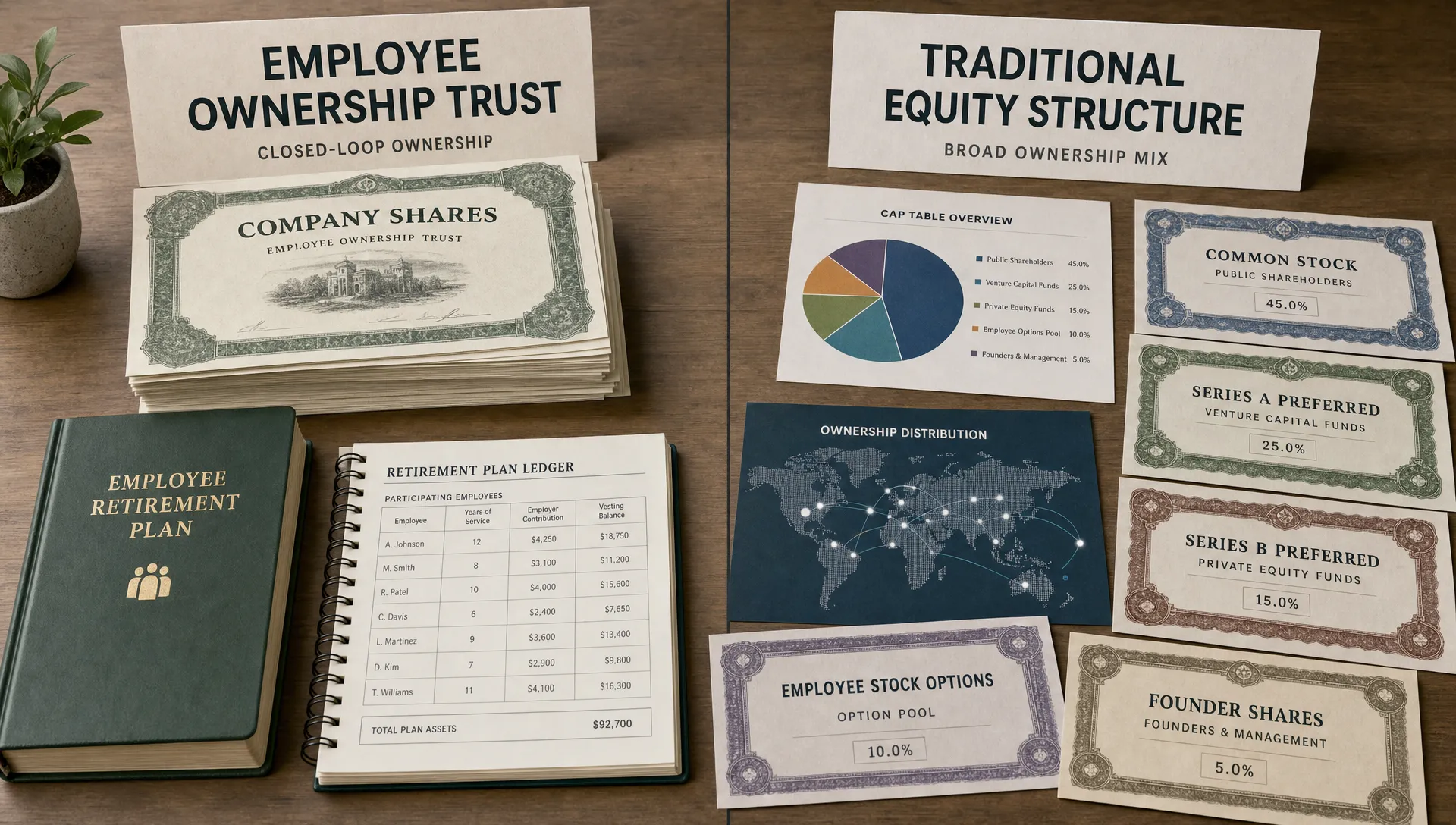
ESOP ownership is often described as a simple win for employees: workers get a stake in the business, owners gain a succession path, and the company builds a more aligned culture. That can be true, but it is only part of the story.
Compared with traditional equity structures, an employee stock ownership plan changes how ownership is held, how value is distributed, who has influence, and where risks sit. For employees, the difference can affect retirement wealth and financial concentration. For investors, it can change incentives, governance, liquidity, and capital allocation.
If you want the basic mechanics first, Upside’s guide to ESOPs for investors and employees covers the foundation. This article takes the next step: comparing ESOP ownership with traditional equity structures from an investor and employee decision-making lens.
What ESOP Ownership Actually Means
An ESOP is a qualified retirement plan that invests primarily in the employer’s stock. In most cases, a trust holds company shares on behalf of eligible employees, and employees receive allocations to individual accounts over time. Those accounts usually vest according to a schedule, and employees generally receive value when they leave, retire, or otherwise qualify for distribution under the plan rules.
That is very different from simply “giving employees shares.” ESOP ownership is typically governed by retirement plan rules, fiduciary duties, valuation requirements, and distribution obligations. In private companies, ESOP shares usually need an independent valuation. In leveraged ESOP transactions, the company may borrow money to buy shares from existing owners, then repay the debt over time while shares are released to employee accounts.
Traditional equity structures are broader. They include founder shares, venture capital ownership, private equity stakes, public company shares, stock options, restricted stock units, employee stock purchase plans, and direct share grants. These structures are usually built around a cap table, shareholder rights, and capital markets rather than a retirement-plan trust.
ESOP Ownership vs Traditional Equity at a Glance
The biggest distinction is not just who owns the shares. It is how ownership is organized.
| Dimension | ESOP ownership | Traditional equity structures |
|---|---|---|
| Legal form | Retirement plan trust holds shares for employees | Individuals, institutions, founders, funds, or employees hold equity directly or through brokerage accounts |
| Primary purpose | Employee retirement benefit, ownership transition, alignment | Capital raising, compensation, founder ownership, public investment, or strategic control |
| Employee cost | Often funded by company contributions rather than employee purchases | Employees may receive grants, exercise options, buy shares, or participate in purchase plans |
| Liquidity | Usually tied to retirement plan distribution rules and company repurchase obligations | Depends on whether shares are public, private, vested, transferable, or subject to lockups |
| Valuation | Private ESOP shares generally require independent appraisals | Public shares trade continuously; private shares are valued through financings, appraisals, or negotiated transactions |
| Governance | Trustee often votes ESOP shares, with limited pass-through voting in certain cases | Voting rights depend on share class, shareholder agreements, and public company rules |
| Risk profile | Employees may have job income and retirement wealth tied to the same company | Risk varies by holder; diversified investors can choose exposure size |
| Investor signal | May suggest long-term alignment, succession planning, or employee-centered culture | May indicate founder control, institutional oversight, venture growth, or public market discipline |
The table shows why “employee-owned” should not be treated as a shortcut for “better.” It can be better in the right circumstances, but it creates a different set of incentives and obligations.
Ownership and Control Are Not the Same Thing
One common misunderstanding is that ESOP ownership means employees directly run the company. In practice, that is rarely the case.
In many ESOPs, the trustee votes the shares held by the plan. Employees may have pass-through voting rights on major corporate events, depending on the company type and plan rules, but day-to-day control usually remains with management and the board. This means an ESOP can create economic participation without turning the company into a worker cooperative.
Traditional equity structures can also separate ownership and control. Public shareholders may own stock but have limited practical influence. Founders may hold super-voting shares. Private equity sponsors may control the board with less than 100% ownership. Venture-backed startups may allocate options to employees while investors retain protective rights.
For everyday investors, the key question is not simply “who owns shares?” It is “who has the power to make decisions, and who benefits from those decisions?” Upside’s article on what share of ownership means is useful context here because ownership percentage, voting rights, dividends, and liquidity can point in different directions.
How the Economics Differ
In an ESOP, employees often accumulate value through plan allocations rather than direct purchases. A company contributes shares or cash to the plan, and the plan allocates value to participants according to a formula. That formula often considers compensation, tenure, or other plan-defined factors.
In a traditional structure, economics depend on the equity type. Public stockholders buy shares and gain or lose based on market price movements and dividends. Startup employees may receive options that only become valuable if the company’s value rises above the exercise price. Public company employees may receive RSUs that vest into shares, creating taxable compensation when they vest. Investors in private rounds may receive preferred shares with liquidation preferences, anti-dilution provisions, or special rights unavailable to common shareholders.
This is why two companies can both say employees “own equity,” while the employee experience is completely different. One employee may have ESOP account value that grows slowly over years and pays out after departure. Another may hold startup options that could become highly valuable, expire worthless, or require cash to exercise. Another may receive RSUs that convert into liquid public shares as they vest.
If you want a deeper explanation of allocation, vesting, valuation, and distributions, see Upside’s guide to how ESOP stock works.
Tax, Liquidity, and Concentration Risk
ESOPs can offer meaningful tax advantages to companies and selling shareholders, but they also come with strict rules. The details vary depending on whether the company is a C corporation or S corporation, how the transaction is structured, and whether the ESOP is leveraged. This is an area where companies, employees, and investors should rely on qualified tax, legal, and financial professionals.
The more practical investor issue is cash flow. A leveraged ESOP can help fund ownership transition, but debt service may reduce flexibility. A mature ESOP-owned company may also face repurchase obligations as employees retire or leave and the company must provide cash for distributions. These obligations are manageable when planned well, but they matter for valuation and capital allocation.
For employees, the largest risk is concentration. If your salary, career prospects, and retirement wealth are all tied to one employer, the ESOP can amplify company-specific risk. Traditional equity compensation can create similar concentration, especially when employees hold large amounts of employer stock, but public company employees often have more control over when to diversify after vesting.
Equity is also only one part of financial and personal wellbeing. Companies that take an employee-centered approach often pair ownership education with retirement planning, health benefits, and broader support. For example, resources like personalized nutrition guidance show how wellbeing programs can extend beyond compensation and ownership design.

Culture and Incentives: Where ESOPs Can Shine
The strongest argument for ESOP ownership is alignment. When employees understand how their work connects to company performance and their ESOP account value, the structure can support retention, productivity, and a long-term mindset.
But the plan alone does not create that culture. A poorly communicated ESOP may feel abstract to employees, especially if distributions are far in the future. A strong ESOP culture usually requires transparent communication, business education, credible leadership, and a clear explanation of how value is created.
Traditional equity can also align incentives, but often in a more targeted way. Startup options can motivate early employees to take risk. Executive stock grants can align management with shareholders. Public company RSUs can help recruit and retain talent. The drawback is that traditional equity structures may concentrate the largest rewards among founders, executives, and early investors, while rank-and-file employees receive less meaningful participation.
Neither model is automatically fair or effective. What matters is whether the structure matches the company’s stage, cash flow, talent needs, and governance priorities.
When ESOP Ownership May Be the Better Fit
ESOP ownership tends to make the most sense when a company is stable enough to support the plan over time. It is especially common in private companies where an owner wants a succession path without selling to a competitor or private equity buyer.
| Scenario | Why an ESOP may work well |
|---|---|
| Founder or owner succession | The ESOP can create a buyer for existing owners while preserving company independence |
| Stable cash-flow business | Predictable earnings can support contributions, debt repayment, and future repurchase obligations |
| Employee retention priority | Broad-based ownership can reinforce long-term commitment |
| Values-driven ownership transition | Owners may prefer employee continuity over an outside sale |
| Mature private company | ESOP valuation and governance processes can fit businesses with established operations |
For investors, these conditions can be positive. A company with broad employee participation, disciplined leverage, and strong retention may have attractive long-term characteristics. But the ESOP should be evaluated as part of the full business model, not as a standalone reason to invest.
When Traditional Equity Structures May Be the Better Fit
Traditional equity structures often work better when a company needs flexible access to outside capital, rapid growth funding, or public market liquidity. Venture-backed companies, for example, usually rely on preferred stock rounds and stock option pools. Public companies rely on common stock, institutional ownership, and market pricing.
| Scenario | Why a traditional structure may work better |
|---|---|
| High-growth startup | Venture investors often require preferred shares, board rights, and financing flexibility |
| Publicly traded company | Liquid shares allow investors and employees to buy, sell, and diversify more easily |
| Heavy capital needs | Outside equity investors may be better suited to fund expansion |
| Complex strategic transactions | Traditional cap tables can provide more flexibility for mergers, acquisitions, or public offerings |
| Performance-based compensation | Options, RSUs, and executive stock grants can be targeted to specific roles or milestones |
This does not mean traditional equity is superior. It means it is designed for a different purpose. A venture-backed software company, a public consumer brand, and a family-owned manufacturing business may all need different ownership systems.
How Investors Should Interpret ESOP Ownership
For retail investors, ESOP ownership is best viewed as a signal that requires follow-up. It can signal employee alignment, succession planning, and long-term orientation. It can also introduce leverage, valuation complexity, and concentration risk for employees.
Useful questions include:
- How much of the company is owned through the ESOP?
- Is the ESOP leveraged, and how does debt affect cash flow?
- How are shares valued, especially if the company is private?
- What are the company’s repurchase obligations over time?
- Do employees understand the plan and participate in ownership culture?
- How does management communicate performance, risk, and long-term strategy?
- Are executives, employees, and outside shareholders economically aligned?
For public companies, some of this information may appear in annual reports, proxy statements, or retirement plan disclosures. For private ESOP companies, information may be harder to obtain, which makes governance and valuation discipline even more important.
The Bottom Line
ESOP ownership and traditional equity structures solve different problems. ESOPs are often built for broad employee participation, succession planning, and retirement wealth creation. Traditional equity structures are often built for capital formation, liquidity, founder control, institutional investment, or targeted compensation.
The better structure depends on the company. A well-run ESOP can create durable alignment and preserve a company’s identity. A poorly structured ESOP can create liquidity pressure and employee concentration risk. A traditional equity structure can provide efficient capital access and liquidity, but it can also leave most employees with limited upside.
For investors and employees, the right question is not “Is ESOP ownership good or bad?” The better question is “What incentives, risks, and obligations does this ownership model create?”
Frequently Asked Questions
What is the main difference between ESOP ownership and traditional equity? ESOP ownership usually means a retirement plan trust holds company shares for employees, while traditional equity is held directly by founders, investors, institutions, employees, or public shareholders. The legal structure, liquidity, voting rights, and tax treatment can differ significantly.
Does ESOP ownership mean employees control the company? Not usually. Employees may benefit economically from ownership, but voting power is often exercised by an ESOP trustee. Management and the board typically continue to run the company.
Is an ESOP better than stock options or RSUs? It depends on the company and the employee’s goals. ESOPs can support broad-based retirement wealth, while options and RSUs may provide more direct upside or liquidity, especially in public companies. Each has different risks, tax implications, and timing.
What should investors watch for in an ESOP-owned company? Investors should look at leverage, cash flow, repurchase obligations, valuation discipline, employee retention, governance, and whether the ownership culture is real or simply a label.
Compare Ownership Signals With Real Investor Behavior
Understanding equity structures is one layer of smarter investing. The next layer is seeing how real investors allocate capital across stocks, funds, sectors, and themes.
With Upside Invest, you can compare your portfolio with verified investors, track trends, review return and Sharpe metrics, and see what top performers are holding while keeping profiles private and anonymous. Use ownership structure as one signal, then combine it with real portfolio intelligence before making your next investment decision.