Fractional Stock Ownership Pros and Hidden Tradeoffs
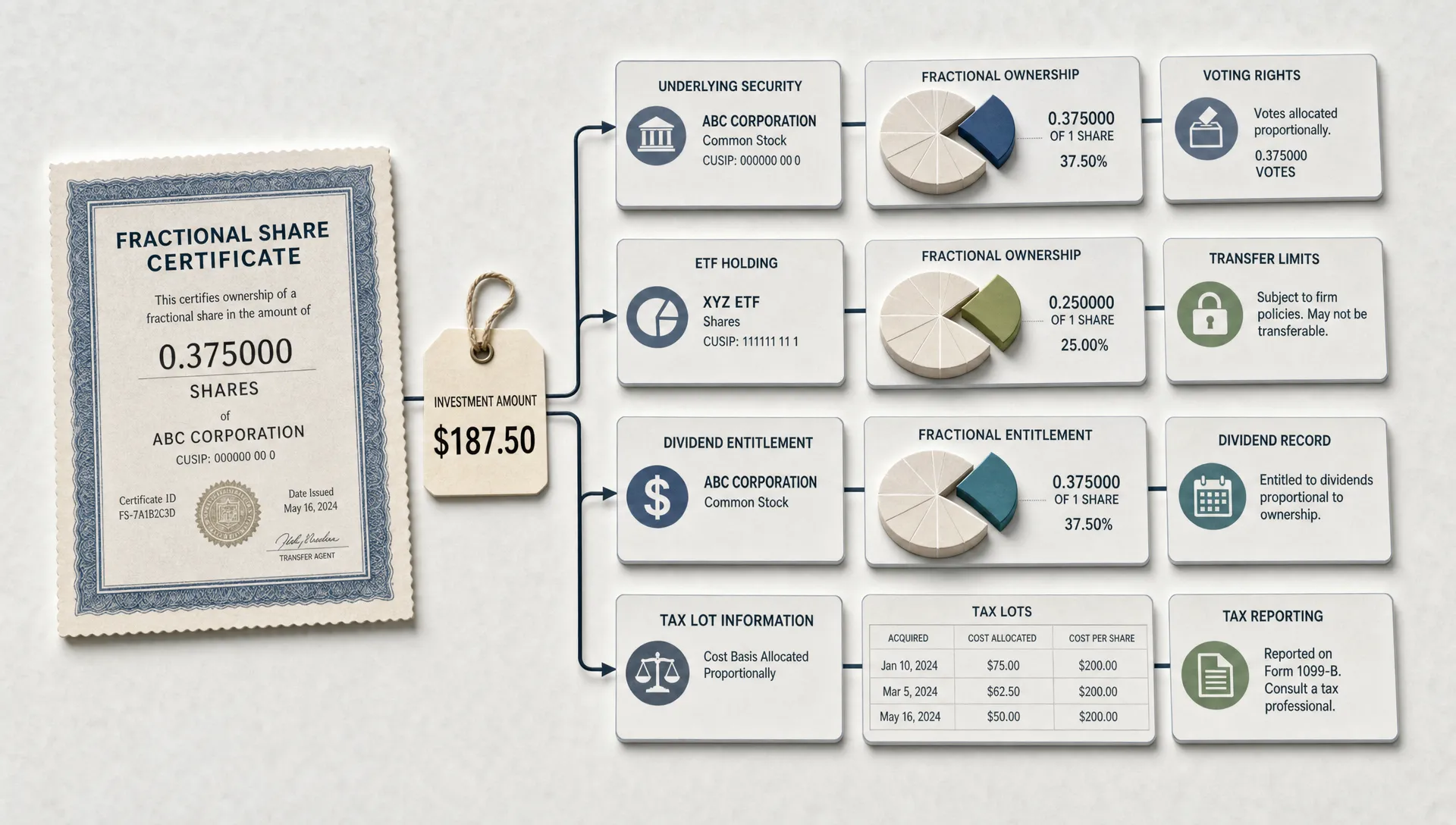
Fractional stock ownership has changed how retail investors build portfolios. Instead of saving enough cash to buy a full share of a high-priced stock or ETF, you can invest a dollar amount and receive a slice of a share. That sounds simple, and for many people it is genuinely useful.
But fractional investing is not just “the same thing, only smaller.” Your rights, order execution, tax records, transfer options, and even investing behavior can look different when your portfolio is built around slices instead of whole shares.
This guide breaks down the main advantages of fractional stock ownership, then digs into the hidden tradeoffs investors should understand before relying on it as a core strategy.
What fractional stock ownership really means
Fractional stock ownership means you own less than one full share of a company or fund. If a stock trades at $1,000 and you invest $100, your account may show 0.10 shares. If an ETF trades at $250 and you invest $25 every week, your position grows in fractions over time.
Economically, fractional shares usually track the value of the underlying security. If the stock rises 10%, your fractional position rises by roughly 10% before fees, spreads, taxes, or execution differences. If the company pays a dividend, you generally receive a proportional dividend based on the fraction you own.
The key word is “generally.” Fractional share programs are set by brokerage firms, and the exact terms can vary. FINRA notes that investors should review a brokerage’s fractional share policies because firms may differ on order handling, voting, dividends, transfers, and corporate actions in fractional share investing programs.
This matters because owning a fraction of a share is not always identical to holding the full share directly in every operational detail. If you want a broader foundation on what share ownership actually gives you, Upside’s guide to ownership of shares in a company explained simply is a useful starting point.
Why fractional shares became so popular
Fractional stock ownership solves a real problem: stock prices and fund prices do not always match the amount an investor wants to allocate.
A $500 monthly investing budget is easy to plan in theory, but awkward in practice if your target portfolio includes securities trading at $180, $430, and $900 per share. Without fractional shares, you may leave cash idle, overweight cheaper securities, or wait months to buy the next full share. Fractional investing lets you allocate by dollar amount instead.
The biggest benefits for everyday investors
Fractional shares are especially helpful for investors who are building wealth gradually, using recurring contributions, or trying to maintain a disciplined allocation.
- Lower starting barrier: You can invest in companies or ETFs without needing enough cash for one full share.
- More precise allocation: You can invest $100 into a position instead of buying whatever whole-share quantity happens to fit your cash balance.
- Less idle cash: Small cash balances can be invested rather than waiting until they add up to a full share.
- Easier diversification: A smaller account can hold several positions without being forced into only low-priced securities.
- More consistent dollar-cost averaging: Recurring investments become cleaner because each deposit can be invested according to your plan.
The practical result is that fractional ownership can make portfolio construction feel less clunky. Instead of asking, “What can I afford to buy one share of?” you can ask, “What allocation do I actually want?”
That shift is powerful. It moves the investor’s attention from share price to portfolio design. A $50 stock is not automatically cheaper than a $500 stock in valuation terms, and a $5 stock is not automatically a bargain. Fractional investing helps remove some of the psychological weight of the share price itself.
Fractional stock ownership can improve portfolio discipline
One underrated advantage is behavioral. Many retail investors struggle with inconsistent investing because buying full shares can create friction. If a stock becomes expensive in nominal terms, the investor may delay buying it. If cash is sitting in the account, the investor may use it for an impulsive trade.
Fractional investing can support better habits when paired with a clear plan. For example, an investor might decide to contribute $300 each month across a diversified set of ETFs and individual stocks. With fractional shares, the contribution can be split according to target weights rather than dictated by current share prices.
This is particularly useful for investors who rebalance gradually. Instead of selling one asset and buying another in full-share increments, they can direct new money toward underweight areas with more precision.
Still, discipline does not come from fractions alone. A poorly designed portfolio made of fractional shares is still a poorly designed portfolio. Fractional access improves execution, but it does not replace asset allocation, risk management, or research.
The hidden tradeoffs investors often miss
The tradeoffs of fractional stock ownership are not always obvious on the brokerage screen. The interface may show a clean dollar amount, a tidy position size, and a gain or loss percentage. Behind the scenes, however, the brokerage may aggregate orders, round dividend payments, limit transfers, or handle voting rights differently.

Here are the main issues to understand before making fractional shares the backbone of your portfolio.
| Area | Benefit | Hidden tradeoff |
|---|---|---|
| Access | Buy expensive stocks with small amounts | You may depend more heavily on the broker’s specific fractional program |
| Allocation | Invest by target dollar amount | Precision can encourage over-optimization and too many small positions |
| Execution | Simple recurring purchases | Fractional orders may be handled differently than standard whole-share orders |
| Dividends | Receive proportional income | Payments may involve rounding or small tax lots |
| Voting | Some brokers support proportional voting | Voting rights may be limited or handled through the broker |
| Transfers | Easy to build positions | Fractional shares may not transfer cleanly between brokers |
| Taxes | Small sales are possible | Many tiny tax lots can make records more complex |
1. Order execution may not work exactly like whole shares
When you buy whole shares, you can often choose from common order types like market, limit, stop, or stop-limit orders. With fractional shares, available order types may be more limited, depending on the broker.
Some firms execute fractional trades in real time. Others may batch or aggregate fractional orders. Some fractional orders are executed in dollar amounts, while others convert your dollar amount into a share fraction at execution. These details can affect the final price you receive, especially in fast-moving or less liquid securities.
For long-term investors buying diversified ETFs, small execution differences may not matter much. For investors making frequent trades in volatile stocks, they can matter more.
2. Fractional shares may be harder to transfer
One of the biggest hidden tradeoffs is portability. If you move your account from one brokerage to another, whole shares can often transfer through standard systems. Fractional shares may not transfer in the same way.
In many cases, the fractional portion must be sold, converted to cash, and then transferred as cash. That may create a taxable event in a taxable brokerage account. It can also leave you temporarily out of the market for that fractional portion.
This is easy to overlook when opening an account, but it matters if you later want to consolidate brokers, switch platforms, or move assets for better service.
3. Voting rights can be limited or indirect
Stock ownership is not only about price appreciation. Shares can also carry voting rights, although many retail investors do not use them actively. With fractional shares, voting may be proportional, unavailable, or handled according to the broker’s policies.
For example, if you own 0.25 shares, your broker may or may not allow you to vote that proportional interest. If you own both whole and fractional shares, the whole-share portion may be treated differently from the fractional portion.
For most passive investors, this may not be a dealbreaker. But if shareholder voting, governance, or proxy issues matter to you, fractional ownership deserves a closer look.
4. Dividends can create tiny payments and many tax lots
Fractional shares generally receive proportional dividends. If you own 0.10 shares of a company and the company pays a $1 dividend per share, you would expect about $0.10 before withholding or account-specific treatment.
That sounds straightforward, but fractional investing can create many small dividend payments and reinvestment transactions. Over time, especially with dividend reinvestment enabled, you may accumulate numerous tiny tax lots.
Good brokers provide tax forms and records, but investors should still understand the complexity. The IRS explains the broader tax treatment of investment income and capital gains in Publication 550, which is worth reviewing if you invest through a taxable account.
5. Corporate actions can be messy
Stock splits, reverse splits, mergers, spin-offs, and tender offers can all affect fractional shares. In some cases, the fractional portion may be paid out in cash rather than converted into a new fractional position. In other cases, treatment may depend on the broker, the transfer agent, or the terms of the corporate action.
This is not usually a daily concern, but it becomes important during major corporate events. If you hold many individual stocks in fractional amounts, you increase the number of situations where these edge cases might appear.
6. Fractional investing can encourage over-diversification
Because fractional shares make almost any stock feel accessible, it becomes tempting to buy tiny slices of everything. A portfolio with 80 small positions may look diversified, but it can also become unfocused and hard to monitor.
Diversification is not just the number of tickers you own. It is the distribution of risk across sectors, factors, geographies, market caps, and asset classes. Ten positions can be dangerously concentrated if they all move together. Fifty positions can still be risky if they are all exposed to the same theme.
This is where portfolio comparison becomes useful. If you want to understand whether your fractional positions are actually reducing risk or simply creating a longer ticker list, Upside’s guide to portfolio comparison tips that reveal hidden risk can help you evaluate overlap, concentration, and benchmark fit.
7. Small trades can make investors feel too active
Fractional shares lower friction. That is good for disciplined investing, but risky for impulsive trading.
When a trade costs only $5 or $10, it can feel harmless. Over time, however, frequent small trades may lead to performance drag, tax complexity, and a portfolio that reflects short-term emotion rather than a coherent strategy.
The danger is not fractional ownership itself. The danger is confusing access with an edge. Being able to buy a small slice of any popular stock does not mean that purchase improves your expected returns.
Fractional shares versus other fractional assets
Fractional stock ownership is part of a broader trend: investors increasingly want access to assets in smaller units. The same logic appears in fractional real estate, private funds, collectibles, and crypto.
But the mechanics are not the same across asset classes. A fractional share of a public stock is usually held through a brokerage account and priced in public markets. A fractional interest in real estate may involve different liquidity, fees, legal rights, and valuation methods. Direct property investing is another category entirely, where due diligence often involves location, rental demand, regulations, financing, and property-level inspection. For example, investors researching UAE real estate opportunities may compare listings and market information through platforms focused on the best property in Dubai before deciding whether direct property exposure fits their goals.
The lesson is simple: “fractional” describes position size, not risk level. Smaller entry amounts do not automatically make an investment safer, more liquid, or easier to understand.
When fractional stock ownership makes the most sense
Fractional shares are most useful when they help you implement a plan that already makes sense. They are less useful when they become a reason to chase every trending stock.
They tend to work well for investors who make recurring contributions, maintain target allocations, buy diversified ETFs, or gradually build positions in high-quality companies. They can also help beginners learn portfolio construction without waiting until they have a large account balance.
Fractional shares may be less appropriate for investors who need full voting control, expect to transfer assets frequently, rely on advanced order types, or trade illiquid and volatile securities where execution details matter.
A simple way to frame the decision is this: fractional ownership is a tool for precision, access, and automation. It is not a substitute for research, valuation, or risk management.
A practical checklist before using fractional shares
Before you rely heavily on fractional stock ownership, review your brokerage’s policies and your own investing habits. A few minutes of due diligence can prevent surprises later.
- Check order types: Confirm whether fractional trades support market orders only or allow limit orders.
- Review execution timing: Understand whether trades happen instantly, in batches, or at certain times of day.
- Confirm transfer rules: Find out what happens to fractional shares if you move to another broker.
- Understand voting rights: See whether fractional positions receive proportional voting access.
- Look at dividend handling: Check how dividends and dividend reinvestment are rounded and reported.
- Plan for taxes: Keep records clean, especially in taxable accounts with frequent contributions or reinvestment.
- Limit position sprawl: Decide how many holdings you can realistically monitor.
The best investors use fractional shares to make their strategy easier to follow, not to avoid having a strategy at all.
How real portfolio data can improve fractional investing decisions
Fractional investing gives you access. The next question is what to do with that access.
Retail investors often look at price charts, social media sentiment, or analyst headlines. Those inputs can be useful, but they are incomplete. It can also help to see how other verified investors are actually allocated, which positions they continue to hold, and where top-performing portfolios are showing concentration or momentum.
That is where Upside Invest fits naturally. Upside focuses on anonymous portfolio sharing and investor intelligence, helping users compare allocations, track trends, and learn from verified investor holdings while preserving privacy. Instead of buying fractional slices in isolation, you can evaluate how a position fits into a broader portfolio and compare your allocation choices against real investor behavior.
For investors who want to go beyond ticker-level decisions, tracking ownership and positioning data can add context. Upside’s article on stock ownership data every investor should track explains signals like institutional holdings, insider ownership, float, dilution, and short interest, all of which can help you think more clearly about what you own.
Frequently Asked Questions
Is fractional stock ownership real ownership? In most brokerage accounts, fractional shares give you economic exposure to the underlying stock or ETF, including proportional gains and losses. However, operational details like voting, transfers, and corporate actions can depend on the broker’s policies.
Do fractional shares pay dividends? Usually, yes. If a company or fund pays a dividend, fractional shareholders typically receive a proportional amount. Very small payments may involve rounding, and dividend reinvestment can create many small tax lots.
Can I transfer fractional shares to another broker? Often, fractional shares cannot be transferred as cleanly as whole shares. Many brokers liquidate the fractional portion and transfer the cash, which may create a taxable event in a taxable account.
Are fractional shares good for beginners? They can be very helpful for beginners because they reduce the amount needed to start and make diversification easier. Beginners should still focus on asset allocation, fees, risk, and long-term discipline rather than buying small slices of too many stocks.
Are fractional shares riskier than whole shares? The market risk is tied to the underlying investment. A fractional share of a volatile stock is still volatile. The additional risks are mostly operational and behavioral, such as broker limitations, execution rules, transfer restrictions, and overtrading.
The bottom line
Fractional stock ownership is one of the most useful changes in retail investing. It lowers barriers, reduces idle cash, supports recurring contributions, and helps investors build portfolios by allocation instead of share price.
The hidden tradeoffs are manageable, but they are real. Before building your portfolio around fractional positions, understand how your broker handles execution, voting, transfers, dividends, taxes, and corporate actions.
If you want to make fractional investing more informed, use real portfolio context rather than guesswork. With Upside Invest, you can compare allocations, learn from verified investor holdings, and see how your portfolio stacks up while keeping your profile private.