How a Partial ESOP Changes Control and Company Value

A partial ESOP can look simple on paper: employees own part of the company through an employee stock ownership plan, while founders, family owners, private equity sponsors or outside investors keep the rest. In practice, that “part” can change how control works, how capital gets allocated and how the company’s value should be interpreted.
For investors, executives and employees, the key question is not only “What percentage does the ESOP own?” It is “What rights, obligations and incentives come with that percentage?” A 15% ESOP with limited voting rights may barely change board control. A 35% ESOP financed with debt can reshape cash flow, valuation and future transaction options. A 51% ESOP can shift economic control even if day-to-day authority still sits with management.
This guide breaks down how a partial ESOP affects control and company value, with a practical lens for anyone analyzing an ESOP-backed business.
What a partial ESOP actually means
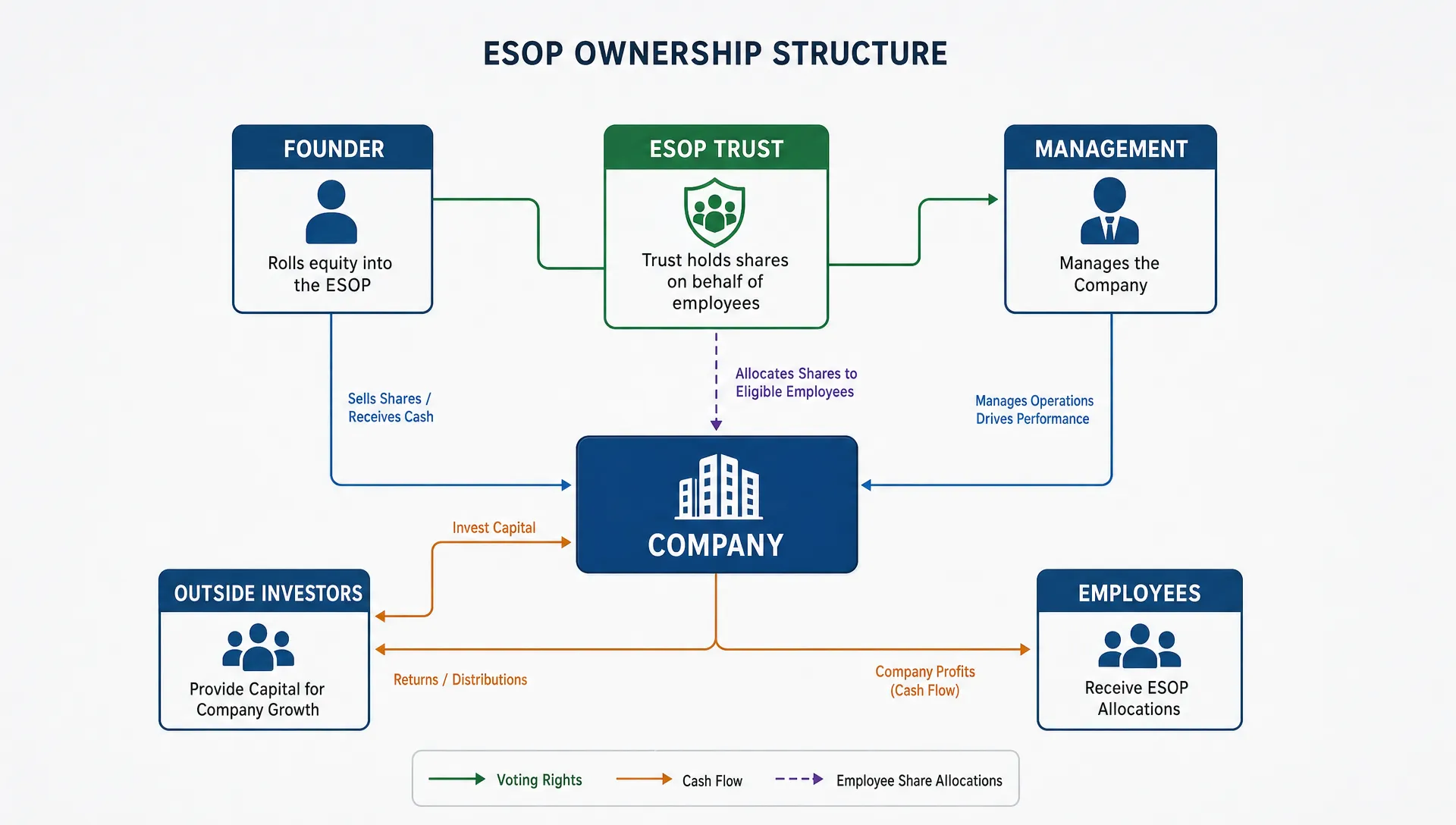
A partial ESOP is an employee stock ownership plan that owns less than 100% of a company’s equity. The remaining shares may be held by founders, family shareholders, management, private investors, a holding company or another strategic owner.
The ESOP itself is a qualified retirement plan. Employees usually do not directly hold shares in their own names while they are active participants. Instead, shares are held in an ESOP trust and allocated to employee accounts over time based on plan rules. A trustee acts on behalf of plan participants, with fiduciary duties that are separate from ordinary corporate management duties.
That distinction matters because partial ESOP ownership creates two layers of analysis:
- Economic ownership: Who benefits from future company value creation?
- Control rights: Who can vote, appoint directors, approve major transactions and influence strategy?
- Cash flow obligations: How will the company fund ESOP debt service, repurchases and employee distributions?
- Valuation mechanics: How are private shares appraised and what assumptions support that value?
If you are new to the mechanics of employee ownership, it helps to start with a broader ESOP explained for investors and employees before analyzing a partial structure.
The ownership percentage is only the starting point
A partial ESOP is often described by its ownership percentage: 10%, 30%, 49%, 51% and so on. That number is useful, but it can mislead if treated as the whole story.
A 30% ESOP may be meaningful for employee wealth building, tax planning and owner succession, yet still leave voting control with the selling shareholder. A 49% ESOP may look like a minority position, but if other shareholders are fragmented, the ESOP trustee can become a major force in governance. A 51% ESOP may technically create employee-owned majority economics, but management may continue running the company much as before.
Control depends on the documents around the transaction, not just the cap table. Important documents include the plan document, trust agreement, shareholder agreement, loan agreements, board resolutions and any seller note terms. In a private company, these documents determine how much influence the ESOP has when the company raises debt, sells assets, brings in new investors or considers a sale.
For outside investors, this means a partial ESOP should not be treated as a generic minority holder. It is a regulated retirement plan shareholder with fiduciary oversight, recurring valuation needs and potential cash obligations.
How a partial ESOP changes control
Control in a partial ESOP company usually changes in subtle ways before it changes in obvious ones. Management may stay in place, the board may look familiar and the founder may still own a large stake. Yet the introduction of an ESOP trust creates a new stakeholder whose interests must be considered in major decisions.
Voting rights may be limited, but not irrelevant
In many ESOP companies, the trustee votes the shares held by the plan. Participants may have pass-through voting rights on certain major corporate matters, depending on company type and plan design. These may include mergers, recapitalizations, liquidations or sales of substantially all assets.
For routine matters, employees usually do not vote like public shareholders. This surprises people who assume “employee-owned” means direct democracy. A partial ESOP does not usually turn the workforce into a daily operating committee.
Still, the trustee’s role can matter. If a proposed transaction affects the value of ESOP shares or treats the ESOP differently from other shareholders, the trustee has fiduciary duties to evaluate whether the action is fair to plan participants.
Board composition may or may not change
A partial ESOP does not automatically give employees board seats. In some companies, the board remains controlled by the founder, family or sponsor. In others, governance agreements may grant the ESOP trustee or employee representatives certain consultation rights, observer rights or formal board representation.
The practical question is whether the ESOP can influence strategic decisions. Examples include:
- Approval of a company sale
- Changes in dividend policy
- New debt issuance
- Large acquisitions
- Management compensation plans
- Related-party transactions
Even without direct board control, an ESOP can affect how directors think about fiduciary risk, employee communication and long-term value creation.
Seller influence may continue after the ESOP transaction
Many partial ESOPs are used as succession tools. An owner may sell a minority stake to the ESOP first, then sell more shares later. In a leveraged transaction, the seller may also receive a note from the company or ESOP structure, which keeps the seller economically tied to future performance.
This can be positive if the seller remains engaged and helps the company transition smoothly. It can become a risk if control rights, debt terms or future sale expectations are poorly aligned.
A partial ESOP is often a staged control transition, not a clean handoff.
How control differs by ESOP ownership level
The following table gives a simplified way to think about partial ESOP control. Actual outcomes depend on company documents, tax status, financing and fiduciary decisions.
| ESOP ownership level | Typical control implications | Main valuation issue |
|---|---|---|
| Less than 20% | Usually limited direct control, but employees gain economic exposure | Whether the stake is large enough to affect incentives or valuation assumptions |
| 20% to 49% | ESOP becomes a meaningful shareholder and governance factor | Minority discounts, debt service and future repurchase obligations |
| 50% to 79% | ESOP may hold majority economics, but board and management rights still matter | Sustainability of cash flow after debt, taxes and employee distributions |
| 80% to 99% | Company is nearly fully ESOP-owned, with minority holders still affecting decisions | Treatment of remaining shareholders and future buyout expectations |
This is why investors should separate “employee-owned” branding from actual governance. The percentage tells you the size of the ESOP stake. It does not tell you who controls the boardroom.
How a partial ESOP can increase company value
A partial ESOP can support value creation when it improves incentives, retention, tax efficiency and succession planning without overloading the company with obligations.
The clearest benefit is alignment. If employees understand the plan and believe their work can influence company value, ownership can reinforce productivity, retention and cost discipline. The effect is not automatic. A plan buried in legal documents, with no communication and no visible link to business performance, will not change behavior much.
A partial ESOP can also help a company solve succession without forcing a sale to a competitor or financial sponsor. This may preserve customer relationships, supplier continuity and management stability. For niche businesses, that continuity can be valuable.
Tax treatment can also matter. For example, ESOP-owned S corporation income is generally allocated to a tax-exempt retirement trust in proportion to the ESOP’s ownership, which can improve after-tax cash flow. In qualifying C corporation transactions, selling shareholders may be able to defer capital gains under Section 1042 if requirements are met, including a 30% ESOP ownership threshold after the sale. These are technical areas that require tax and legal advice, but they can materially affect transaction economics.
A partial ESOP can also create a disciplined ownership culture. Businesses that treat ownership seriously often become more transparent internally about margins, working capital and operating priorities. Even everyday operating decisions can become more value-conscious. In a retail or consumer-products company, for example, that discipline may show up in practical details such as inventory storage, merchandising and even space efficiency, the same type of operating focus seen in businesses selling space-saving closet organization products to help customers make better use of limited capacity.
How a partial ESOP can reduce or obscure company value
A partial ESOP can hurt value if the transaction price is too high, the financing is too aggressive or the company underestimates future repurchase obligations.
In a leveraged partial ESOP, the company typically borrows money or uses seller financing to fund the purchase of shares. That debt can create value for selling shareholders while adding risk for the operating business. Cash that might have gone toward hiring, product development, acquisitions or working capital may instead go toward debt service.
This does not mean leveraged ESOPs are bad. It means debt must be evaluated against recurring free cash flow, cyclicality and reinvestment needs. A company with stable margins and low capital intensity may handle ESOP debt comfortably. A cyclical industrial business with large capex swings may have less room for error.
Repurchase obligations are another major issue. When employees retire, leave or diversify, the company may need to buy back shares or fund distributions. In a partial ESOP, this obligation can grow as the share price rises, which is good for participants but can pressure company liquidity.
Investors should also be careful with private ESOP appraisals. ESOP shares in private companies are typically valued through periodic independent appraisals, not by daily market trading. The valuation may be reasonable, but it is still based on assumptions about cash flow, risk, comparables and discounts. If those assumptions are too optimistic, the ESOP price can overstate economic value.
For a deeper look at private appraisal mechanics, Upside has a separate guide on how ESOP stock price gets valued in private firms.
The valuation impact depends on who is analyzing the company
A partial ESOP does not have one universal valuation impact. The effect depends on whether you are an employee, selling shareholder, lender, outside investor or potential acquirer.
Employees may focus on account value, vesting and long-term wealth potential. Selling shareholders may focus on liquidity, tax treatment and whether they can retain influence. Lenders may focus on debt capacity and covenant protection. Investors and acquirers may focus on enterprise value, governance complexity, transaction approvals and future cash claims.
From an investor’s perspective, the ESOP affects value through several channels.
First, it changes free cash flow. Debt service, repurchase obligations and plan administration costs must be considered. A company can report strong accounting earnings while still facing liquidity pressure from ESOP-related cash needs.
Second, it changes risk. Fiduciary oversight, valuation disputes and employee communication obligations can add complexity. This may be manageable, but it should be priced.
Third, it changes incentives. A well-communicated ESOP can improve retention and productivity. A poorly understood ESOP may be little more than a retirement plan on paper.
Fourth, it changes exit options. A buyer may need to negotiate with the trustee, satisfy fairness requirements and address participant interests. That can affect deal timing, structure and certainty.
Minority discounts, control premiums and fair market value
Partial ESOP valuation often involves the tension between minority value and control value.
If the ESOP buys a minority stake, the appraiser may consider whether discounts apply for lack of control or lack of marketability. A minority shareholder usually cannot force dividends, replace management or sell the entire company. In a private firm, the shares also cannot be easily sold in a public market.
If the ESOP buys a controlling stake, the valuation may reflect some degree of control value. But control is not only a percentage issue. If governance documents restrict the ESOP’s practical authority or if management remains entrenched, the economic meaning of control can be more nuanced.
The Department of Labor has historically paid close attention to whether ESOPs overpay for shares. That is why valuation process quality matters. Good valuations include supportable forecasts, reasonable comparable company data, clear discount assumptions and careful review of transaction terms.
For investors, the most important question is not whether the ESOP valuation looks precise. It is whether the valuation is economically defensible under stress.
The company’s capital allocation changes after a partial ESOP
A partial ESOP adds a new recurring claim on capital. Management must balance business reinvestment, debt repayment, employee distributions, dividends to non-ESOP shareholders and potential future ESOP purchases.
This can create healthy discipline. It can also create tension.
A founder who still owns 60% may want dividends. The ESOP may benefit more from reinvestment that increases long-term share value. Lenders may want faster debt repayment. Employees may want clarity on how their account value will eventually translate into cash.
Capital allocation becomes more complex when the company plans a second-stage transaction. For example, an owner might sell 30% to the ESOP now and another 40% later. The valuation of that future sale may depend partly on how the company performed after the first ESOP transaction and how much debt capacity remains.
This is why partial ESOP analysis should include a multi-year cash model, not just a snapshot ownership table.
What to examine before investing in or benchmarking an ESOP company
If you are comparing companies, funds or private opportunities with ESOP exposure, do not stop at the phrase “employee-owned.” Ask what the structure does to control, value and liquidity.
A practical review should include these questions:
- What percentage does the ESOP own today?
- Is the ESOP stake minority, majority or expected to increase over time?
- Who appoints the board and who has veto rights?
- Is the ESOP leveraged, and what are the repayment terms?
- How are repurchase obligations forecast and funded?
- What valuation method supports the ESOP share price?
- Are non-ESOP shareholders receiving dividends, notes or special rights?
- How transparent is management with employees about business performance?
- Could the ESOP complicate a future sale or recapitalization?
For a fuller diligence framework, see Upside’s guide on how to analyze ESOP companies before investing.
When a partial ESOP is a positive signal
A partial ESOP is more likely to be value-positive when the company has durable cash flow, conservative leverage, credible management and a culture that can turn ownership into better decisions.
The strongest structures usually share a few traits. The transaction price is supported by realistic forecasts. Debt service leaves room for reinvestment. Employees receive plain-language communication about how the plan works. The company models repurchase obligations before they become urgent. Governance rights are clear enough that major decisions do not become a legal maze.
In these cases, a partial ESOP can create a useful bridge between private ownership and broader employee participation. It can help a founder diversify, give employees a path to wealth creation and preserve company independence.
When a partial ESOP is a warning sign
A partial ESOP deserves extra scrutiny when it appears designed mainly to create seller liquidity at a high valuation. Warning signs include aggressive projections, heavy leverage, unclear governance, weak cash conversion and little communication with employees.
Another red flag is a mismatch between ESOP obligations and business volatility. A company with unpredictable revenue, high fixed costs or large capital needs may struggle if ESOP debt and repurchase liabilities are layered on top of ordinary operating risk.
Investors should also watch for overly promotional employee ownership language. “Employee-owned” can be real and meaningful, but the phrase does not guarantee strong governance, fair valuation or durable competitive advantage.
Frequently Asked Questions
What is a partial ESOP? A partial ESOP is an employee stock ownership plan that owns less than 100% of a company. Other shareholders, such as founders, family owners, management or investors, continue to own the remaining equity.
Does a partial ESOP give employees control of the company? Not necessarily. Employees usually receive economic benefits through the ESOP, but voting and governance rights often sit with the ESOP trustee, board and existing shareholder agreements. Control depends on ownership percentage and legal documents.
Can a partial ESOP increase company value? Yes, if it improves retention, incentives, succession planning and after-tax cash flow without creating excessive debt or liquidity pressure. The value impact depends on execution and financial structure.
Can a partial ESOP lower company value? It can. Overpaying for shares, using too much leverage or underestimating repurchase obligations can reduce flexibility and pressure future cash flow.
Is a 30% ESOP considered control? Usually no, 30% is often a meaningful minority stake. However, it can still influence governance, tax planning and valuation, especially if other shareholders are fragmented or the transaction gives the ESOP specific rights.
How should investors evaluate a partial ESOP? Investors should review ownership percentage, voting rights, board control, debt terms, valuation assumptions, repurchase obligations and management’s track record of communicating the ESOP’s purpose to employees.
Bringing ESOP structure into portfolio analysis
A partial ESOP changes more than who owns shares. It changes incentives, governance, cash flow priorities and the way private company value should be interpreted. For investors, the best analysis separates the feel-good appeal of employee ownership from the actual economics of the structure.
Upside Invest helps retail investors compare portfolios, study verified holdings and spot how other investors are positioning across stocks, funds and crypto. If ownership structure, governance quality and long-term incentives matter to your investment process, use Upside Invest to benchmark your portfolio against real investor behavior and make more informed decisions.