How ESOP Stock Price Gets Valued in Private Firms
In a public company, stock price is easy to see but not always easy to interpret. In a private ESOP company, the opposite is true: the price is not visible on an exchange, yet it is supposed to come from a disciplined valuation process. The ESOP stock price is generally based on an independent appraisal of the company’s fair market value, then translated into a per-share value for participant accounts, transactions, and distributions.
That private valuation matters. It affects employee retirement balances, seller proceeds, repurchase obligations, lender confidence, and how outside investors think about an employee-owned business. If you already understand the basics of how ESOP stock works, the next question is more specific: how does a private firm actually put a price on those shares?
ESOP stock price is a valuation, not a market quote
A private company ESOP does not have a daily bid and ask spread. There is no public order book showing what buyers and sellers are willing to pay at every second. Instead, the company’s ESOP stock price is typically derived from fair market value.
Fair market value is commonly understood as the price at which a willing buyer and willing seller would transact, with neither under compulsion and both having reasonable knowledge of relevant facts. In an ESOP context, that standard is especially important because plan participants rely on the valuation even though they usually cannot sell shares freely in an open market.
The U.S. Department of Labor describes ESOPs as retirement plans that invest primarily in employer stock. Because ESOPs are retirement plans, the valuation process is tied to fiduciary duties under ERISA. The trustee or other plan fiduciary must act in the interest of participants and cannot simply accept a price because management, sellers, or lenders prefer it.
This is the key distinction: management may provide forecasts, financial records, and strategic context, but the ESOP trustee is responsible for determining whether the valuation is reasonable for the plan.
Who values ESOP shares in a private company?
For private firms, ESOP shares are generally valued by an independent appraiser. The appraiser analyzes the business, applies accepted valuation methods, and issues a valuation report or opinion. The ESOP trustee reviews that work, asks questions, challenges assumptions where needed, and ultimately relies on the valuation only if it believes the conclusion is reasonable.
The process usually involves several parties:
| Party | Role in the valuation process | What they should not do |
|---|---|---|
| Independent appraiser | Estimates fair market value using financial, market, and company-specific data | Advocate for a predetermined price |
| ESOP trustee | Acts as fiduciary for ESOP participants and evaluates the valuation | Rubber-stamp management’s preferred number |
| Company management | Provides financial statements, forecasts, business updates, and risk context | Control the final ESOP valuation conclusion |
| Board of directors | Oversees the company and corporate decisions | Treat ESOP value as a simple board-approved target |
| Legal and tax advisors | Help with compliance, plan rules, and transaction structure | Replace the need for a supportable valuation |
The IRS overview of employee stock ownership plans notes that ESOPs are qualified retirement plans with specific tax and operational rules. For private employer securities, independent valuation is a central part of keeping the plan compliant and credible.
When does the ESOP stock price get updated?
Most private ESOP companies value their stock at least annually, often as of the plan year-end. Employees may receive account statements after the valuation is complete, which means the price they see can reflect conditions as of a prior valuation date rather than today’s real-time business environment.
A new valuation may also be needed when there is a major corporate event. Examples include an ESOP transaction, a sale of the company, a recapitalization, a large acquisition, a material downturn, or a significant distribution event. If the business has changed meaningfully since the last valuation, relying on an outdated price can create fiduciary risk.
For employees, this timing can be confusing. A company may have a strong quarter after year-end, but that upside may not appear in the ESOP account value until the next appraisal. The reverse is also true: a business may weaken after the valuation date, but the most recent account statement may not yet reflect that deterioration.
The main valuation methods used for private ESOP stock
Private company valuation is not a single formula. Appraisers typically consider several methods, then weigh the ones that best fit the company’s facts. The three broad approaches are the income approach, market approach, and asset approach.
Income approach
The income approach values the company based on its expected future cash flows. The most common version is a discounted cash flow analysis, often called a DCF. The appraiser projects revenue, margins, taxes, capital expenditures, working capital needs, and cash flow, then discounts those future cash flows back to present value using a rate that reflects business risk.
A DCF is especially useful when the company has reliable forecasts, recurring revenue, stable margins, or identifiable growth plans. It is also sensitive. Small changes in the discount rate, terminal growth rate, or margin assumptions can move the valuation materially.
Market approach
The market approach estimates value by comparing the company with similar businesses. Appraisers may examine public company trading multiples, private transaction multiples, or both. Common valuation multiples include enterprise value to EBITDA, enterprise value to revenue, and price to earnings.
This approach works best when there are comparable companies with similar size, margins, growth rates, customer concentration, and risk profiles. A private manufacturing firm, for example, should not automatically receive the same multiple as a larger public industrial company with better liquidity, scale, and diversification.
Asset approach
The asset approach values the company based on the fair value of its assets minus liabilities. It is more common for asset-heavy businesses, holding companies, real estate-rich firms, or companies with limited operating earnings. For a healthy operating business, the income and market approaches often carry more weight, but the asset approach can still provide a useful floor or reasonableness check.
| Valuation approach | Best suited for | Main weakness |
|---|---|---|
| Income approach | Companies with forecastable cash flows | Highly sensitive to assumptions |
| Market approach | Companies with good public or transaction comparables | Comparables are rarely perfect |
| Asset approach | Asset-heavy or low-earnings businesses | May undervalue strong operating franchises |
From company value to ESOP share price
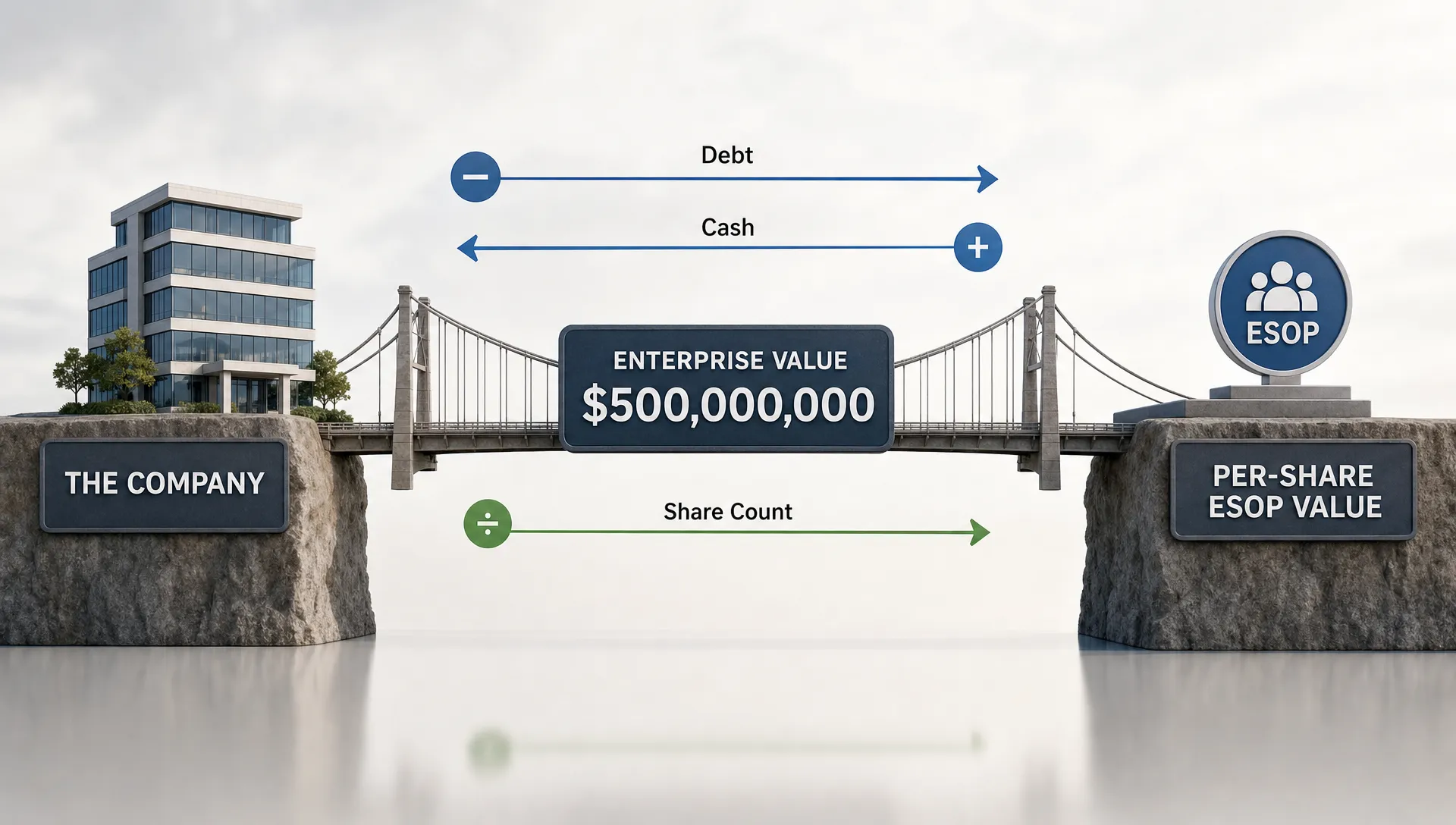
After estimating the company’s enterprise value, the appraiser must bridge to equity value. Enterprise value represents the value of the operating business before considering capital structure. Equity value reflects what remains for shareholders after debt and other claims are considered.
A simplified bridge looks like this:
| Step | What happens | Why it matters |
|---|---|---|
| Estimate enterprise value | Use income, market, and sometimes asset methods | Establishes the value of the operating business |
| Adjust for debt and cash | Subtract interest-bearing debt and add excess cash where appropriate | Converts enterprise value to equity value |
| Consider non-operating assets or liabilities | Include assets or obligations outside normal operations | Prevents overstatement or understatement |
| Apply relevant discounts or premiums | Reflect control, marketability, and share rights | Aligns the value with the actual interest being valued |
| Divide by applicable shares | Convert total equity value into per-share value | Produces the ESOP stock price used for accounts |
This final per-share number is what participants often focus on, but the real work is in the assumptions behind it. Two companies can have the same EBITDA and very different ESOP stock prices if one has high debt, volatile revenue, customer concentration, or large future repurchase obligations.

What drives ESOP stock price up or down?
The ESOP stock price generally rises when the company becomes more valuable on a risk-adjusted basis. That can come from revenue growth, margin expansion, stronger cash flow, debt reduction, better customer diversification, improved management depth, or higher market multiples in the company’s sector.
It can fall for the opposite reasons. Slower growth, compressed margins, rising interest expense, customer losses, litigation, operational disruption, or a weaker industry outlook can all reduce value. Even if a company is profitable, a lower valuation multiple can pull the ESOP price down if market sentiment toward comparable businesses has deteriorated.
Operational data quality can also influence confidence in the valuation. A company that can substantiate utilization, backlog, compliance, customer history, and project profitability gives appraisers better inputs. For example, a drone services company with well-documented flight planning, risk assessments, client records, and reporting through a platform such as drone operations management and flight planning may be better positioned to support its revenue assumptions than a similar operator relying on scattered spreadsheets.
The point is not that software creates value by itself. Rather, clean operating records make it easier to test whether forecasts are realistic, recurring revenue is durable, and risks are being managed.
ESOP leverage can complicate the valuation
Many ESOPs are leveraged, meaning the ESOP trust borrows money to buy shares, often with the company making contributions that allow the trust to repay the loan over time. This structure can create powerful ownership transitions, but it also affects valuation analysis.
Debt reduces equity value. If the company borrowed to finance the ESOP transaction, that liability can lower the per-share value available to equity holders. At the same time, as debt is repaid and shares are released to participant accounts, employees may benefit from a larger allocated ownership base and potential equity growth if the business performs well.
This is one reason employees should not evaluate an ESOP only by the first share price they see after a transaction. The company may be carrying acquisition debt, and the ESOP may still be in the early stage of releasing shares. Over time, the economics depend on business performance, debt repayment, contributions, repurchase obligations, and the valuation multiple applied to future earnings.
For investors comparing employee-owned businesses, leverage is one of the first issues to study. Upside’s guide on how to analyze ESOP companies before investing goes deeper into the ownership, incentive, and balance sheet questions that matter before committing capital.
Discounts, premiums, and control matter
Private company stock is less liquid than public stock. A public shareholder can usually sell shares quickly at a market price. An ESOP participant in a private company usually receives value through plan distributions under plan rules, not through open-market trading.
That illiquidity can affect valuation through a discount for lack of marketability. The size of any discount depends on facts such as company size, dividend policy, expected liquidity events, transfer restrictions, financial strength, and the nature of the ownership interest.
Control is another major factor. A controlling interest may be worth more than a minority interest because control can include the ability to influence strategy, dividends, management, capital structure, and a sale process. A minority interest may be worth less because it lacks those rights.
ESOP valuations must be clear about what is being valued. Is the ESOP buying a controlling block or a minority block? Are there multiple share classes? Do certain shares have different voting, dividend, or liquidation rights? The per-share value should reflect the actual economic and legal rights attached to the shares.
Repurchase obligations are a hidden valuation issue
Private ESOP companies must eventually provide liquidity for participants who retire, leave, die, or become disabled, subject to plan rules. This future need is called a repurchase obligation. It does not always appear as simple debt on the balance sheet, but it can become a major cash flow demand.
A growing ESOP stock price is good for employees, but it can increase the future cost of buying back shares from departing participants. If the company does not plan for that obligation, cash flow pressure can rise even when the business is performing well.
Appraisers and trustees often look at repurchase obligation studies, participant demographics, expected retirements, distribution policy, and projected cash needs. A company with a large wave of retirements approaching may face a different risk profile than a younger company with a similar income statement.
This is where valuation and corporate finance intersect. The ESOP price is not just a scorecard. It affects future liquidity planning, capital allocation, hiring flexibility, debt capacity, and shareholder outcomes.
A simple example of private ESOP valuation
Assume a private company generates $10 million of normalized EBITDA. Comparable companies trade around 7 times EBITDA, but the appraiser applies a lower multiple of 6 times because the company is smaller, less diversified, and privately held.
That implies an enterprise value of $60 million. If the company has $15 million of interest-bearing debt and $3 million of excess cash, the implied equity value is $48 million. If there are 1 million relevant shares outstanding, the indicated value is $48 per share before any final adjustments for share rights, control, marketability, or other company-specific factors.
This is intentionally simplified. A real appraisal would likely include a DCF, a more detailed comparable company analysis, normalization adjustments, balance sheet review, legal rights analysis, and trustee diligence. Still, the example shows the basic path: operating performance becomes enterprise value, enterprise value becomes equity value, and equity value becomes ESOP stock price.
What employees should look for in their ESOP statement
Employees do not need to become valuation experts, but they should understand what their statement is showing. The account value is usually a function of the number of allocated ESOP shares multiplied by the appraised share price, plus any other plan assets if applicable.
Employees should pay attention to the valuation date, the share price, the number of allocated shares, vesting status, and distribution rules. A higher share price is positive only if it is supportable and if the company can manage future liquidity needs. A lower price is not always bad if it reflects temporary leverage after a transaction or a conservative appraisal during a transition period.
It is also worth understanding whether the company is fully employee-owned, partially ESOP-owned, or using the ESOP alongside other equity structures. For a broader foundation, Upside’s ESOP explained for investors and employees covers how ESOPs differ from stock options, RSUs, and other forms of equity compensation.
Common misconceptions about ESOP stock price
One misconception is that the company’s leadership simply chooses the ESOP price. Management provides critical information, but a credible private ESOP valuation depends on independent appraisal and fiduciary review.
Another misconception is that ESOP stock should always rise if the company is profitable. Profitability helps, but valuation also depends on growth, risk, leverage, capital needs, industry multiples, and future liquidity obligations.
A third misconception is that private ESOP stock is equivalent to publicly traded stock. Both represent ownership, but private ESOP shares are governed by plan rules, valuation timing, liquidity limits, and fiduciary processes. That difference is central to understanding the risk and reward of employee ownership.
Frequently Asked Questions
How often is ESOP stock price valued in private firms? Private ESOP companies typically obtain an independent valuation at least annually, often as of the plan year-end. Additional valuations may be needed for major transactions, material business changes, or distribution events.
Who decides the ESOP stock price? An independent appraiser estimates fair market value, but the ESOP trustee or fiduciary is responsible for reviewing the analysis and determining whether relying on that valuation is prudent for plan participants.
Can ESOP stock price go down? Yes. ESOP shares can decline in value if company performance weakens, debt increases, industry multiples contract, risk rises, or future cash flow expectations fall.
Is ESOP stock price the same as 409A valuation? Not necessarily. A 409A valuation is typically used for setting the exercise price of stock options for tax compliance. An ESOP valuation is used for a retirement plan holding employer stock and has its own fiduciary and valuation considerations.
Why does my ESOP account value change if I did not buy or sell shares? Your account value can change because the appraised share price changes, more shares are allocated to your account, vesting changes, or plan activity affects your balance.
Bring ESOP valuation into your broader investing research
Understanding how private ESOP stock price gets valued helps you read employee ownership claims with a sharper eye. The most important question is not whether a company has an ESOP. It is whether the valuation, leverage, governance, and repurchase planning support durable value for employees and shareholders.
For public market investors building watchlists, comparing portfolio exposures, or studying what other verified investors hold, Upside Invest helps connect company analysis with real portfolio behavior. ESOP valuation is private and appraisal-driven, but the same discipline applies everywhere: know what you own, understand how it is valued, and compare your assumptions against better data.