How an ESOP Holding Company Affects Investors and Employees
An ESOP holding company can be a powerful alignment tool, but it is not a simple label. For investors, it can change the way cash flow, control, valuation and liquidity should be analyzed. For employees, it can create a meaningful path to ownership, but usually through a retirement plan account rather than direct control over company decisions.
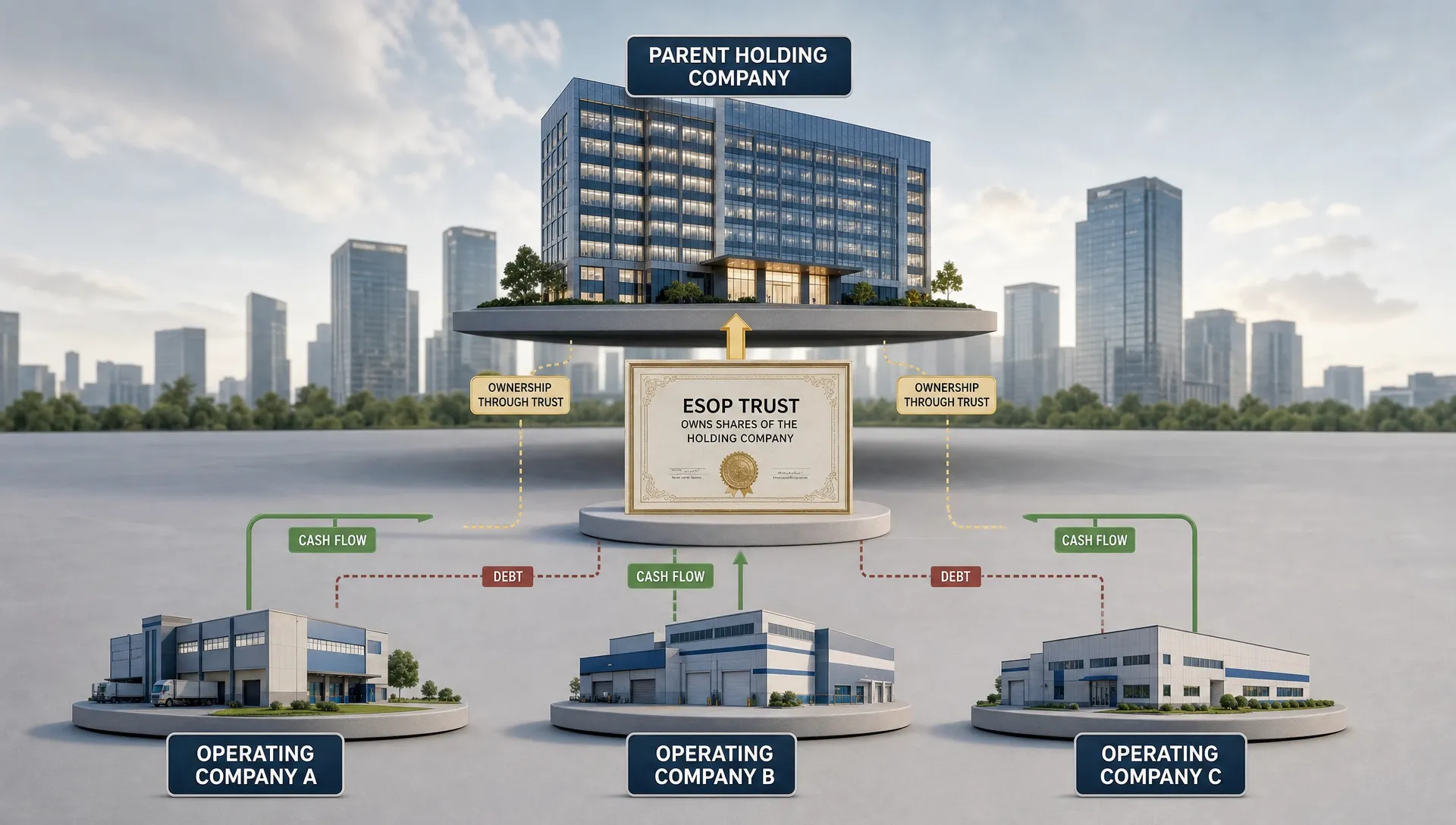
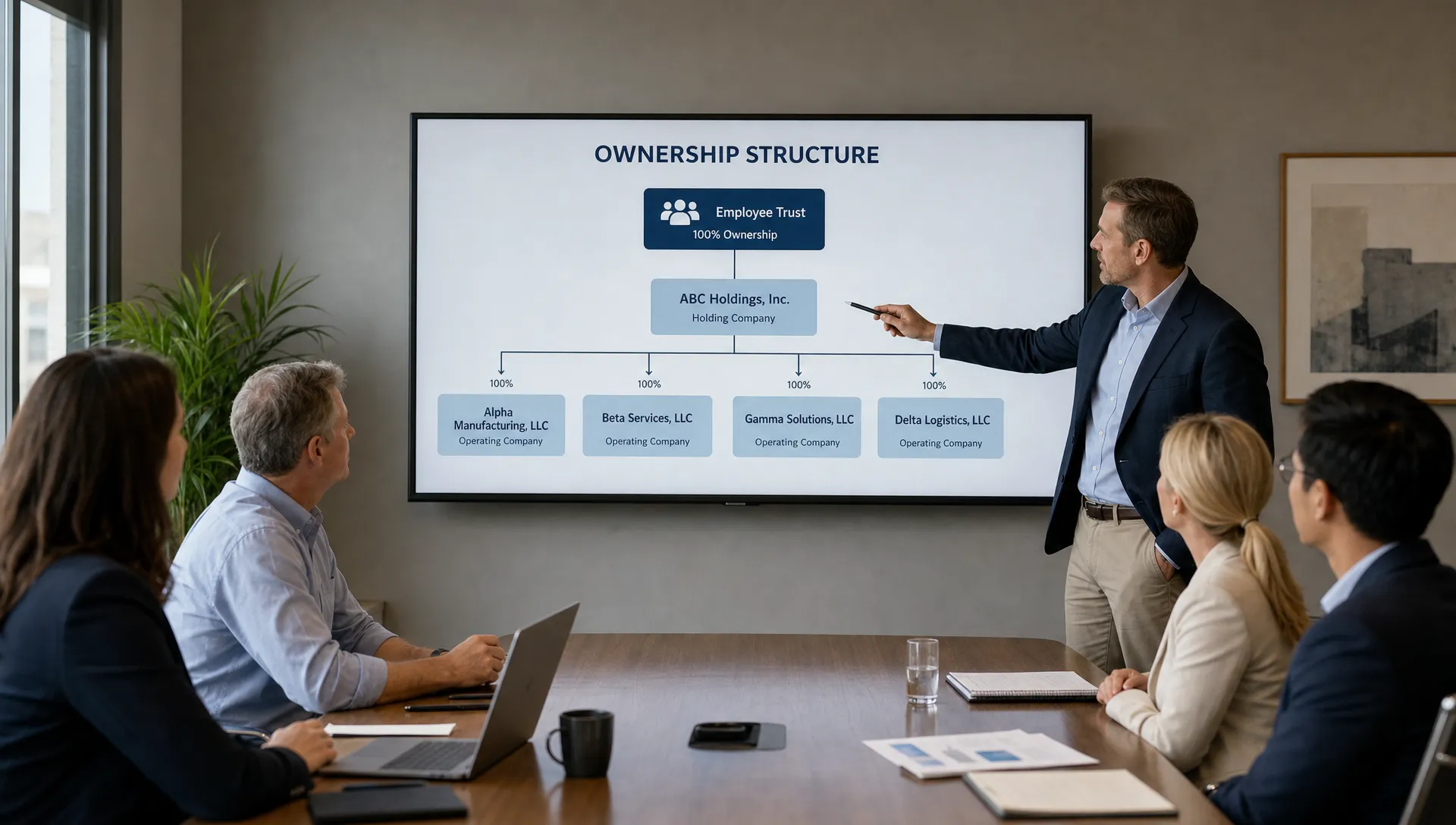
The key is understanding where the ESOP sits in the corporate structure. In many cases, the ESOP trust owns shares of a parent holding company, and that holding company owns one or more operating businesses. The operating companies generate revenue, the holding company allocates capital and the ESOP trust holds shares on behalf of eligible employees.
That structure can work very well when the business is profitable, conservatively financed and transparent with participants. It can also create risk when debt, repurchase obligations or aggressive expansion plans consume more cash than the company can comfortably generate.
What is an ESOP holding company?
An ESOP, or employee stock ownership plan, is a qualified retirement plan that invests primarily in employer stock. A holding company is a parent entity that owns other companies, subsidiaries or business units. Put together, an ESOP holding company usually means the ESOP trust owns shares in the parent company, not necessarily in each operating subsidiary directly.
If you need a broader foundation first, Upside has a separate guide that walks through the basics of an ESOP explained for investors and employees. This article focuses on the holding company layer and why that layer changes the analysis.
A simplified structure often looks like this:
| Component | Role in the structure | Why it matters |
|---|---|---|
| Holding company | Owns operating subsidiaries and parent-level assets | ESOP shares are often shares of this parent entity |
| ESOP trust | Holds employer stock for eligible employees | Employees receive account value through the plan, not direct tradable shares |
| Operating companies | Generate sales, earnings and cash flow | Their performance supports valuation, debt service and future distributions |
| Board and management | Run the parent and subsidiaries | They set strategy, acquisitions, leverage and capital allocation |
| ESOP trustee and fiduciaries | Act for the plan and its participants | They oversee plan-related duties such as stock transactions and valuation processes |
This structure is common in succession planning, private company buyouts and multi-subsidiary businesses. A founder may sell part or all of the company to an ESOP trust. A parent company may then use the holding company model to own several brands, branches or operating units under one employee-owned umbrella.
The phrase can also appear in public markets, where a listed parent company has an ESOP or employee ownership plan while operating through subsidiaries. In that case, public investors still see a market price, but the ESOP may hold a strategic block of shares.
Why companies use an ESOP holding company structure
Companies typically choose this model for one or more practical reasons.
First, it can help owners transition out of the business without selling to a competitor or private equity buyer. The ESOP trust becomes a buyer of company stock, often with financing, while the company keeps its operating identity and workforce.
Second, it can consolidate multiple subsidiaries under one employee ownership plan. A regional services group, manufacturing platform, consumer brand portfolio or distribution business may prefer one parent-level ESOP rather than separate ownership plans at every subsidiary.
Third, it may create tax and cash flow advantages, depending on the entity type and transaction structure. For example, S corporation ESOPs can have special tax treatment when the ESOP owns part or all of the company, although the rules are technical and subject to strict compliance. C corporation ESOPs may involve different tax considerations, including seller-side planning in some qualified transactions.
Fourth, it can support a long-term ownership culture. Employees may be more willing to think like owners when their retirement account value is tied to the combined performance of the enterprise. That is the theory. In practice, ownership culture depends on communication, incentives, management quality and whether employees actually understand how value is created.
How an ESOP holding company affects investors
For investors, the ESOP label should not be treated as automatically bullish or bearish. It is a structural feature that changes the questions you ask.
Ownership and control can be less straightforward
If the ESOP trust owns a large percentage of the holding company, outside investors need to understand where they sit in the ownership stack. Are they buying common equity alongside the ESOP trust, preferred equity above common shareholders or debt with contractual protections? Each position has a different risk profile.
Control also deserves attention. Employees may be called owners, but the ESOP trust is usually the legal shareholder. The trustee has fiduciary duties to plan participants. The board still governs the company. Management still makes day-to-day decisions. In certain major corporate events, participant voting rights may apply, but employees usually do not vote on every operating decision the way direct shareholders might imagine.
For minority investors, the practical question is whether the ESOP trust creates stability or reduces flexibility. A large ESOP shareholder may discourage short-term financial engineering, but it can also complicate a sale, recapitalization or restructuring if the plan fiduciaries need to evaluate whether a transaction is fair to participants.
Cash flow may be committed before investors see upside
Many ESOP transactions are leveraged. In a leveraged ESOP, the ESOP trust borrows money, often with the company making contributions that allow the trust to repay the loan. The financing may also include seller notes or bank debt at the holding company level.
That debt can make the structure work, but it also competes with other uses of cash. The same operating cash flow may need to cover payroll, working capital, capital expenditures, acquisition integration, debt repayment and ESOP-related obligations. If the business hits a downturn, the pressure can show up quickly.
Investors should look beyond adjusted EBITDA and ask how much cash is truly available after maintenance capital expenditure, taxes, debt service and expected repurchase obligations. A profitable ESOP holding company can still be financially tight if it has heavy leverage or a wave of retiring employees.
Valuation is different in private ESOP companies
Public investors can observe a market price. Private ESOP participants and private investors often rely on an independent appraisal process. The ESOP share price is generally updated periodically, commonly annually, based on fair market value.
That appraisal is important, but it is not the same as a liquid market quote. It reflects assumptions about earnings, risk, comparables, control, marketability and future cash flows. If those assumptions are too optimistic, employees may see account values that feel stable until a later adjustment. If they are too conservative, employees may underestimate the value being built.
For a deeper look at this issue, Upside explains how ESOP stock price gets valued in private firms, including why appraisal value and economic value are not always identical.
Repurchase obligations behave like a hidden liability
One of the most important investor issues is the repurchase obligation. When employees retire, leave or diversify out of company stock under applicable rules, the company may need cash to buy shares or fund distributions. In a mature ESOP, this can become a significant recurring cash need.
Investors sometimes treat repurchase obligations as an employee benefit issue. That is too narrow. They affect capital allocation, liquidity planning and valuation. A holding company with older demographics, high share value and limited cash reserves may face pressure even if the operating business remains healthy.
A disciplined ESOP holding company will usually forecast repurchase obligations years ahead, stress test them against downturn scenarios and maintain a funding plan. Without that planning, employees can face delayed or disappointing liquidity, and investors can face lower free cash flow than expected.
How an ESOP holding company affects employees
For employees, the biggest benefit is the possibility of building wealth through the value of the company. The biggest misunderstanding is assuming that employee ownership equals direct ownership of a freely tradable stock account.
In most ESOPs, employees receive allocations in a retirement plan account. Those allocations may be based on compensation, tenure or plan formulas. Account value typically vests over time. If the holding company performs well, the value of the ESOP account can grow. If the company performs poorly or its valuation declines, account value can fall.
This creates real upside, but it also creates concentration risk. Employees may already depend on the company for wages, healthcare and career advancement. If their retirement wealth is also tied to the same company, a business downturn can affect both income and savings at the same time.
Employees should also understand whether they work for a participating employer. In a holding company with multiple subsidiaries, not every employee is automatically covered in the same way. Eligibility can depend on the plan document, corporate structure, service hours, acquisition timing and employment classification.
Communication matters as much as structure. A well-run ESOP holding company explains how shares are valued, how vesting works, what drives enterprise value and when employees may receive distributions. A weak communication culture leaves employees with vague ownership language but little practical understanding.
Employee and investor concerns side by side
The same ESOP holding company can look different depending on where you sit. Employees focus on retirement value, job stability and fair treatment. Investors focus on cash flow, control and risk-adjusted return. The strongest companies understand both sides.
| Question | Employee perspective | Investor perspective |
|---|---|---|
| Who owns the stock? | The ESOP trust holds shares for eligible participants | The ESOP trust may be a major shareholder with fiduciary protections |
| How is value created? | Account value rises if the holding company grows in value | Enterprise value depends on subsidiary performance and capital allocation |
| What can reduce value? | Poor performance, dilution, debt pressure or valuation changes | Leverage, repurchase obligations and weak governance can reduce returns |
| Who controls decisions? | Management and the board run the company, with limited participant voting in many cases | Control rights depend on share class, agreements, trustee role and governance documents |
| What happens when employees leave? | Vested benefits are distributed under plan rules and timing | Distributions can create recurring cash needs for the company |
| How does expansion affect the plan? | Growth can increase value, but failed expansion can reduce account value | New markets can improve returns or consume capital with uncertain payoff |
Due diligence questions investors should ask
An ESOP holding company deserves the same fundamental analysis as any other business, plus a few ESOP-specific checks. Upside has a broader framework for how to analyze ESOP companies before investing, but the holding company structure adds extra emphasis on cash movement between entities.
Start with these questions:
- What percentage of the holding company is owned by the ESOP trust?
- Is the ESOP leveraged, and what is the debt repayment schedule?
- Which subsidiaries generate the cash that funds parent-level obligations?
- Does the company have a formal repurchase obligation study?
- How often is the stock valued, and who performs the independent appraisal?
- Are there outside shareholders, preferred investors or lender covenants?
- How are acquisitions funded and integrated?
- Does management compensation align with sustainable value creation?
Expansion strategy deserves special attention. A holding company that owns consumer brands, retailers or distribution businesses may pursue new countries, marketplaces and channel partnerships to grow enterprise value. That can benefit employees and investors when the plan is disciplined. It can also drain cash if the company enters the wrong market, chooses weak partners or underestimates compliance and logistics costs. For brand-led ESOP platforms, it can be useful to validate international expansion plans before committing ESOP capital, especially when management is weighing GCC, EU or Asia opportunities against debt service and repurchase obligations.
The main issue is not whether growth is good. The issue is whether growth is funded with realistic assumptions and enough liquidity to protect the plan.
Questions employees should ask before relying on ESOP value
Employees do not need to become valuation analysts, but they should ask practical questions. If management cannot answer them in plain language, that is a signal in itself.
- Am I eligible for the ESOP, and when do I start receiving allocations?
- What is the vesting schedule?
- How is the share price determined?
- What percentage of the company does the ESOP own?
- Is the ESOP leveraged, and how does that affect annual allocations?
- When can I diversify or receive distributions?
- What happens if my subsidiary is sold or reorganized?
- How does the company explain annual changes in share value?
Employees should also ask how the holding company balances reinvestment and benefit security. Reinvesting in growth can raise future value, but a company that never plans for liquidity may create stress when participants need distributions.
Red flags and green flags in an ESOP holding company
No single signal tells the whole story. A high ESOP ownership percentage can be positive in one company and risky in another. The difference usually comes down to leverage, profitability, governance and transparency.
| Area | Green flag | Red flag |
|---|---|---|
| Leverage | Debt is manageable under conservative cash flow assumptions | ESOP debt depends on aggressive growth or refinancing |
| Repurchase planning | Company updates long-range forecasts and funds obligations proactively | Management treats repurchase obligations as a future problem |
| Valuation | Appraisal assumptions are explained clearly to participants | Share value changes are presented with little context |
| Governance | Board, trustee and management roles are clearly separated | Insider influence appears to dominate plan-related decisions |
| Subsidiary structure | Cash flows between operating companies and parent are understandable | Profits, costs and liabilities are hard to trace across entities |
| Employee communication | Employees receive practical education about value drivers and risks | Ownership messaging is motivational but vague |
| Growth strategy | Expansion is staged, measured and funded prudently | Acquisitions or new markets are pursued without integration discipline |
Public vs private ESOP holding companies
The investor analysis changes depending on whether the holding company is public or private.
In a public company, the market price gives investors a continuous signal. The ESOP may still matter if it owns a meaningful block of shares, influences voting outcomes or affects dilution and compensation expense. Public investors should look at plan disclosures, share issuance, repurchases and insider ownership alongside normal financial analysis.
In a private ESOP holding company, the valuation process is less visible. Employees may only see account statements and annual communications. Outside investors, if any, may need access to private financials, governance documents and plan-related obligations. The lack of daily liquidity makes diligence more important, not less.
Private ESOP structures also require careful fiduciary oversight. The Department of Labor has historically scrutinized ESOP transactions when valuation, process or fiduciary conduct appear weak. That does not make ESOPs inherently problematic, but it reinforces why documentation and independent judgment matter.
The bottom line
An ESOP holding company can align employees with enterprise value while giving founders, families or shareholders a succession path that preserves the business. It can also create a stable shareholder base and a long-term culture that public markets sometimes struggle to reward.
But the structure adds complexity. Investors need to evaluate the ESOP trust, leverage, repurchase obligations, valuation process, subsidiary cash flows and governance. Employees need to understand that ESOP value is not guaranteed, not immediately liquid and not the same as direct control.
The best ESOP holding companies treat employee ownership as a financial system, not a slogan. They explain how value is created, plan for liquidity, use debt carefully and make growth decisions that respect both employee retirement wealth and investor return expectations.
Frequently Asked Questions
Is an ESOP holding company fully owned by employees? Not always. The ESOP trust may own 100 percent of the holding company, a minority stake or something in between. Employees usually participate through the ESOP trust rather than holding shares directly in their own brokerage accounts.
Does an ESOP holding company make a company safer to invest in? No structure makes a company automatically safer. ESOP ownership can improve alignment and stability, but investors still need to analyze leverage, valuation, cash flow, repurchase obligations and governance.
Can outside investors own shares in an ESOP holding company? Yes, depending on the structure. Some ESOP companies are partially ESOP-owned and may have outside shareholders, lenders or preferred investors. The rights of each party depend on the capitalization, shareholder agreements and governance documents.
How are ESOP shares valued in a private holding company? Private ESOP shares are generally valued through an independent appraisal process based on fair market value. The appraisal may consider earnings, cash flow, comparable companies, risk, debt, control factors and marketability.
What should employees watch most closely? Employees should understand eligibility, vesting, annual share value changes, diversification rights, distribution timing and how company performance affects their account. They should also pay attention to whether management communicates clearly about debt and growth strategy.
What happens if an ESOP holding company buys another business? The acquisition can increase value if it improves earnings and cash flow. It can also add integration risk, debt or complexity. Employees should ask whether new subsidiaries participate in the ESOP and investors should examine how the acquisition is funded.
Make ESOP analysis part of your investing process
Employee ownership can be a useful signal, but it should never replace portfolio-level diligence. Upside Invest helps retail investors compare allocations, observe verified investor holdings, track trends and benchmark portfolios using anonymous real-world data. For ESOP-related investments, that broader context can help you separate an attractive ownership story from a durable risk-adjusted opportunity.