How to Assess Amazon Stock Upside Without Hype

Amazon stock upside depends on what the business can earn relative to the price you pay, not on how often someone mentions artificial intelligence, cloud computing or a bullish analyst target. Amazon can execute well operationally and still deliver disappointing stock returns if investors have already priced in that success.
The useful question is narrower: What has to happen for Amazon’s future earnings and cash generation to justify a meaningfully higher share price? Answering it requires separating the company’s operating engines, accounting for investment spending and testing more than one valuation outcome.
This guide provides a framework, not a live price target. Refresh the inputs using Amazon’s latest filings and a current AMZN quote before making an investment decision.
Start with filings, not price targets
Begin with Amazon’s annual reports and shareholder letters, then check subsequent quarterly results. Record the reporting period beside every figure so you do not mix trailing earnings with forward revenue estimates.
Your starting worksheet should contain segment sales and operating income, operating cash flow, capital spending, cash, debt and diluted shares. Also record the current market capitalization and your proposed holding period.
Analyst targets can help identify disagreements about growth or valuation. They are not independent proof of fair value, especially when their assumptions and time horizons differ.
Break Amazon stock upside into three operating drivers
Amazon reports three operating segments: North America, International and Amazon Web Services. Advertising is an important business within the company, but it is not a fourth reportable operating segment. That distinction matters when building a valuation: adding an advertising valuation on top of retail earnings that already include advertising can double-count value.
AWS: distinguish demand from profitable growth
For Amazon Web Services, examine revenue growth alongside operating margins and infrastructure investment. Faster cloud growth is valuable only if the economics of serving that demand support attractive returns.
Watch whether customers are expanding existing workloads, adopting new services or simply resuming spending after a period of optimization. AI-related demand deserves scrutiny because equipment, power and data-center capacity require substantial investment before the full revenue opportunity is visible.
An AWS forecast should answer two separate questions: how much revenue can grow and how much cash the additional business can ultimately generate. Do not assume every dollar of AI infrastructure spending produces an immediate dollar of profitable demand.
Retail: measure efficiency without assuming endless improvement
North America and International need their own assumptions. Fulfillment productivity, delivery costs, inventory management and the mix of first-party sales versus third-party seller services can all affect profitability.
Revenue alone is an incomplete guide. First-party merchandise sales and third-party service fees have different reporting and economic characteristics, so changes in business mix can alter reported growth without an equivalent change in underlying activity.
A retail-led Amazon stock upside case should show where margin improvement comes from and why it can persist. If the thesis relies on logistics becoming more efficient, look for evidence across several reporting periods rather than extrapolating one strong quarter.
Also test whether better margins depend on spending less in ways that could weaken delivery quality or customer retention later.
Advertising: look beyond an attractive growth rate
Advertising benefits from Amazon’s proximity to purchase decisions. But growth still depends on advertiser budgets, shopper engagement and the usefulness of ad placements.
Track advertising sales separately while keeping its contribution inside the appropriate consolidated or segment model. Amazon does not disclose a standalone advertising operating-income figure in its segment reporting, so any estimate of advertising profitability needs to be labeled as an assumption.
The central question is whether advertising strengthens Amazon’s overall economics without damaging the shopping experience. A forecast that assumes uninterrupted advertising growth and expanding retail margins deserves a downside test, not automatic acceptance.
Translate operating progress into shareholder value
A credible estimate of Amazon stock upside connects those operating drivers to cash generation and a defensible valuation. Revenue growth is an input, not the conclusion.
Reconcile cash flow with infrastructure spending
Start with operating cash flow and Amazon’s stated free-cash-flow definition. Then inspect equipment acquired through financing arrangements, finance-lease principal payments and future commitments. Different cash-flow measures can make the same investment cycle look more or less demanding.
Avoid subtracting the same spending twice. The goal is a consistent view of economic investment, not the lowest possible cash-flow number.
Working capital also matters. Supplier-payment timing and inventory movements can improve operating cash flow temporarily without representing a permanent increase in earning power. Compare several periods and explain material changes.
Stock-based compensation needs similar care. Its cash-flow add-back does not make it economically free. Use a consistent expense and share-count treatment, and assess whether repurchases actually offset dilution rather than assuming they do.
Use two valuation methods as cross-checks
A consolidated cash-flow model asks what the whole company can generate after necessary investment. A sum-of-the-parts model values AWS and the consumer businesses separately, then reconciles those values to equity value.
Both require judgment. A segment model must account for shared costs and avoid counting advertising twice. An enterprise-value approach must handle cash, debt and leases consistently before dividing equity value by an appropriate share count.
Keep the model internally consistent: do not combine pre-tax segment operating income with an after-tax cash-flow multiple without explaining the adjustment. Compare the resulting valuation with Amazon’s own history and relevant peers, but do not assume a historical premium is permanently deserved.
Build bear, base and bull cases with a defined horizon
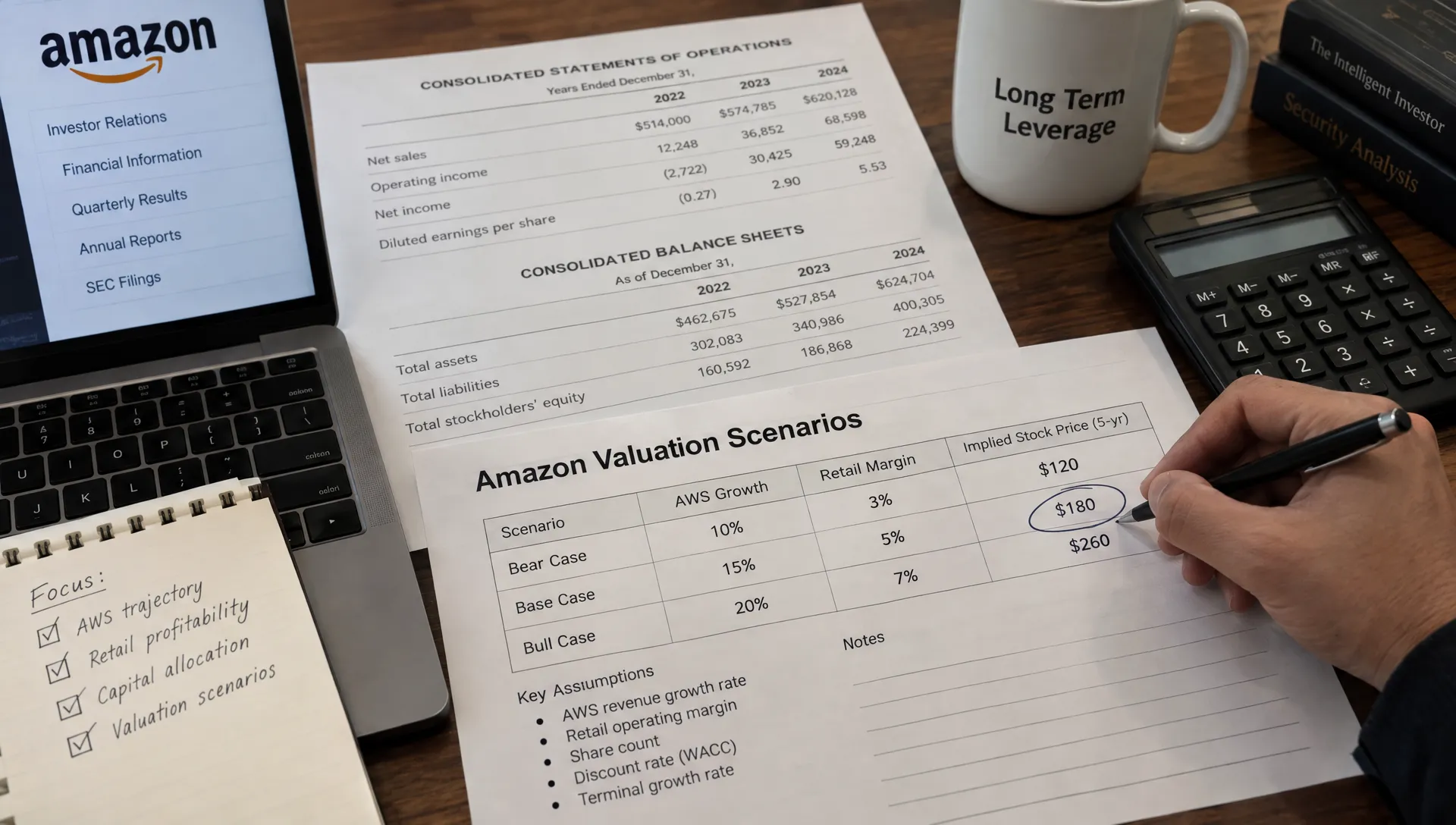
Amazon stock upside becomes easier to evaluate when the forecast includes a downside case and an explicit date. A target that might be reached next year is different from one requiring five years of execution.
Use scenarios that change business assumptions, not just the final valuation multiple. The bear case might combine slower AWS growth with stubborn infrastructure spending and weaker retail margins. The bull case might require stronger cloud demand, improved fulfillment economics and sustained advertising growth.
The following figures are hypothetical teaching inputs, not current Amazon prices, forecasts or recommendations. Assume an entry price of $200 and a three-year holding period.
| Scenario | Operating assumptions | Illustrative terminal share value | Total price return |
|---|---|---|---|
| Bear | Slower cloud growth, weaker retail margins and a lower valuation multiple | $150 | -25% |
| Base | Steady cloud growth, modest retail improvement and a stable multiple | $260 | +30% |
| Bull | Strong cloud demand, better consumer-business profitability and a higher multiple | $330 | +65% |
The calculation is straightforward: total price return = terminal share value ÷ entry price − 1. It excludes taxes, transaction costs and any distributions.
The base case’s 30% gain over three years is about 9.1% annualized, not 30% per year. If the entry price were $240 instead, the same $260 terminal value would produce only an 8.3% total gain, or about 2.7% annualized.
That difference is why a promising business story is not enough. Entry valuation can absorb much of the benefit of successful execution.
Separate business improvement from multiple expansion
Identify how much of your projected return comes from higher earnings or cash flow and how much comes from investors paying more for each dollar of those results.
A thesis that works only if Amazon receives a richer multiple is more vulnerable to interest rates and market sentiment. Test the same operating forecast with an unchanged multiple, then with a lower one.
For a more resilient Amazon stock upside case, the base scenario should not quietly borrow the bull case’s margins, growth rate and valuation premium all at once.
Decide what the next earnings report must prove
Use Amazon’s quarterly results and earnings materials to update a small evidence dashboard. Track a few variables that can change the valuation rather than collecting every available metric.
| Variable | Evidence to review | Reason to revisit the thesis |
|---|---|---|
| AWS growth and operating margin | Segment results and management’s demand commentary | Growth weakens or profitability misses the model repeatedly |
| Retail profitability | North America and International operating results | Expected efficiency gains fail to appear |
| Advertising growth | Disclosed advertising sales and relevant commentary | Growth slows beyond the assumed range |
| Investment burden | Cash spending, financing arrangements and commitments | Capacity costs rise faster than the modeled payoff |
| Per-share economics | Diluted shares and repurchase disclosures | Dilution erodes expected per-share improvement |
Write your decision rules before earnings. For example, if your model assumes improving cash generation as a buildout matures, continued spending increases without corresponding operating progress should trigger a review.
One quarter rarely settles a long-term thesis. Repeated misses against the same assumption carry more weight than a single noisy result.
Use investor holdings as context, not confirmation
Verified ownership data can show how investors are positioning around Amazon, but it cannot establish intrinsic value. A large position may reflect a low historical purchase price, tax considerations or risks that another investor can tolerate more easily than you.
When reviewing Amazon stock upside through portfolio behavior, distinguish a new purchase from a position that merely increased in weight because the stock appreciated. Also separate the number of investors holding AMZN from the size of their allocations.
Upside Invest provides verified investor holdings, portfolio comparisons and return and Sharpe metrics. These can help you examine whether an allocation resembles those of comparable investors and how their broader portfolios have behaved.
Before drawing conclusions, consider the observation period and selection effects. A top performer may have benefited from concentration in a favorable market regime. A high historical Sharpe ratio does not prove that an Amazon purchase made today will have the same risk-adjusted outcome.
Learning to benchmark your portfolio against verified investors adds useful context, but other investors’ conviction should remain separate from your valuation assumptions.
Check concentration and funding before buying
An Amazon position can overlap with exposures you already hold through broad-market ETFs, technology funds or other cloud and AI-related stocks. Assess the combined exposure rather than treating each holding as independent.
Translate stock-level downside into portfolio-level consequences. If a position represents 5% of your portfolio and falls 40%, its direct contribution to the portfolio loss is approximately 2 percentage points, before changes in other holdings. Correlated declines can make the overall damage larger.
Keep emergency reserves and near-term spending needs outside the investment thesis. Personal-loan repayments remain due even when stocks fall. For Singapore readers assessing borrowing obligations, Swift Credit’s loan calculator and borrowing guidance provide a resource for reviewing repayment commitments. Do not treat forecast equity gains as money available to service a loan or use a bullish valuation scenario to justify unsecured borrowing.
Even substantial Amazon stock upside does not eliminate the need for position limits and an exit plan. Define what would lead you to reduce exposure: a broken operating assumption, an excessive valuation or concentration beyond your chosen limit. A clear sell discipline for high-upside stocks helps distinguish those decisions from reacting to daily price moves.
Frequently asked questions
Does a higher analyst price target mean Amazon is undervalued? No. A target reflects a particular model, valuation method and time horizon. Review its assumptions and compare them with your own scenarios rather than treating the percentage upside as a fact.
Which matters more for Amazon, AWS or retail? Both matter, but in different ways. AWS can contribute significant operating profit, while retail efficiency, seller services and advertising affect the consumer businesses’ economics. The importance of each depends on what your forecast assumes will change.
Why can Amazon stock fall after good earnings? Reported results may be strong but below market expectations. Guidance, capital spending or a lower valuation multiple can also offset operational progress.
Can verified investor holdings prove Amazon stock upside? No. Holdings reveal exposure and portfolio behavior, not future returns. They are most useful for checking concentration, comparing allocations and identifying questions to investigate in the filings.
Compare your allocation after testing the valuation
First build the operating model, test the entry price and define your downside limits. Then use Upside Invest to compare your allocation with verified investor portfolios through private, anonymous profiles.
Keep the distinction clear: financial evidence supports the investment case, while portfolio comparisons help you assess how that case fits your own exposure.