How to Build an ESOP Companies List That Matters
Searching for an ESOP companies list usually leads to two extremes: generic directories of famous employee-owned businesses, or dense regulatory data that is hard to turn into an investment view. Neither is enough by itself.
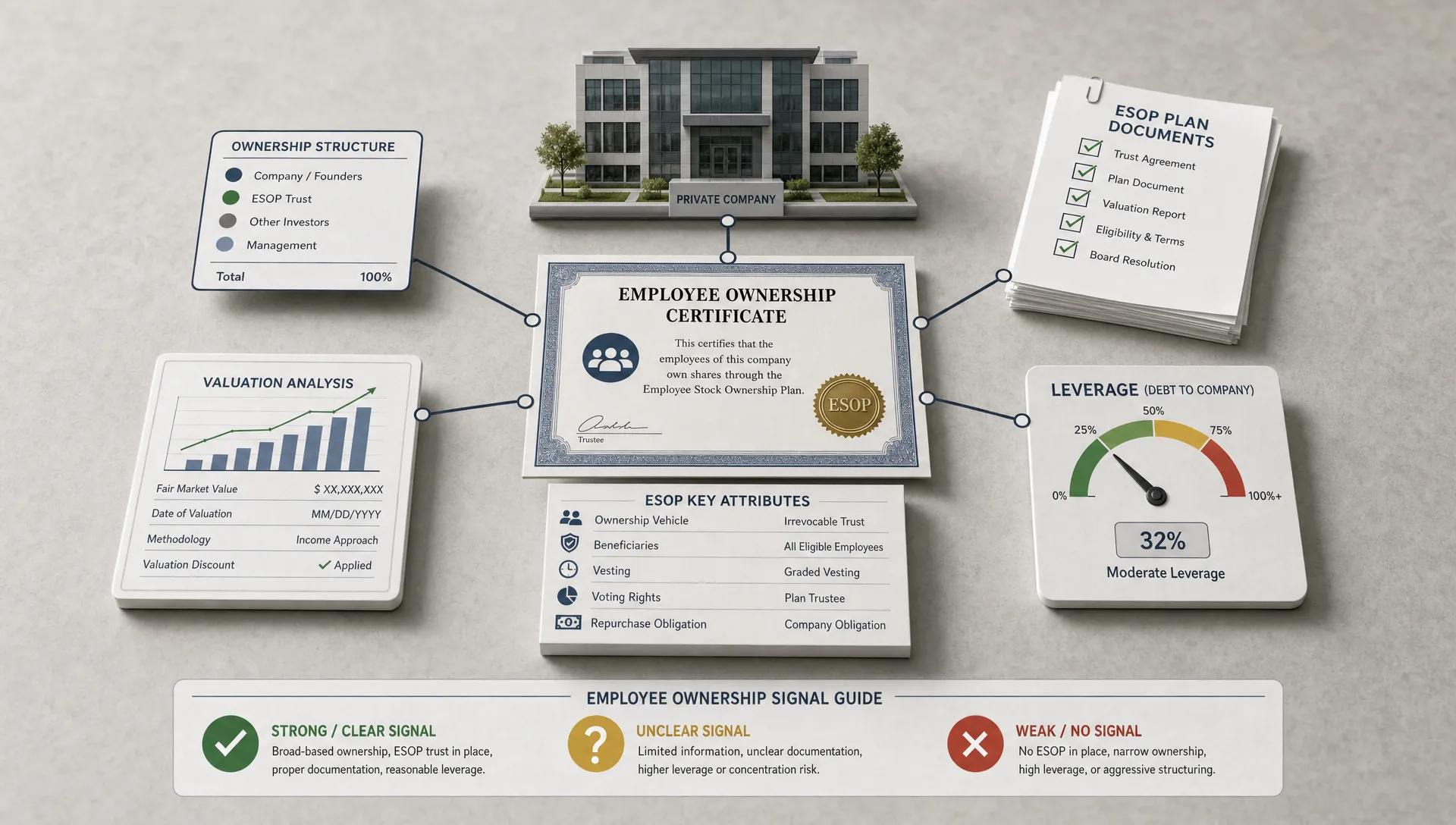
For investors, a useful list should answer more than “Which companies have an ESOP?” It should show whether the ownership is meaningful, whether the company is public or private, how reliable the source is, and what signals the ESOP structure adds to your research process.
That matters because employee ownership can be a powerful alignment signal, but it is not automatically an investment thesis. A mature ESOP company with strong cash flow, transparent governance, and disciplined valuation assumptions is very different from a highly leveraged ESOP with unclear repurchase obligations. Your list should help you separate the two.
Start with the right definition of an ESOP company
An ESOP, or Employee Stock Ownership Plan, is a qualified retirement plan designed to invest primarily in employer stock. In the United States, ESOPs are governed under federal retirement plan rules, which makes them different from stock options, RSUs, ESPPs, or informal employee equity programs.
That distinction is important. If your ESOP companies list includes every business that gives employees some kind of equity-like benefit, the list becomes noisy fast. A company with broad RSU grants may be employee-aligned, but it is not necessarily an ESOP company.
A practical inclusion standard is simple: add a company only if there is credible evidence that it has, or recently had, a formal ESOP or employee ownership trust-like structure. If you need a refresher on the mechanics, Upside’s guide to how ESOP stock works and why it matters explains how ESOP shares are created, allocated, vested, valued, and distributed.
Before adding any company, record three details:
- ESOP status: active, former, announced, pending, or unclear.
- Ownership scope: minority, majority, 100% employee-owned, or unknown.
- Investability: publicly traded, private, subsidiary, acquired, or not directly investable.
This prevents a common mistake: building a list that looks comprehensive but mixes investable stocks, private companies, old transactions, and vague employee ownership claims into one undifferentiated spreadsheet.
Decide what your list is meant to do
A list built for curiosity will look different from a list built for portfolio research. Before collecting names, define the job your list needs to perform.
For retail investors, there are usually four useful list types:
| List type | Primary use | What to include | What to avoid |
|---|---|---|---|
| Public equity watchlist | Finding investable public companies with ESOP exposure | Tickers, filings, ownership disclosures, fundamentals | Private companies with no tradeable security |
| Private company intelligence list | Studying employee-owned business models | Industry, ownership percentage, transaction year, size indicators | Treating private names as buyable stocks |
| Sector benchmark list | Comparing employee-owned firms by industry | Peer groups, margins, growth signals, cyclicality | Mixing unrelated industries without context |
| Deal or credit research list | Evaluating ESOP transaction quality | leverage, cash flow, repurchase obligations, management continuity | Culture-only narratives with no financial data |
If you are building the list for investing, public and private companies should not sit in the same category. Private ESOP companies can be excellent case studies, but most cannot be purchased through a brokerage account. They belong in your research universe, not your tradable universe.
Use credible sources, not recycled blog lists
The strongest ESOP lists are source-driven. The weakest ones copy company names from other directories without checking whether the ESOP still exists.
Start with primary or near-primary sources whenever possible. The National Center for Employee Ownership estimates that there are roughly 6,500 ESOPs in the United States, covering millions of participants. That scale makes ESOPs too important to ignore, but it also means no simple article can be treated as a complete, always-current master list.
Good source categories include:
- Department of Labor Form 5500 filings: These can confirm plan sponsors, participants, assets, and annual reporting details through the EFAST2 Form 5500 search.
- SEC filings for public companies: Search 10-Ks, proxy statements, S-8 registration statements, and 11-K filings through SEC EDGAR.
- Company disclosures: Annual reports, ownership pages, press releases, and transaction announcements can clarify ownership percentage and timing.
- Specialist organizations: ESOP associations, employee ownership centers, and industry groups can help identify companies, but the data should still be verified.
For every company, add the source link, publication date, and confidence level. A name with a 2020 press release and no later confirmation should not carry the same weight as a company with current plan filings or recent annual report disclosure.
Capture the fields that actually matter
A simple list of company names is not enough. To make the list useful for research, your spreadsheet should connect ESOP status to investment relevance.
At minimum, include these fields:
| Field | Why it matters | Suggested format |
|---|---|---|
| Company name | Basic identifier | Full legal or commonly used name |
| Ticker or private status | Separates investable from non-investable names | Ticker, private, subsidiary, acquired |
| Industry | Helps compare like with like | GICS sector, NAICS code, or plain-English category |
| ESOP ownership level | Shows whether ownership is economically meaningful | 100%, majority, minority, unknown |
| Source type | Helps assess reliability | SEC filing, Form 5500, company report, news release |
| Source date | Prevents stale data from driving decisions | Year and month if available |
| Balance sheet risk | ESOP leverage can affect resilience | low, medium, high, unknown |
| Liquidity and investability | Determines whether the name can enter a portfolio | public, private, indirect, not investable |
| Research notes | Captures open questions | free-text notes with next steps |
This structure turns your ESOP companies list into a research tool. You can filter by public tickers, compare companies by sector, isolate majority employee-owned firms, or flag names that need deeper due diligence.
For public companies, combine ESOP data with broader ownership signals. Insider ownership, institutional holdings, float, dilution, and short interest can all change how you interpret employee ownership. Upside’s guide to stock ownership data every investor should track is a useful companion when you move from ESOP screening to full ownership analysis.

Segment the list by ownership quality
Not all ESOPs send the same signal. A company that is 100% employee-owned may have a very different culture, incentive structure, and capital allocation profile than a public company where an ESOP holds a small minority stake.
Segment your list into practical buckets:
| Segment | What it suggests | Investor interpretation |
|---|---|---|
| 100% employee-owned private company | Employees are the economic owners | Strong alignment signal, but usually not directly investable |
| Majority ESOP-owned company | Employee ownership likely influences governance | Worth studying for culture, retention, and capital allocation |
| Minority ESOP stake | Employees participate, but control may sit elsewhere | Useful signal, but not enough on its own |
| Public company with ESOP disclosure | Potentially investable and easier to analyze | Combine ESOP data with valuation, fundamentals, and ownership metrics |
| Former or unclear ESOP | Data may be stale or incomplete | Keep on watchlist until verified |
This segmentation protects you from overrating a company simply because it appears on an employee-owned list. ESOP structure is one input. It does not replace financial analysis.
Add business quality signals to the list
Once you know which companies belong, the next step is to add the signals that help you evaluate them. For public companies, this means standard equity research: revenue growth, margins, free cash flow, debt, valuation, shareholder returns, and governance. For private companies, you may need proxies such as employee count, industry position, transaction history, customer concentration, and management continuity.
The most important question is whether employee ownership reinforces an already strong business model or masks a weak one. ESOPs can improve alignment, retention, and long-term thinking, but they cannot fix poor unit economics or declining demand.
For founder-led B2B companies, especially those transitioning toward employee ownership, the revenue engine deserves close attention. If growth depends too heavily on the founder’s personal relationships, the ESOP may inherit a fragile commercial model. Frameworks focused on founder-led B2B revenue acceleration can help you think more clearly about sales repeatability, pipeline quality, and scalability beyond the founder.
Consider adding these business quality tags to your list:
- Financial strength: profitable, cash generative, cyclical, turnaround, unknown.
- Growth profile: expanding, stable, shrinking, acquisition-led, early-stage.
- Ownership relevance: core to culture, financial benefit only, unclear.
- Governance visibility: transparent, moderate, opaque.
- Risk flags: high leverage, customer concentration, declining industry, stale valuation data.
These tags make the list easier to filter. For example, you might screen for public companies with current ESOP disclosures, low leverage, strong cash flow, and improving industry momentum. Or you might build a private-company benchmark list of majority employee-owned firms in engineering, distribution, or manufacturing.
Build a scoring system instead of a static directory
A good ESOP companies list should help you prioritize. Scoring does not need to be complicated. The goal is to create a consistent way to rank names by research value.
Here is a practical scoring model for investors:
| Category | Example question | Suggested weight |
|---|---|---|
| Source confidence | Is the ESOP confirmed by a current filing or credible company disclosure? | 20% |
| Investability | Can a retail investor buy the stock or gain exposure indirectly? | 15% |
| ESOP significance | Is employee ownership economically meaningful? | 20% |
| Business quality | Does the company show durable earnings, cash flow, or competitive strength? | 20% |
| Balance sheet and obligation risk | Could debt or repurchase obligations pressure the business? | 15% |
| Governance clarity | Are control, valuation, and management incentives understandable? | 10% |
A public company with a small ESOP stake but excellent disclosures may score well on investability and source confidence, but lower on ESOP significance. A 100% private ESOP may score high on ownership alignment but low on investability. That difference is exactly what your scoring model should reveal.
If a company scores well enough to become a serious candidate, move it into a deeper due diligence workflow. Upside’s guide on how to analyze ESOP companies before investing covers the next layer, including ownership structure, leverage, repurchase obligations, valuation assumptions, governance, and business fundamentals.
Watch for common list-building mistakes
The most common mistake is treating “employee-owned” as a synonym for “better investment.” Employee ownership may improve incentives, but valuation still matters. A great ESOP company can be a poor investment if the price is too high, the balance sheet is stretched, or the industry is deteriorating.
Another mistake is failing to date the data. ESOP transactions, acquisitions, plan terminations, and ownership changes can make a list outdated quickly. If you cannot verify a company’s current ESOP status, label it as unconfirmed rather than deleting it or treating it as current.
Investors should also avoid mixing cultural admiration with financial analysis. Many employee-owned companies are admired for good reason, but admiration does not tell you whether the business has attractive reinvestment opportunities, pricing power, or a reasonable valuation.
Finally, be careful with public-company ESOP disclosures. A plan may exist, but the actual ownership percentage may be small relative to total shares outstanding. In that case, the ESOP may be part of the compensation story, not a controlling ownership feature.
Maintain the list like a research asset
An ESOP list gets more valuable when it is maintained over time. Treat it like a living research database, not a one-time spreadsheet.
A simple maintenance workflow works well:
- Review public-company filings annually: Update 10-K, proxy, 11-K, and S-8 references when new filings are released.
- Refresh private-company sources twice a year: Check company ownership pages, transaction announcements, and industry databases.
- Version your list: Keep a date-stamped record so you know when a name was added, changed, verified, or removed.
- Track status changes: Note acquisitions, plan terminations, public listings, ownership percentage changes, and major leverage events.
- Re-score companies after major news: A refinancing, acquisition, leadership transition, or valuation change can materially affect the investment signal.
This discipline turns your ESOP companies list into something far more useful than a directory. It becomes a map of ownership structures, incentive quality, business models, and potential investment relevance.
Turn your ESOP list into better portfolio decisions
The real purpose of building an ESOP companies list is not to collect names. It is to improve decision quality.
For retail investors, the best use case is to combine ESOP research with real portfolio behavior. Which employee-owned or employee-aligned companies are showing up in investor portfolios? Are top-performing investors concentrated in specific sectors? Are ownership signals supported by momentum, fundamentals, or improving market sentiment?
That is where Upside Invest can add context. Upside helps investors compare portfolios, see verified investor holdings, track trends and momentum, explore sector and theme discovery, and benchmark against real portfolios while keeping profiles private and anonymous.
An ESOP screen can help you find interesting companies. Portfolio intelligence can help you understand whether those ideas fit into a broader strategy.
Frequently Asked Questions
What is an ESOP companies list? An ESOP companies list is a research database of businesses with confirmed or reported Employee Stock Ownership Plans. A useful list includes ownership status, source quality, ownership percentage, industry, investability, and investor-relevant notes.
Are all ESOP companies publicly traded? No. Many ESOP companies are privately held, and some are 100% employee-owned. Public companies may also have ESOPs or employee stock ownership features, but investors need to verify how meaningful the plan is relative to total shares outstanding.
Where can I find reliable ESOP company data? Reliable sources include Department of Labor Form 5500 filings, SEC filings for public companies, company annual reports, official ownership pages, transaction announcements, and specialist employee ownership organizations. Always record the source date and confidence level.
Should investors automatically favor ESOP companies? No. ESOPs can be a positive alignment signal, but they do not replace valuation, balance sheet analysis, cash flow analysis, governance review, or industry research. Treat ESOP status as one factor in a broader investment process.
How often should I update an ESOP companies list? Public-company data should be reviewed at least annually when new filings are released. Private-company data should be refreshed periodically, especially after acquisitions, refinancing events, leadership changes, or major ESOP transaction announcements.
Build a list that earns its place in your research process
A strong ESOP companies list is selective, sourced, segmented, and connected to investment questions. It tells you which companies are employee-owned, how meaningful that ownership is, whether the company is investable, and what risks deserve a closer look.
If you want to move beyond static lists, use Upside Invest to compare your portfolio with verified investors, spot ownership and momentum trends, and turn research themes into smarter investment decisions.