How to Spot Trending Trades Before the Crowd

Spotting trending trades before the crowd is not about predicting the future or guessing the next viral ticker. It is about noticing when capital, attention, and fundamentals begin moving in the same direction before that move becomes obvious to everyone else.
For retail investors, the challenge is that most public signals are noisy. A stock can trend on a meme, a fund can attract flows because of one hot holding, and a crypto asset can spike on nothing more than social momentum. The edge comes from building a repeatable process that separates early, durable trends from late-stage hype.
Below is a practical framework for finding trending trades earlier, using price behavior, ownership data, verified portfolio activity, and risk controls without falling into the trap of chasing every fast-moving chart.
What a Trending Trade Really Looks Like
A trending trade is not simply an asset that went up yesterday. A useful trend usually has several forces behind it: buyers are accumulating, the asset is outperforming relevant peers, the story is improving, and the move is not yet fully priced into expectations.
That distinction matters. By the time a ticker dominates financial media or social platforms, the easiest part of the move may already be over. Early trend detection is more subtle. It often starts with small allocation changes, repeated buying by informed or high-performing investors, improving relative strength, and a catalyst that gives the move a reason to continue.
The best trending trades tend to combine three qualities:
- Direction: Price, flows, or ownership are moving consistently in one direction.
- Participation: More than one type of buyer is involved, such as retail investors, institutions, or top-performing portfolios.
- Confirmation: The trend is supported by earnings, revisions, sector momentum, liquidity, or a clear macro theme.
If you only see one of those qualities, you may be looking at noise. If you see all three, the trade deserves closer research.
Start With Signal Stacking, Not Single Indicators
Many investors look for one magic signal: a breakout, a social mention spike, a moving average crossover, or a famous investor buying. That approach is fragile because every signal has false positives.
A better approach is signal stacking. You gather several independent clues and ask whether they are pointing in the same direction. One signal creates curiosity. Two signals create a watchlist candidate. Three or more signals may justify deeper analysis.
| Signal layer | What to look for | Why it matters |
|---|---|---|
| Price action | Higher highs, higher lows, relative strength versus peers | Shows the market is starting to reward the asset |
| Ownership | Rising holder count, institutional accumulation, stronger hands | Suggests capital is moving in, not just price noise |
| Portfolio behavior | Verified investors increasing allocation over time | Reveals what real investors are doing with actual money |
| Catalyst | Earnings revisions, product cycle, regulation, macro shift, sector rotation | Gives the trend a reason to persist |
| Risk context | Valuation, volatility, liquidity, concentration, downside levels | Helps avoid chasing fragile moves |
The goal is not to be first at any cost. The goal is to be early enough while still having evidence.
Watch What Investors Do, Not Just What They Say
Public market commentary is cheap. Buying with real capital is not. That is why portfolio behavior can be one of the most useful ways to spot trending trades early.
When investors begin adding to the same stock, ETF, fund, or crypto theme across multiple portfolios, it may indicate that a trend is forming beneath the surface. This is especially meaningful when the buyers are not just random accounts, but investors with strong historical returns, disciplined risk-adjusted performance, or concentrated conviction.
This is where verified portfolio data can help. Upside Invest is built around anonymous portfolio sharing, so investors can compare allocations, track what verified investors are holding, and identify emerging themes without relying only on headlines. Instead of asking, "What is everyone talking about?" you can ask, "What are real portfolios actually adding?"
That shift is important because popular narratives often lag behavior. By the time a trade becomes a consensus talking point, early accumulators may already have built their positions.
Use Ownership Data to Find Accumulation
Ownership data helps you see whether a move is supported by actual positioning. A stock that rises on thin volume and no meaningful ownership change may be a short-term squeeze. A stock that rises while holder quality and position sizes improve may be developing a more durable trend.
For equities, this can include insider ownership, institutional holdings, float, short interest, and changes in major shareholder positions. Each metric has limitations, but together they help answer a critical question: who is on the other side of this move?
For a deeper breakdown of the ownership signals worth monitoring, Upside Invest has a useful guide on stock ownership data every investor should track. The key takeaway is that ownership data should not be read in isolation. A rising institutional stake can be bullish, neutral, or even misleading depending on valuation, liquidity, index inclusion, and whether the buying is active or passive.
As a rule, accumulation is more interesting when it is persistent. One filing, one whale wallet, or one large trade can be an anomaly. Repeated buying across multiple reporting periods, investors, or portfolio types is more meaningful.
Borrow a Pipeline Mindset From Other Markets
Early trend detection is really a filtering problem. You are trying to turn thousands of weak signals into a smaller list of high-quality opportunities. That same logic appears outside investing. For example, B2B growth teams often use structured systems to identify prospects before competitors reach them, and agencies like DirectB2BLeads help companies turn raw intent signals into a sales pipeline. Investors can apply a similar mindset by building a research pipeline that captures market intent, filters weak signals, and prioritizes the strongest setups.
Instead of reacting to every trending ticker, create a process where ideas move through stages: signal, watchlist, research, position, review. This reduces emotional decision-making and makes it easier to compare opportunities objectively.
Separate Early Trends From Crowded Trades
The hardest part of spotting trending trades is knowing whether you are early or late. A trade can look strongest right before it becomes most dangerous. Vertical price moves, euphoric commentary, and crowded positioning can make an asset feel safe precisely when risk is rising.
The table below can help you distinguish an emerging trend from a crowded trade.
| Feature | Emerging trend | Crowded trade |
|---|---|---|
| Price behavior | Gradual breakout, constructive pullbacks, steady relative strength | Sharp vertical move, extreme volatility, gap-driven rallies |
| Investor behavior | Accumulation across quality portfolios | Everyone appears to own or promote the same idea |
| Narrative | Improving but still debated | Treated as obvious or inevitable |
| Valuation | Expanding with improving fundamentals or adoption | Expanding faster than evidence can support |
| Risk profile | Clear invalidation level and manageable position sizing | Downside ignored because recent returns feel persuasive |
A practical warning sign is narrative certainty. When investors stop discussing risks and only debate how high something can go, the trend may be mature.
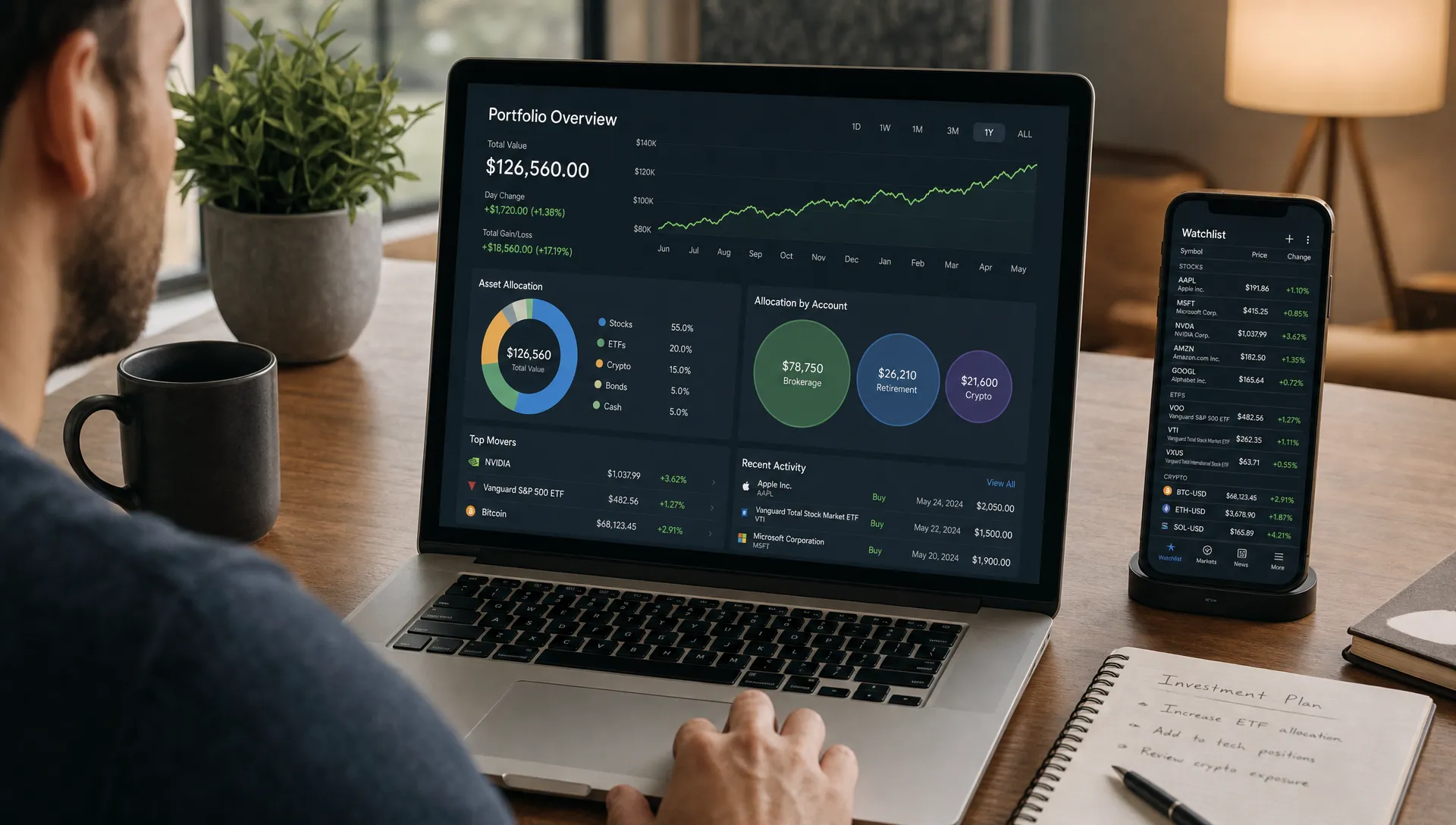
Compare the Trade Against Your Existing Portfolio
A trending trade can be attractive on its own and still be a poor fit for your portfolio. If you already own several assets exposed to the same factor, sector, currency, or macro theme, adding another similar position may increase hidden concentration.
For example, an AI infrastructure stock, a semiconductor ETF, and a cloud software fund may appear different at the ticker level but behave similarly during a market rotation. The same is true across crypto beta, small-cap risk, rate-sensitive growth stocks, or commodity-linked equities.
Before acting on a trend, ask whether the trade adds something new or simply doubles down on a risk you already have. Upside Invest's guide to benchmarking your portfolio against verified investors explains why comparing allocations can reveal exposures that a simple performance chart misses.
This step is especially important during strong markets. In bull phases, correlation often feels low because everything is rising. The real test comes when the trend reverses.
Build a Repeatable Early-Trend Checklist
A checklist prevents you from confusing excitement with evidence. It also helps you pass on trades that look interesting but do not meet your standards.
Use questions like these before adding a trending idea to your portfolio:
- Is the asset outperforming its relevant benchmark or peer group? A stock beating the S&P 500 may still be weak if its sector is much stronger.
- Are verified or higher-quality investors increasing exposure? Repeated allocation increases are more useful than one-off purchases.
- Is there a clear catalyst or fundamental improvement? Trends with no underlying driver can reverse quickly.
- Is ownership still underappreciated rather than universally crowded? The best opportunities often appear before consensus forms.
- Do I understand the downside case? If you cannot explain how the trade could fail, you are not ready to size it.
- Does the position improve my portfolio? A good idea can still create too much overlap or volatility.
The purpose of the checklist is not to eliminate risk. Risk is unavoidable. The purpose is to make sure you are being paid to take it.
Use Momentum, But Do Not Worship It
Momentum is one of the most studied market behaviors, and trend-following approaches can help investors avoid fighting strong price moves. But momentum is not a guarantee. It works best when paired with risk management and context.
A simple moving average, relative strength rank, or breakout level can help confirm that demand is improving. However, a momentum signal should not replace research. Strong momentum in a low-liquidity asset can disappear quickly. Strong momentum after a massive valuation reset may be more durable if fundamentals are also improving.
If you want a more detailed look at rules-based momentum frameworks, Upside Invest covers several practical approaches in its guide to trend following strategies that still work in 2026. For early trend spotting, the most useful lesson is consistency: define your rules before the market tests your emotions.
Track Trend Persistence, Not Just Trend Discovery
Finding a trend early is only the first step. You also need to monitor whether the trend remains intact.
A good trend tends to persist through normal pullbacks. It may consolidate, retest breakout levels, or pause while fundamentals catch up. A weak trend often depends on constant hype. Once attention fades, price and ownership momentum disappear.
Watch for changes in these areas:
- Allocation persistence: Are investors holding, adding, or quietly reducing exposure?
- Relative strength: Is the asset still outperforming peers after pullbacks?
- Volume and liquidity: Is participation broadening or drying up?
- Catalyst follow-through: Are earnings, adoption, policy, or macro conditions confirming the thesis?
- Risk-adjusted behavior: Is the return coming with reasonable volatility, or is the trade becoming unstable?
Upside Invest's emphasis on verified holdings, return metrics, Sharpe metrics, and investor move alerts is useful here because it allows investors to monitor behavior after the initial signal. A trend that top performers keep holding may deserve patience. A trend they abandon may deserve caution.
Avoid the Most Common Trend-Spotting Mistakes
The biggest mistake is assuming that early means "before price moves." In reality, many of the best trending trades have already started moving by the time they become investable. Waiting for some confirmation can be wise. The goal is not to buy the absolute bottom, it is to participate in the middle of a durable move while avoiding the final euphoric stage.
Another mistake is treating social attention as proof. Social platforms are useful for discovering ideas, but they are poor at sizing risk. A ticker can trend online because people are curious, angry, excited, or trapped in a losing position. None of those automatically make it a good investment.
A third mistake is ignoring liquidity. Thinly traded assets can look like clean trends until you try to enter or exit. Wide spreads, shallow order books, and sudden gaps can turn a good thesis into a poor realized return.
Finally, many investors fail to define an exit. If you buy because a trend is strengthening, you need to know what weakening looks like. That could be a break below a moving average, a deterioration in portfolio ownership, a failed catalyst, or a change in your broader allocation needs.
A Practical Workflow for Spotting Trending Trades
A simple weekly workflow can keep your process disciplined without turning investing into a full-time job.
Start by scanning for assets with improving relative strength across stocks, funds, and crypto. Then look for ownership changes, especially where verified investors or high-performing portfolios are increasing exposure. Next, group those ideas by theme so you can see whether the same trend is appearing in multiple places. After that, check valuation, liquidity, catalysts, and portfolio overlap.
Only then should you decide whether the trade belongs on your watchlist or in your portfolio. If it does, size it according to risk, not excitement.
The best investors are rarely the ones reacting the fastest. They are the ones who build better filters.
Frequently Asked Questions
What are trending trades? Trending trades are investments gaining sustained momentum through price action, investor accumulation, portfolio flows, or improving fundamentals. The strongest ones usually have more than one confirming signal.
How can retail investors spot trending trades early? Retail investors can look for improving relative strength, rising ownership, repeated buying from verified investors, sector momentum, and catalysts that are not yet fully reflected in consensus expectations.
Is social media useful for finding trending trades? Social media can help with idea discovery, but it should not be treated as confirmation. Always compare online attention with real portfolio behavior, ownership data, liquidity, and risk.
How do I know if a trending trade is already crowded? Warning signs include vertical price action, universal bullishness, extreme valuation expansion, heavy promotion, and little discussion of downside risk.
Should I buy a trade as soon as it starts trending? Not necessarily. A trend signal should trigger research, not automatic buying. Confirm the setup, check your portfolio exposure, define your risk, and decide whether the potential reward justifies the position.
Turn Market Signals Into Better Investing Decisions
Spotting trending trades before the crowd is easier when you can see what real investors are doing, not just what the market is saying. Upside Invest helps retail investors compare portfolios, track verified holdings, discover emerging themes, and monitor investor moves while keeping profiles private and anonymous.
If you want a clearer view of where capital is flowing, explore Upside Invest and start turning portfolio data into a smarter investing edge.
Educational content only, not personalized investment advice.