How to Use Mutual Fund Insight Beyond Past Returns
A fund’s five-year return tells you what happened, not whether you should own it now. Useful mutual fund insight connects that record to the manager who produced it, the risks taken, the share class available to you and the tax consequences of buying or selling.
For retail investors, the goal is not to find the fund with the most impressive chart. It is to decide whether a specific fund can do a specific job in your portfolio at an acceptable cost. That requires looking beneath the performance table and turning your research into a decision you can explain.
Start with the job, not the leaderboard
Before comparing funds, write down what the investment needs to accomplish. A core U.S. equity holding, a short-term bond allocation and a specialized healthcare position need different evaluation criteria.
Define your intended holding period, tolerance for losses and account type. Money you expect to spend soon should not depend on a volatile equity fund recovering on schedule. A fund held in a taxable brokerage account also raises questions that may matter less inside an IRA.
Next, choose a relevant benchmark. Comparing a small-cap value fund with the S&P 500 can confuse differences in market exposure with differences in manager skill. Bond funds need comparisons that account for duration and credit quality.
A useful comparison starts with similar mandates, not similar recent returns. Once the fund’s role is clear, you can judge whether its strategy, costs and risks support that role.
Turn mutual fund insight into a document checklist
Start with the fund provider’s current documents rather than a performance screenshot. You can also find registered fund filings through the SEC’s EDGAR search.
Different documents answer different questions:
| Document or disclosure | What to inspect | Decision it supports |
|---|---|---|
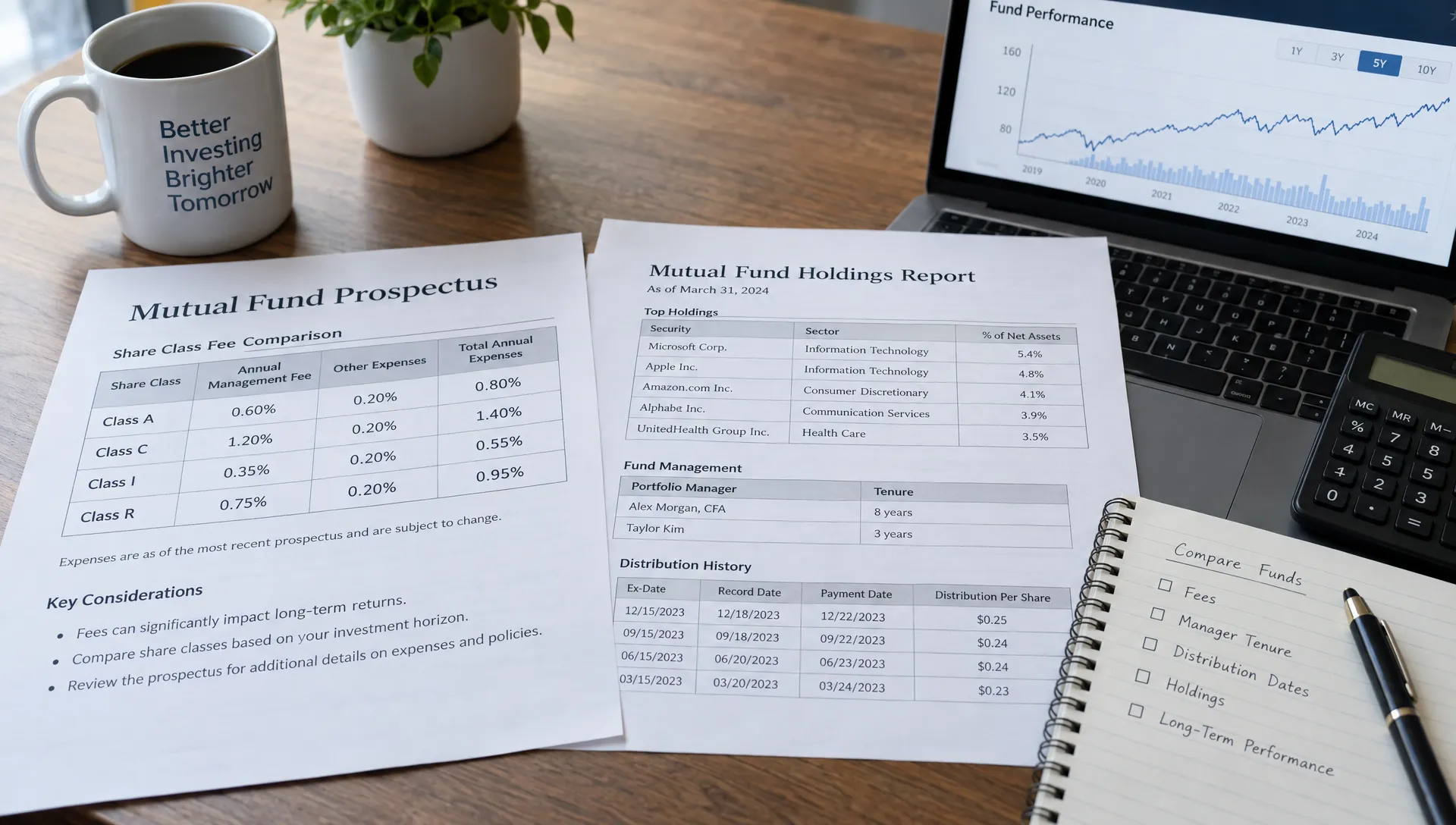
| Summary or statutory prospectus | Objective, principal strategies, risks and fee table | Whether the fund’s mandate and costs fit your needs |
| Shareholder report | Expenses, performance discussion and portfolio information | What happened during the reporting period |
| Holdings disclosure | Positions, weights and reporting date | What exposures you would actually add |
| Statement of additional information | More detail on policies, management and operations | Whether a concern needs deeper investigation |
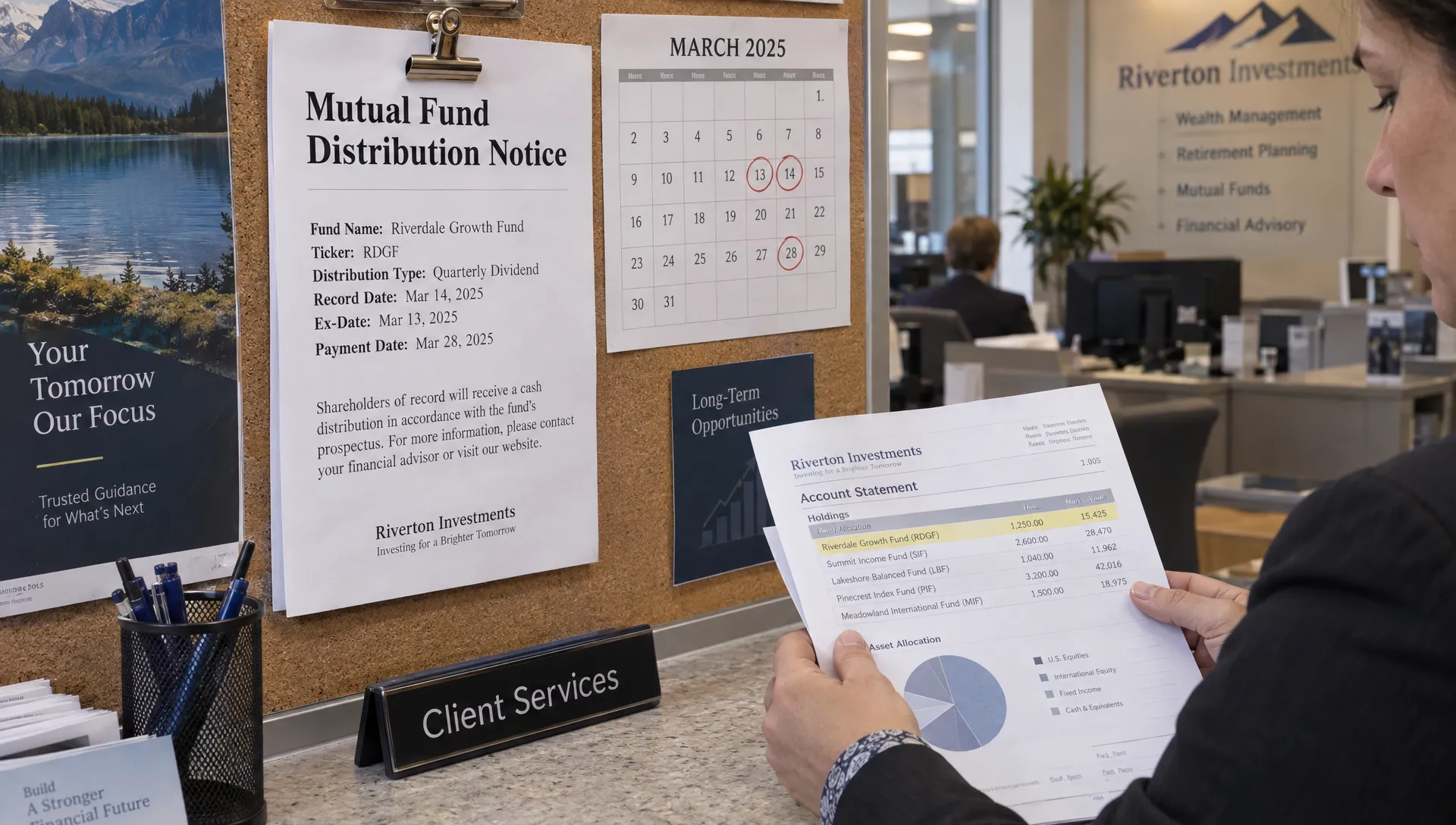
| Distribution notices and calendar | Announced or estimated income and capital gains distributions | Potential purchase timing and tax questions |
Record the exact ticker and share class beside each document. Two classes of the same fund can hold the same underlying portfolio but charge different expenses.
Also record the dates. A current factsheet may display holdings from an earlier reporting period. Treat those holdings as a dated snapshot, not a live view of the manager’s positions.
Find out who produced the track record
The next step in mutual fund insight is separating the fund’s historical record from the people and process currently responsible for it. Check when the lead manager joined, whether the team changed and whether the investment mandate remained consistent.
A ten-year return is less informative about a manager appointed two years ago. A stable fund name can also conceal a shift in strategy, portfolio concentration or risk-taking.
Look at several rolling periods rather than one convenient start date. Rolling three- or five-year returns can show whether results depended heavily on a single favorable stretch. They still describe the past, but they reduce reliance on one endpoint.
Evaluate the difficult periods too. Maximum drawdown measures the largest peak-to-trough decline within the period examined. Recovery time shows how long the fund took to regain its previous high. Both depend on the dates and data frequency used.
A Sharpe ratio can add context, but compare ratios calculated over the same period with consistent assumptions. It does not fully describe liquidity risk, concentrated positions or the experience of enduring a large loss.
Ask whether the fund’s results came from repeatable decisions or simply exposure to a style that happened to perform well.
Read holdings as an economic story
Useful mutual fund insight explains what drives the portfolio, not just how many securities it owns. Review the largest positions, sector weights, geographic exposure and, for bond funds, duration and credit quality.
A fund with many holdings can still depend heavily on a few companies or one economic outcome. Conversely, concentration is not automatically inappropriate if it is intentional, disclosed and compatible with the role you assigned the fund.
Test the investment theme, not just the label
Thematic funds need particular care because a convincing industry story is not the same as an attractive investment.
Consider a fund marketed around obesity treatment or healthcare innovation. The ecosystem includes drug manufacturers, suppliers, distributors and care providers. For example, medically supervised weight-management programs can combine GLP-1 medication with coaching and ongoing monitoring. That illustrates how treatment delivery extends beyond the medicine itself.
For the investment decision, however, you need to establish which businesses the fund actually owns. Then examine how those companies earn money, what competition or reimbursement changes could affect them and how much growth their valuations already assume.
Growing demand does not guarantee rising profits for every participant. Nor does it establish that a thematic fund is a better purchase than a broader, less expensive alternative.
Measure the fund’s effect on your portfolio
Apply mutual fund insight to your combined holdings rather than treating each fund as an isolated purchase. A new fund can look diversified by itself while increasing your existing exposure to the same large companies.
Suppose you already hold a broad U.S. stock fund, a growth fund and shares in your technology-sector employer. Another growth-oriented mutual fund may add little diversification despite having a different name.
Compare underlying positions and weights where disclosures allow. Upside’s guide to comparing fund overlap without missing risk explains why counting shared holdings alone can overlook concentration.
If holdings are disclosed with a delay, acknowledge that limitation. Combine the latest positions with the fund’s stated mandate and historical exposures rather than assuming the snapshot is complete or current.
Compare the costs you can actually buy
Use the exact share class available through your account. Check its expense ratio, sales charges, eligibility rules and any platform transaction fees. If a fee waiver lowers current expenses, inspect its terms and expiration date.
Cost-focused mutual fund insight should distinguish recurring expenses from charges tied to buying, selling or using a particular account. The FINRA Fund Analyzer can help compare fund costs under stated assumptions.
For illustration, a 0.95% annual expense ratio versus 0.45% represents a 0.50 percentage-point difference. On an unchanged $50,000 balance, that is approximately $250 over one year. This example excludes other charges and changes in investment value.
Do not subtract ongoing fund expenses twice when reviewing performance figures that already reflect them. Check the presentation’s methodology, including how it treats sales charges and reinvested distributions.
Portfolio turnover adds another question. Frequent trading may create transaction costs and, in taxable accounts, contribute to distributions. Turnover alone does not reveal the total cost, however. Trading conditions and the securities involved matter too.
A higher-cost fund needs a credible reason for its price, not simply a stronger recent return.
Account for distributions and your tax position
In a taxable account, mutual fund insight needs an after-tax perspective. A fund can distribute realized capital gains even when your own investment has lost value. Your personal outcome depends on when you bought, the fund’s activity and applicable tax rules.
Before a substantial purchase, check for announced or estimated distributions and relevant dates. Buying shortly before a capital gains distribution can create a tax liability associated with gains the fund realized before you became a shareholder.
A distribution is not free additional wealth. All else equal, the fund’s net asset value falls by the amount distributed. Reinvesting buys additional shares but does not eliminate a taxable distribution in a taxable account.
That does not mean you should automatically delay every purchase. Weigh potential taxes against market exposure, your investment plan and the uncertainty of distribution estimates.
When considering a switch, account for taxes on selling your existing position as well. A cheaper replacement may not justify an immediate taxable sale. Material decisions deserve an individualized tax calculation, potentially with a qualified tax professional.
Use investor behavior to ask better questions
Community data can complement fund documents, but it cannot replace them. Used carefully, mutual fund insight from verified portfolio behavior can reveal questions worth investigating: whether investors hold a fund as a core allocation, pair it with similar exposures or reduce it after a strategy change.
Upside provides verified investor holdings, portfolio comparison tools and private anonymous profiles. Its return and Sharpe metrics offer additional context when examining portfolios. Those views can help you explore how other investors allocate capital without treating their choices as instructions.
A high-ranking investor may have a different time horizon, tax situation or tolerance for loss. Their reported portfolio may also omit assets held elsewhere. Verification does not make a sample representative or prove that past success will persist.
Likewise, an increase in a holding’s portfolio weight does not necessarily mean the investor bought more. The position may simply have appreciated faster than the rest of the account.
Before copying a position, ask what evidence would make it suitable for your own plan. Upside’s portfolio comparison framework offers further context for separating allocation differences from risk differences.
Write a decision rule before you invest
Finish your research with a short decision note. This turns scattered observations into a record you can revisit when performance becomes uncomfortable.
Capture the fund’s intended role, why you prefer it to a realistic alternative and what would cause you to reconsider. Include the share class, account type and document dates so your reasoning remains traceable.
A hypothetical note might read: “This fund will serve as my diversified international equity allocation. I selected it for its mandate and available share-class cost. I will review it if the strategy changes, the management team changes materially or its exposures no longer fit my allocation.”
The practical value of mutual fund insight is a better decision rule, not a more elaborate prediction. Separate reasons to investigate from automatic reasons to sell. A manager departure deserves review, but its significance depends on team depth, succession and process continuity.
Choose a review schedule that matches your investment horizon. An annual review plus checks after material changes is often more useful than reacting to each monthly ranking. Before switching, compare the expected benefit with taxes, transaction costs and the risk of chasing yesterday’s winner.
Frequently asked questions
Are past returns useless when evaluating a mutual fund? No. They help you understand performance across market conditions, losses and consistency. Their value improves when you connect them to the relevant benchmark, manager tenure and risks taken. They do not establish what future returns will be.
Can two share classes of the same fund produce different returns? Yes. Classes generally share an underlying portfolio, but different expenses and sales charges can change investor outcomes. Compare the class you can actually purchase, including any eligibility requirements and account-level fees.
How often should I review a fund’s holdings? Review holdings during your scheduled portfolio check and after material strategy changes. Always check the reporting date. A newly published document does not necessarily contain current positions.
What is the most useful mutual fund insight before buying? Establish whether the exact fund and share class fit your portfolio’s purpose after accounting for exposure, recurring costs and taxes. A fund that fails that test does not become suitable because its recent returns look attractive.
Add portfolio context to your fund research
Use fund documents to understand the investment, then use portfolio comparisons to test your assumptions about how it fits. Explore Upside’s verified investor holdings and anonymous portfolio comparisons to generate better research questions and examine allocation choices in context. Keep the final decision anchored to your own objectives, costs and risk limits rather than another investor’s ranking.