Why Beneficial Stock Ownership Matters in SEC Filings

A shareholder’s name and a reported ownership percentage rarely tell the whole story. Beneficial stock ownership in SEC filings helps investors identify who can vote shares, direct their sale or benefit from transactions, depending on the reporting rules involved. Those distinctions matter when you assess management incentives, shareholder influence and changes in corporate control.
For retail investors, the value is not simply finding a large stake. It is understanding what that stake represents. A founder’s ownership may include unexercised options, an investment adviser may report shares belonging to clients and several filers may disclose authority over the same position.
Ownership disclosures identify authority, not just account names
Under SEC Rule 13d-3, beneficial ownership generally includes having or sharing voting power or investment power over a security. Voting power concerns voting or directing votes. Investment power concerns disposing of shares or directing their disposition.
These powers can arise indirectly through a contract, arrangement or relationship. The person whose name appears on the shareholder register is therefore not necessarily the only person whose ownership matters for disclosure.
If you hold shares through a brokerage account, the distinction between beneficial ownership and registered share ownership provides useful background. SEC filings take that distinction further by examining authority over securities, not merely custody.
This explains why an ownership table can include a trust, a holding company and an individual associated with those entities. Their reported positions may describe overlapping rights rather than separate pools of stock.
Beneficial stock ownership reveals more than personal investment
Ownership disclosures help answer two different investment questions: Who can influence the company, and whose financial interests are tied to its results? Those answers are not always identical.
A founder with substantial voting authority may influence director elections even without owning a majority of the company’s equity. An asset manager may control voting or investment decisions for client accounts without personally bearing the economic risk of every reported share.
For management, meaningful personal exposure can support alignment with shareholders. But a high percentage alone does not establish that alignment. You also need to examine compensation, acquisition costs, pledging arrangements and the securities included in the calculation.
A stake built through open-market purchases is different from one consisting largely of equity awards. Both may be relevant, but they provide different evidence about capital committed and incentives.
Control also affects accountability. A shareholder with decisive voting power may be able to maintain board influence despite opposition from other investors. That structure can support long-term decision-making, but it can also limit minority shareholders’ ability to challenge management.
The filing does not settle whether the arrangement is good or bad. It tells you which governance questions deserve closer attention.
Different forms answer different ownership questions
Beneficial stock ownership must be interpreted through the rules governing the particular filing. Large-shareholder reporting emphasizes voting and disposition authority, while Section 16 transaction reporting generally uses a pecuniary-interest test to identify reportable economic exposure. One definition should not be applied indiscriminately across every form.
| Filing | What it helps reveal | What it does not establish by itself |
|---|---|---|
| Schedule 13D | A reportable large stake, acquisition purpose and relevant arrangements | That the investment will succeed or a proposed action will occur |
| Schedule 13G | A large stake reported by an eligible filer under a different disclosure framework | That the holder has no influence over governance |
| Forms 3, 4 and 5 | Reportable insider holdings and transactions under Section 16 | That every reported acquisition is an open-market purchase |
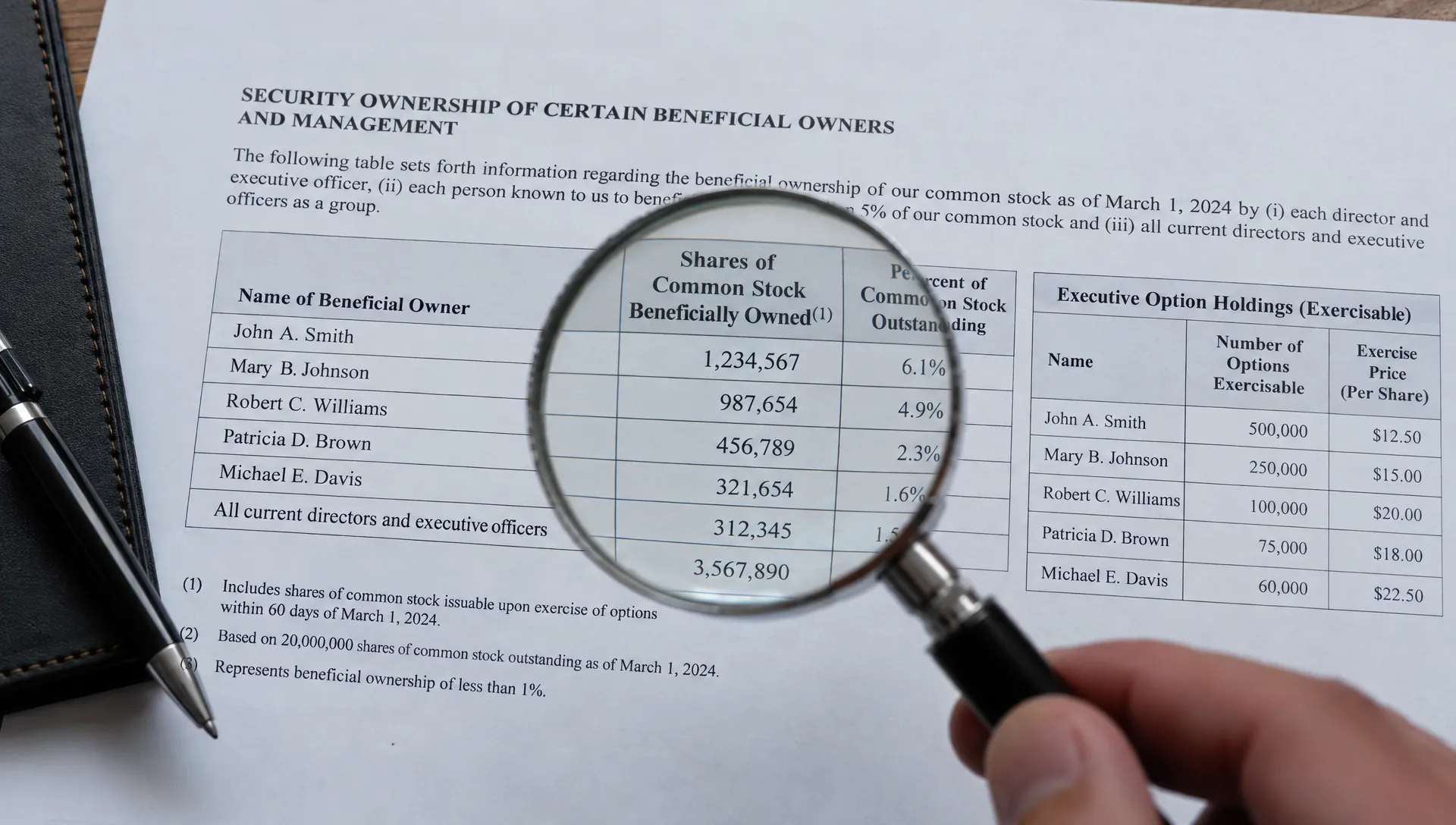
| DEF 14A proxy statement | Ownership information for specified major holders, directors and executives | A real-time ownership snapshot |
| Form 13F | Certain managers’ quarterly holdings of specified reportable securities | A complete portfolio or an equivalent measure of beneficial ownership |
Rule 16a-1 distinguishes the ownership test used to determine whether someone is a more-than-10% holder from the pecuniary-interest test generally used for Section 16 holdings and transactions.
For investors, the practical lesson is simple: two filings can describe the same securities differently without either being wrong.
Why reported ownership percentages can mislead
A percentage is only useful when you understand its numerator, denominator and measurement date. Beneficial stock ownership can include securities that are not yet outstanding, and it can attribute the same shares to more than one person.
Before comparing percentages, read the table’s introductory language and footnotes. They often contain the information that changes the interpretation.
Options can change both sides of the calculation
Rule 13d-3 generally includes shares a person has the right to acquire within 60 days, such as through exercisable options or warrants. Those shares are treated as outstanding when calculating that person’s ownership percentage, but generally not when calculating another person’s percentage.
Consider a hypothetical company with 100 million shares outstanding. An executive owns 12 million shares and has options to acquire another 3 million within 60 days.
The calculation would generally be:
15 million beneficially owned shares ÷ 103 million adjusted outstanding shares = approximately 14.56%.
It would not simply be 15 million divided by 100 million.
This adjustment matters when comparing executives or tracking changes across reporting periods. One person’s percentage may use a different denominator from another’s because their acquisition rights differ.
It also separates disclosure from present voting authority. The options may count toward the reported ownership figure even though the underlying shares do not yet carry voting rights for that holder. Check whether securities are outstanding, exercisable or merely subject to future vesting.
Shared authority can produce overlapping disclosures
Beneficial stock ownership figures are not always additive. An adviser and a controlled entity might both report authority over the same block of shares. Adding their disclosed positions could therefore overstate the amount held by distinct investors.
Suppose two reporting persons each disclose the same 8 million shares. That does not automatically mean they collectively own 16 million separate shares.
Look for language such as “shared voting power,” “shared dispositive power,” “through” or “may be deemed to beneficially own.” Then identify which shares overlap and why authority is attributed to each reporting person.
A disclaimer of beneficial ownership also needs careful reading. It may qualify a person’s claimed economic interest or attribution, but it does not make the underlying position disappear. The surrounding explanation is more useful than treating the disclaimer as a simple yes-or-no ownership label.
Equity ownership and voting power can diverge
Dual-class structures make this distinction especially important. A company may issue one class with one vote per share and another with multiple votes per share.
Assume a hypothetical company has 80 million Class A shares carrying one vote each and 20 million Class B shares carrying ten votes each. Assume both classes have identical economic rights per share and a founder owns all the Class B shares.
The founder has 20% of the outstanding equity but approximately 71.4% of the voting power: 200 million votes out of 280 million total votes.
Beneficial stock ownership therefore needs to be read alongside share-class rights, not as a substitute for them. Conversion provisions, voting agreements and sunset clauses can change the practical significance of that control.
When evaluating minority-shareholder risk, compare economic ownership, reported ownership and voting power separately. A single headline percentage cannot reliably represent all three.
Read ownership changes in their reporting context
An increase in a reported percentage does not necessarily mean someone bought shares. A buyback can reduce the outstanding share count and increase an existing holder’s percentage without any additional investment.
Likewise, a percentage can fall because the company issued shares, even if the holder sold nothing. Transfers between related entities, newly exercisable options and changes in shared authority can also alter reported figures.
Distinguish the date of the underlying event from the filing date and the ownership measurement date. A proxy statement’s ownership table usually reflects a specified date, while Form 13F reports positions as of quarter-end. Neither should be treated as a live account balance.
Reporting deadlines also affect how quickly information becomes available. Under the SEC’s modernized ownership-reporting rules, an initial Schedule 13D is generally due within five business days after the relevant threshold is crossed, with amendments generally due within two business days after a material change. Schedule 13G deadlines depend on the filer’s category and circumstances.
Changes in beneficial stock ownership become more informative when you can explain their cause. Compare share counts, acquisition rights and transaction details before concluding that a holder has become more bullish or less committed.
Even a correctly identified purchase leaves unanswered questions about valuation, time horizon and the position’s importance within the buyer’s overall assets.
Turn disclosure into an investment assessment
A useful ownership assessment connects the filing to a specific decision. For governance, focus on voting authority and arrangements that concentrate control. For incentive alignment, examine personal economic exposure and how the stake was acquired. For potential corporate action, review disclosed intentions and subsequent amendments.
A short checklist can keep that analysis disciplined:
- Identify the reporting framework: Establish which filing and ownership definition you are reading.
- Inspect the footnotes: Separate direct holdings, shared authority and acquisition rights.
- Reconcile the percentages: Check the outstanding share count, adjusted denominator and share classes.
- Explain the change: Determine whether it reflects a transaction, dilution, a buyback or another event.
- Test the investment relevance: Connect the evidence to governance, incentives or a potential catalyst.
Beneficial stock ownership is strongest as evidence about rights and relationships, not as a stand-alone forecast of returns. A controlling shareholder can still oversee a poorly performing business, and a respected institution can make an unsuccessful investment.
To put the findings in context, incorporate them into a broader ownership profile for the stock. Then evaluate valuation, financial condition and business performance independently rather than allowing a prominent shareholder’s name to decide the investment.
Frequently asked questions
What ownership threshold usually triggers Schedule 13D or 13G reporting? For a class of equity securities registered under Section 12 of the Exchange Act, acquiring beneficial ownership of more than 5% generally triggers Schedule 13D reporting unless the holder qualifies to report on Schedule 13G. Eligibility, exemptions and deadlines require separate consideration.
Does a reported stake mean the investor personally paid for every share? No. Beneficial stock ownership can arise through indirect holdings, shared authority or qualifying acquisition rights. A manager may also report authority over client assets. The filing’s ownership breakdown and footnotes help distinguish personal economic exposure from attributed authority.
Does high insider ownership always benefit outside shareholders? No. It can strengthen financial alignment, but concentrated voting power can also reduce outside shareholders’ influence. Assess the ownership structure alongside board oversight, related-party transactions and the company’s treatment of minority investors.
Is a Form 13F position the same as beneficial ownership? No. Form 13F reports certain securities over which a qualifying manager exercises investment discretion. It is not interchangeable with a Schedule 13D, Schedule 13G or proxy ownership table, and it does not show every asset or exposure in a manager’s portfolio.
Does this ownership terminology apply equally to other assets? No. Ownership rights depend on the legal setting. Buying a residential park home at Hermitage Park, for example, involves homeownership and residential site terms rather than the voting and disposition tests for public-company shares. Read the contract and applicable rules for the asset involved.
Add portfolio context without confusing it with disclosure
SEC filings explain legally reportable ownership. Portfolio comparisons answer a different question: how investors allocate their capital.
Use Upside Invest to explore verified holdings and compare allocations through private, anonymous profiles, then pair that perspective with your filing research. Keep the two sources distinct: community holdings can provide portfolio context, while SEC documents remain the primary evidence for disclosed control, insider transactions and reportable ownership.