ETF Insights That Actually Improve Portfolio Decisions

ETFs are often marketed as simple building blocks, and in many ways they are. One ticker can give you exposure to hundreds of stocks, a full bond market segment, a specific sector, a dividend strategy, or even a niche theme. But simple access does not automatically lead to better portfolio decisions.
The problem is not that investors lack ETF information. The problem is that most ETF information is too shallow to guide action. A fund’s one-year return, expense ratio, star rating, or popularity can be useful context, but none of those tells you whether the ETF improves your portfolio.
Better ETF insights answer a more practical question: What changes if I add, remove, trim, or replace this fund?
That means looking beyond the ticker and into holdings, overlap, concentration, factor exposure, costs, trading behavior, and how verified investors are actually using similar funds. When ETF analysis connects directly to allocation decisions, it becomes a tool for improving risk and return instead of another dashboard to refresh.
What makes an ETF insight useful?
A useful ETF insight has three qualities.
First, it is portfolio-specific. A technology ETF may be a smart satellite position for one investor and redundant risk for another who already owns the Nasdaq 100, several megacap stocks, and a growth fund.
Second, it is decision-oriented. It should point toward a possible action, such as reducing overlap, improving diversification, lowering fees, adding missing exposure, or changing position size.
Third, it includes context. An ETF outperforming over six months may simply reflect a factor or sector cycle. A low expense ratio may not matter much if the fund is illiquid, highly concentrated, or poorly aligned with your objective.
Good ETF insights do not tell you, “This fund is good.” They tell you, “This fund plays this role, adds this exposure, creates this risk, and may or may not fit with what you already own.”
Start with the ETF’s job in your portfolio
Before comparing funds, define the job you want the ETF to do. Many poor ETF decisions happen because investors buy a fund based on a story, then later realize they never defined its purpose.
An ETF can be a core holding, a tactical tilt, an income tool, a hedge, a liquidity sleeve, or a thematic bet. Each role requires different insights.
| ETF role | Main decision question | Most useful ETF insights |
|---|---|---|
| Core market exposure | Does this fund efficiently cover a broad asset class? | Expense ratio, tracking, diversification, liquidity, benchmark fit |
| Sector or factor tilt | Does this improve expected return or risk balance? | Factor exposure, sector concentration, performance drivers, correlation |
| Thematic exposure | Is the theme investable and durable? | Holdings purity, index rules, valuation, overlap, position sizing |
| Income generation | Is the yield sustainable for the risk taken? | Distribution history, credit quality, duration, covered call structure, tax considerations |
| Defensive allocation | Does it behave differently when stocks fall? | Drawdown history, correlation, duration, quality, liquidity |
This framing keeps the analysis grounded. You should evaluate a broad S&P 500 ETF differently from a thematic robotics ETF, a short duration Treasury ETF, or a high yield bond ETF. The same performance chart cannot answer every question.
Look through the ETF wrapper, not just at the ticker
An ETF is a wrapper around assets. The ticker is convenient, but the holdings are what you actually own.
Two ETFs with similar names can have very different exposures. One “AI” ETF may hold megacap software and semiconductor companies, while another may include smaller automation, data infrastructure, and robotics firms. One dividend ETF may favor mature low-volatility companies, while another may lean into high-yield stocks with weaker balance sheets.
When reviewing holdings, focus on four things.
- Top holdings concentration: If the top 10 positions dominate the fund, the ETF may behave more like a concentrated stock basket than a diversified fund.
- Sector and industry exposure: A broad-sounding fund may still have heavy sector tilts.
- Weighted overlap with your portfolio: Owning five ETFs does not mean owning five distinct exposures.
- Index methodology: Cap-weighted, equal-weighted, dividend-weighted, factor-screened, and actively managed ETFs can produce very different outcomes.
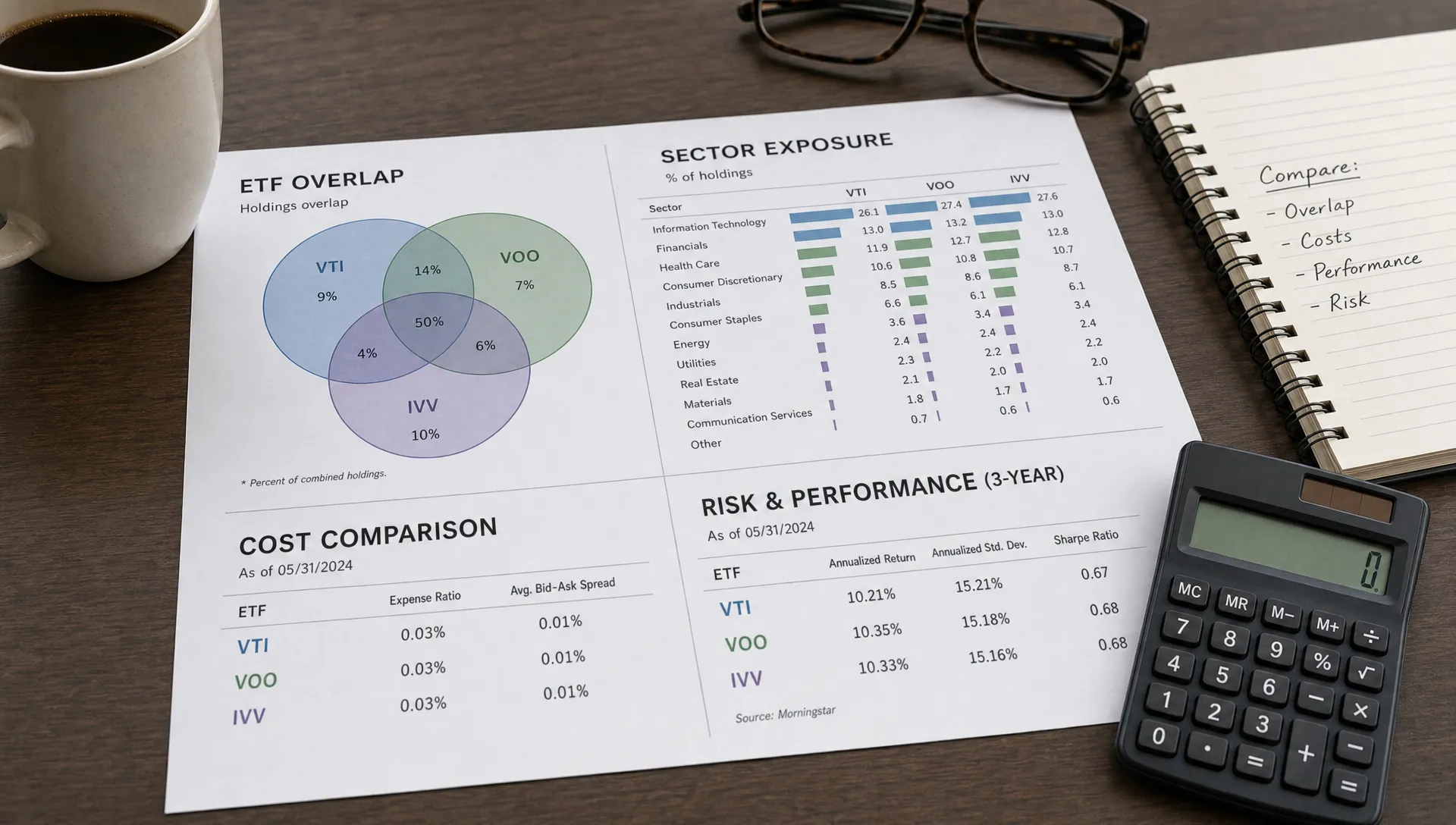
Overlap is especially important. Many investors think they are diversified because they own multiple ETFs, yet the same large companies may appear across several funds. If you own a broad market ETF, a growth ETF, a technology ETF, and individual megacap stocks, your true exposure may be far more concentrated than it looks.
For a deeper process, Upside Invest’s guide on how to compare funds overlap without missing risk explains why weighted overlap and exposure overlap matter more than simply counting duplicate holdings.
Separate performance from the reason for performance
ETF performance is easy to measure but easy to misread. A fund’s return tells you what happened, not why it happened.
For example, a clean energy ETF may outperform because of policy expectations, falling interest rates, a few large holdings, or a broad risk-on environment. A dividend ETF may lag because it is underweight technology during a growth rally, not because the strategy is broken. A small-cap ETF may outperform during a rotation but still carry higher volatility and drawdown risk.
When an ETF has strong returns, ask what drove them:
- Was performance broad-based or concentrated in a few holdings?
- Did the ETF benefit from a factor tilt such as growth, value, quality, momentum, or size?
- Did macro conditions help the fund, such as falling rates, a weaker dollar, or commodity strength?
- Did the ETF outperform its proper benchmark or only look good against the wrong comparison?
Benchmark selection matters. Comparing a semiconductor ETF to the S&P 500 may show strong outperformance during a chip cycle, but that does not tell you whether it beat a relevant semiconductor benchmark or whether the risk was worth taking.
This is where portfolio-level context becomes essential. A fund can outperform and still make your portfolio worse if it adds too much concentration, increases volatility, or duplicates exposure you already have.
Use trend and momentum signals carefully
ETF flows, price momentum, and rising popularity can be helpful, but they are not buy signals by themselves.
ETF flows may reveal where investors are allocating capital. Momentum may show that a theme or asset class has improving demand. But crowded trades can reverse quickly when expectations change. A fund attracting large inflows after a strong run may be early evidence of durable adoption, or it may be a sign that late buyers are chasing performance.
A better approach is to treat ETF trend signals as prompts for deeper analysis. If a sector ETF is gaining momentum, ask whether earnings revisions, macro conditions, institutional positioning, or verified investor behavior support the move. If a bond ETF is attracting inflows, ask whether investors are seeking yield, duration, safety, or a tactical rate view.
Trend data is most useful when it helps you identify what to investigate next. It is least useful when it replaces your investment thesis.
Pay attention to ETF structure and hidden costs
Expense ratios are important, but they are only one part of ETF cost. A cheap ETF is not automatically the best ETF, and a higher-fee ETF is not automatically a bad choice if it delivers a specific exposure efficiently.
Decision-useful ETF insights should include the following cost and structure checks.
| Cost or structure factor | Why it matters | What to look for |
|---|---|---|
| Expense ratio | Reduces long-term returns | Compare with similar funds offering the same exposure |
| Bid-ask spread | Affects entry and exit cost | Wider spreads can matter for frequent or large trades |
| Liquidity | Influences trade execution | Review average trading volume and underlying holdings liquidity |
| Tracking difference | Shows how closely the ETF follows its benchmark | Persistent gaps may signal implementation drag |
| Distribution profile | Affects income and taxable events | Review yield source, payout history, and tax treatment |
| Leverage or inverse exposure | Can behave unexpectedly over longer periods | Understand daily reset mechanics and compounding effects |
For long-term investors, structure matters because small frictions compound. For tactical investors, liquidity and spreads can matter even more because position changes happen more frequently.
Do not evaluate an ETF only on headline yield either. Some high-yield equity, bond, and options-based ETFs may offer attractive distributions while carrying risks that are not obvious from the yield alone. Income is useful only if the underlying risk fits your plan.
Evaluate thematic ETFs with extra skepticism
Thematic ETFs are appealing because they connect investing to big ideas: artificial intelligence, cybersecurity, clean energy, digital assets, aging populations, space, robotics, wellness, and more. They can also be dangerous when the story is stronger than the portfolio.
A good thematic ETF insight separates the real-world trend from the investable basket. A theme can be real and still produce poor ETF returns if valuations are stretched, holdings are only loosely connected, or the fund owns companies where the theme is a small part of revenue.
When evaluating a theme, ask three questions.
First, is the trend durable? A short-lived consumer fad is different from a multi-year shift in infrastructure spending, regulation, demographics, or productivity.
Second, are the holdings pure enough? If a wellness ETF mostly owns broad consumer staples and large healthcare companies, it may not provide the exposure you think you are buying. Real-world innovation can help you understand whether a theme has substance. For example, a company focused on herbal wellness through vaporization reflects how niche health and wellness products can emerge, but an ETF investor still needs to ask whether that trend is represented meaningfully and profitably inside any fund’s holdings.
Third, what role should the theme play? Even a compelling theme may belong in a small satellite position rather than a core allocation. Thematic ETFs often have higher concentration, higher fees, and more sensitivity to investor sentiment than broad-market funds.
Compare ETFs against your actual portfolio
ETF analysis becomes much more powerful when it is connected to what you already own.
A fund may look attractive in isolation but add little value to your portfolio. Another fund may have average standalone performance but improve diversification, reduce volatility, or fill an exposure gap.
Useful comparison questions include:
- Does this ETF add new exposure or duplicate existing positions?
- How would it change sector, country, market cap, bond duration, or factor exposure?
- Would it increase concentration in a small number of stocks?
- Does it improve risk-adjusted return potential or just raise expected volatility?
- What would I sell or reduce to make room for it?
This last question is underrated. Every new ETF competes for capital with something else in your portfolio. If you cannot identify what role it replaces or improves, the purchase may be driven by curiosity rather than strategy.
Portfolio comparison also helps prevent accidental risk stacking. You may not realize that your growth ETF, tech ETF, innovation ETF, and direct stock holdings all respond to the same interest rate and earnings multiple assumptions. A portfolio can look diversified by ticker count while depending on one dominant market view.
Upside Invest’s article on portfolio comparison tips that reveal hidden risk is useful if you want to move beyond return comparisons and understand how exposure, correlation, and concentration interact.
Add verified investor behavior to your ETF research
Traditional ETF research is fund-centric. It looks at the ETF’s factsheet, returns, holdings, flows, and costs. That is necessary, but it leaves out an important question: how are other investors actually using this exposure?
Verified portfolio behavior can add a valuable layer of context. If top-performing investors are increasing exposure to a specific sector ETF, reducing a crowded theme, or replacing individual stocks with broader ETFs, that behavior may reveal a shift worth studying. It does not mean you should copy the trade, but it can help you identify where conviction is changing.
This is especially useful because ETF decisions are often allocation decisions. Seeing how verified investors balance ETFs, stocks, funds, and crypto can help you compare your own positioning against real portfolios rather than generic model allocations.
Upside Invest is designed around this idea: anonymous, verified investor holdings, portfolio comparison, trend tracking, top performer rankings, return and Sharpe metrics, alerts on investor moves, and private profiles. If you want to understand how your ETF choices compare with real investor behavior, the guide on how Upside Invest helps you benchmark your portfolio explains why peer benchmarking can be more informative than relying only on broad market indexes.
Turn ETF insights into an action checklist
The best ETF insights lead to a specific portfolio decision. Before buying or selling an ETF, translate your research into an action checklist.
| Insight | Decision it should inform | Possible action |
|---|---|---|
| High overlap with existing funds | Am I truly diversifying? | Replace overlapping funds or reduce position size |
| Strong recent performance from one sector | Am I chasing a narrow driver? | Rebalance, wait for better entry, or size smaller |
| Low fee but poor liquidity | Is the fund efficient to trade? | Use limit orders or choose a more liquid alternative |
| Attractive theme but weak holdings purity | Am I buying the theme I want? | Find a more targeted ETF or avoid the exposure |
| Rising verified investor interest | Is conviction building? | Investigate fundamentals, flows, valuation, and risk |
| Higher yield than peers | What risk pays for that yield? | Review credit, options strategy, duration, and distribution source |
This approach helps you avoid “interesting but useless” analysis. If an insight does not affect sizing, selection, timing, risk control, or monitoring, it may not be worth much attention.
Common ETF insight mistakes to avoid
Many ETF mistakes come from using the right data in the wrong way.
One common mistake is buying last year’s winner without understanding the driver. Another is assuming that more ETFs always mean more diversification. A third is focusing on expense ratios while ignoring overlap, liquidity, and concentration.
Investors also overestimate how precise ETF labels are. A fund’s name can suggest a clean exposure, but the holdings may tell a more complicated story. Always confirm what the ETF owns, how it weights those holdings, and how often the strategy rebalances.
Finally, avoid treating ETF insights as predictions. The goal is not to forecast the next three months perfectly. The goal is to build a portfolio where every holding has a clear purpose, a sensible size, and a known risk profile.
Frequently Asked Questions
What are ETF insights? ETF insights are decision-useful observations about an ETF’s holdings, costs, overlap, performance drivers, structure, liquidity, trends, and role in a portfolio. The best insights help investors decide whether to buy, sell, replace, resize, or monitor a fund.
Which ETF insight matters most before buying? Holdings overlap is often one of the most important checks because it shows whether the ETF truly adds diversification. A fund with strong performance may still duplicate exposures you already own.
Are ETF flows a reliable buy signal? ETF flows can show where investor attention and capital are moving, but they should not be used alone. Flows are most useful when combined with holdings analysis, valuation, performance drivers, and broader portfolio context.
How many ETFs should a portfolio have? There is no universal number. A portfolio with a few well-chosen ETFs can be more diversified than one with many overlapping funds. The better question is whether each ETF has a distinct purpose and improves the portfolio’s overall risk and return profile.
Can verified investor data improve ETF decisions? Verified investor data can add context by showing how real investors are allocating, trimming, or rotating exposures. It should not replace your own analysis, but it can help you spot trends, compare positioning, and challenge assumptions.
Make ETF insights part of your investing process
ETF investing works best when each fund has a clear job and every insight connects to a decision. Instead of asking whether an ETF is popular, cheap, or up recently, ask whether it improves your portfolio after accounting for overlap, concentration, cost, liquidity, and risk.
Upside Invest helps retail investors compare portfolios, see verified holdings, track trends, and learn from anonymous investor behavior. Use it to pressure-test your ETF allocations, spot hidden exposures, and make decisions with better context instead of relying on ticker-level impressions alone.