How to Find Stocks With Most Upside Without Chasing Hype
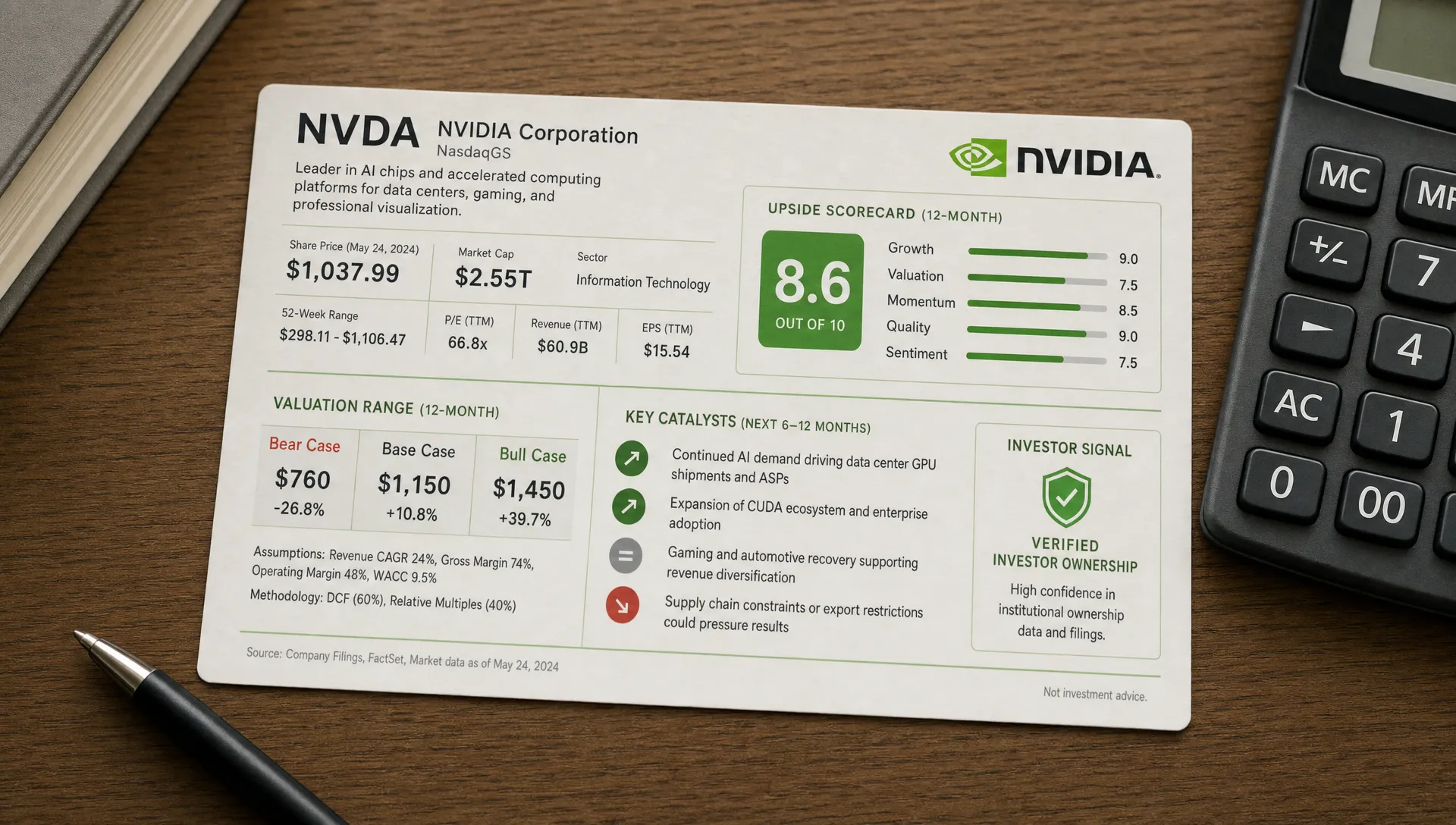
Searching for stocks with most upside can be useful, but it can also send investors straight into the loudest corners of the market. The problem is not ambition. The problem is confusing upside with attention.
A stock can have real upside because earnings are inflecting, valuation is too low, ownership is still underdeveloped or a catalyst has not been priced in. A stock can also look exciting because it doubled last month, dominates social feeds and has a story that is easy to repeat. Those are very different setups.
The goal is to find asymmetric opportunities before they become consensus hype, then avoid turning a good idea into a bad position. That requires a process built around evidence, not vibes.
What upside actually means
Upside is the gap between what a stock trades for today and what it could reasonably be worth if the business performs better than the market expects. The key word is reasonably. A fantasy target price does not create upside. Neither does a viral chart.
A useful upside case has four parts: a source of mispricing, a measurable improvement, a timeline and a risk limit. If any of those are missing, you may still have a trade, but you probably do not have a strong investment thesis.
| Upside component | What to ask | Weak answer |
|---|---|---|
| Mispricing | What does the market misunderstand? | Everyone is talking about it |
| Evidence | What data supports the thesis? | The chart looks strong |
| Catalyst | What could change investor perception? | It should go up eventually |
| Valuation | What is a realistic fair value range? | A round-number price target |
| Risk | What would prove the thesis wrong? | I will hold no matter what |
This is why upside should not be reduced to analyst price targets. Targets can be useful inputs, but they often lag the story. A better approach is to build your own range of outcomes, then compare that range with how verified investors, fundamentals and price behavior are evolving.
For a deeper framework on valuation ranges, benchmarks and scenario thinking, Upside Invest has a useful guide on how to measure investment upside with better context.
Start with the source of upside, not the ticker
Before opening a screener, decide what type of upside you are trying to find. Different upside sources require different evidence.
Some stocks have upside because the company is high quality but temporarily ignored. Others have upside because revenue growth is accelerating, margins are about to expand or the balance sheet is improving. In cyclical industries, upside may come from the market pricing in a downturn just as conditions stabilize. In smaller companies, it may come from optionality that large investors have not modeled yet.
Common sources of real upside include:
- Estimate revisions: Revenue, earnings or free cash flow expectations are moving higher before the stock is fully re-rated.
- Margin expansion: A company grows into fixed costs, cuts waste or shifts toward higher-margin products.
- Multiple re-rating: The market starts valuing a business more like its stronger peers.
- Balance sheet repair: Debt, liquidity or dilution risk improves enough to change the equity story.
- Sector inflection: A beaten-down industry stops getting worse, which can be enough for large upside.
- Hidden ownership signal: Better-performing investors start building positions before broad attention arrives.
A mistake many investors make is screening for the biggest estimated upside percentage first. That tends to surface distressed stocks, speculative small caps and companies with stale analyst targets. It is more effective to ask why upside might exist, then screen for evidence that matches that specific reason.
Use screens as filters, not answers
Stock screeners are helpful for narrowing a universe, but they cannot tell you whether a thesis is real. A low valuation multiple can mean a stock is cheap, or it can mean earnings are about to fall. High growth can signal an exceptional business, or it can signal a company that is spending heavily to buy revenue with poor returns.
Instead of one magic screen, use several filters that point in the same direction.
| Filter | What it can reveal | What to verify next |
|---|---|---|
| Revenue growth acceleration | Demand may be improving | Is growth organic or acquisition-driven? |
| Earnings revision strength | Analysts may be catching up | Are revisions broad or from one estimate? |
| Free cash flow yield | Valuation may be reasonable | Is cash flow recurring or temporary? |
| Gross margin improvement | Pricing power or mix may be better | Are costs being deferred? |
| Relative strength | Buyers are already accumulating | Is the move overextended? |
| Low institutional attention | The stock may be underfollowed | Is liquidity sufficient? |
The best candidates usually pass more than one test. For example, a stock showing improving margins, positive estimate revisions and quiet accumulation by strong investors is more interesting than a stock that only appears cheap.
Also watch out for screen results that look too perfect. Extremely low price-to-earnings ratios, huge projected upside and very high short interest can be legitimate, but together they often signal a battleground stock. Battlegrounds can work, but they require more discipline because the range of outcomes is wider.
Replace the story with filings and unit economics
Once a stock passes an initial screen, slow down. The next step is to test whether the business can support the upside story.
Start with the company’s 10-K, 10-Q and earnings transcripts. The SEC’s EDGAR company search is the primary source for US public company filings. You are looking for the moving parts that matter most: revenue segments, customer concentration, debt maturities, share count, margins, cash conversion, capital spending and management guidance.
A high-upside thesis often depends on one or two drivers. If you cannot identify them, the thesis is probably too vague. For a software company, the key driver might be net retention or sales efficiency. For a retailer, it might be inventory normalization and store productivity. For a miner, it may be commodity prices, production volume and cost per unit.
Sector mapping helps too. If you are evaluating public companies exposed to online gaming, payments, compliance or digital infrastructure, it is useful to understand how private platforms package the full stack. For example, modular iGaming platform providers combine payments, KYC, fraud prevention, game aggregation and backoffice tools, which can help investors think more clearly about where value may accrue across a sector.
The point is not to become an industry consultant. The point is to understand whether the company’s claimed edge is durable, measurable and economically meaningful.
Use verified investor behavior instead of social noise
Hype spreads fast in 2026 because investors have social feeds, AI summaries, short-form video and real-time market data in the same workflow. That creates more information, but not always more signal.
Verified portfolio behavior is different. If real investors are building positions, holding through volatility or outperforming with a specific allocation, that is more useful than a loud thread from an anonymous account. Ownership data does not tell you what to buy by itself, but it can reveal whether a stock is gaining quiet conviction or simply attracting short-term attention.
Retail ownership can be especially interesting when it appears before institutional narratives catch up. Upside Invest has covered this in more detail in its article on what retail ownership of stocks can reveal early. The main takeaway is simple: ownership is most valuable when you study who is buying, whether they have been right before and whether their position sizes show conviction.
This is where an investing intelligence platform can add context. Upside Invest shows verified investor holdings, anonymous profiles, top performer rankings, portfolio comparison tools, trend and momentum tracking, return metrics and alerts on investor moves. Instead of treating every popular ticker equally, you can ask better questions: Are strong investors accumulating? Is the move broadening? Are top performers holding or trimming? Is your own portfolio already exposed to the same theme?

Separate early trends from crowded trades
Momentum is not the enemy of upside. Many big winners start moving before the full fundamental improvement is obvious. The danger is buying after a trend becomes crowded, when future buyers are already in and the catalyst is already priced.
A healthy early trend usually has improving fundamentals, expanding ownership and price strength that builds over time. A hype-driven move often has vertical price action, sudden social-media intensity, vague catalysts and a sharp increase in short-term traders. Both can look exciting, but only one gives you a reasonable base for risk management.
Useful questions to ask before buying a fast-moving stock include:
- Has the thesis improved, or has only the price changed?
- Are verified investors adding after the move, or are they reducing exposure?
- Is volume confirming institutional interest, or is it mainly speculative churn?
- Does valuation still leave room for error?
- What event could disappoint the market?
If you want to go deeper on signal quality, this guide on how to spot trending trades before the crowd explains how to combine price action, ownership data and catalysts without blindly chasing momentum.
Build a simple upside scorecard
A scorecard keeps you honest. It forces you to compare opportunities using the same criteria, instead of letting the most exciting story win.
You do not need a complex model for every stock. A simple 0 to 2 score for each category can help you rank ideas. A 0 means weak or unproven, 1 means acceptable and 2 means strong.
| Category | Score 0 | Score 1 | Score 2 |
|---|---|---|---|
| Business quality | Declining or unclear | Stable but average | Durable and improving |
| Valuation | Prices in perfection | Fair with some room | Discounted versus realistic outcomes |
| Catalyst | None visible | Possible within 12 months | Clear and measurable |
| Ownership signal | Pure hype | Mixed behavior | Verified accumulation by strong investors |
| Financial strength | High dilution or debt risk | Manageable risk | Strong balance sheet and cash generation |
| Downside control | No clear invalidation point | Some risk limits | Defined thesis break and exit plan |
The goal is not to buy only stocks with perfect scores. Some of the best opportunities are messy. The scorecard helps you see where the mess is and whether the upside is large enough to compensate.
For example, a turnaround stock might score low on business quality but high on catalyst and valuation. That does not make it uninvestable. It means you should size it differently from a profitable compounder with cleaner financials and slower upside.
Watch for hype red flags
Hype usually asks you to ignore something: valuation, dilution, insider selling, weak cash flow, poor governance or the lack of a real catalyst. The more emotional the pitch, the more important it is to slow down.
Be cautious when a stock’s upside case depends mainly on one of these claims:
- This is the next big thing, with no financial evidence attached.
- Analysts do not understand it, but no one can explain what they are missing.
- The company is pre-revenue, yet the valuation assumes flawless execution.
- Dilution is dismissed as irrelevant, even though the company needs capital.
- Short sellers are blamed for every decline.
- The only catalyst is more people discovering the stock.
None of these automatically means a stock is bad. It means the burden of proof is higher. If a thesis cannot survive basic questions, it should not get your capital.
Size positions for uncertainty
Finding stocks with most upside is only half the game. The other half is surviving the mistakes.
High-upside stocks often come with higher volatility, thinner liquidity or more uncertain outcomes. Even a strong thesis can fall 30 percent before it works. If the position is too large, you may be forced out for emotional or risk reasons before the thesis has time to play out.
A practical approach is to size based on thesis quality and downside clarity. A stock with strong financials, verified accumulation and a clear catalyst can justify a larger position than a speculative idea with binary risk. You can also scale in, buying an initial position when the evidence is promising and adding only if the thesis strengthens.
Set an invalidation point before buying. That could be a missed catalyst, deteriorating margins, a broken balance sheet assumption, verified investors exiting or price action that signals the market has rejected the thesis. Selling because the thesis changed is discipline. Selling because the stock is down and you are uncomfortable usually means the position was too large or the original work was incomplete.
A practical workflow for finding high-upside stocks
A repeatable workflow beats inspiration. You can adapt this process to your style, but the sequence matters: find candidates, test the thesis, compare behavior, then manage risk.
Use this as a starting point:
- Define the type of upside you want: re-rating, recovery, acceleration, hidden quality or optionality.
- Screen for matching evidence, such as revisions, margins, valuation, relative strength or cash flow.
- Read filings to identify the few drivers that actually determine fair value.
- Compare ownership behavior using verified investor data, not just social attention.
- Build a base, upside and downside scenario before buying.
- Size the position so you can hold through normal volatility without ignoring new evidence.
This process will not catch every winner. It will help you avoid the most common trap: buying a popular stock after the easy upside has already been captured.
Frequently Asked Questions
What does it mean for a stock to have the most upside? It means the stock has a large gap between its current price and a realistic fair value range, based on fundamentals, catalysts, valuation and investor behavior. The largest quoted price target is not always the best upside opportunity.
Are high-upside stocks always risky? They usually carry more uncertainty, but risk varies by setup. A profitable company trading below fair value is different from a cash-burning company that needs perfect execution. Position size should reflect that difference.
How do I avoid chasing hype stocks? Look for evidence beyond price momentum. Check filings, earnings revisions, valuation, catalysts, balance sheet strength and verified ownership behavior. If the thesis depends mainly on attention, be careful.
Can retail investor activity help identify upside early? Yes, but only with context. Retail buying is more useful when it comes from verified investors with strong track records, reasonable position sizing and holding behavior that suggests conviction rather than short-term speculation.
Should I buy a stock just because top performers own it? No. Top performer ownership is a signal, not a substitute for research. Use it to generate questions, compare conviction and understand market behavior, then test the business and valuation yourself.
Find upside with better signals
The best upside opportunities rarely come from copying the loudest trade. They come from connecting valuation, fundamentals, catalysts and real investor behavior before the story becomes crowded.
Upside Invest helps retail investors compare portfolios, study verified investor holdings, track trends, follow top performers and receive alerts on investor moves while keeping profiles private and anonymous. Use it to turn stock discovery into a more disciplined process, not a hype chase.